Senedd Home
Oggy Bloggy Ogwr
State of Wales
Sunday, August 9, 2026
  • About & Contact
    • About State of Wales
    • Comments Policy
    • Complaints Policy
    • Contact
    • Disclaimer
  • Elections Centre
  • The Independence Index
    • The Independence Index (Full)
    • Foreign Policy
      • Relations with the former UK & Ireland
      • Relations with Europe
      • Foreign Policy (General)
      • International Organisations & Law
      • Overseas Aid
    • Defence
      • Defence Policy
      • NATO
      • Armed Forces
      • National Security
      • Civil Defence
    • Rules & Regulations
      • Safety & Standards
      • Intellectual Property
    • Economics & Money
      • Business & Economy
      • Currency
      • Tax & Spending
      • Transport & Infrastructure
    • Society
      • Communities & Housing
      • Culture & Sport
      • Education
      • Health
      • Media & Communications
      • Science & Technology
    • The State
      • Environment & Natural Resources
      • Justice
      • Local Government
  • Support & Donate
No Result
View All Result
  • About & Contact
    • About State of Wales
    • Comments Policy
    • Complaints Policy
    • Contact
    • Disclaimer
  • Elections Centre
  • The Independence Index
    • The Independence Index (Full)
    • Foreign Policy
      • Relations with the former UK & Ireland
      • Relations with Europe
      • Foreign Policy (General)
      • International Organisations & Law
      • Overseas Aid
    • Defence
      • Defence Policy
      • NATO
      • Armed Forces
      • National Security
      • Civil Defence
    • Rules & Regulations
      • Safety & Standards
      • Intellectual Property
    • Economics & Money
      • Business & Economy
      • Currency
      • Tax & Spending
      • Transport & Infrastructure
    • Society
      • Communities & Housing
      • Culture & Sport
      • Education
      • Health
      • Media & Communications
      • Science & Technology
    • The State
      • Environment & Natural Resources
      • Justice
      • Local Government
  • Support & Donate
No Result
View All Result
State of Wales
No Result
View All Result
Home Featured

What would independence mean for trading standards & product safety?

There are currently just under 300 trading standards officers in Wales.

Owen Donovan by Owen Donovan
July 6, 2026
in Featured, Rules & Regulations, Safety & Standards
What would independence mean for trading standards & product safety?

Monmouthshire Council

Share on FacebookShare on TwitterShare on RedditShare on BlueskyShare by email

Image Source: Monmouthshire Council

This site is best viewed in landscape mode on smartphones.
Support IndyWales? Support State of Wales!

Donations keep this site going. If you like what I’m doing here and think this work is important to the independence movement, consider a donation. One-off or monthly; as little or as much as you want. Click the links below, or full details are available here.

What Happens Now?

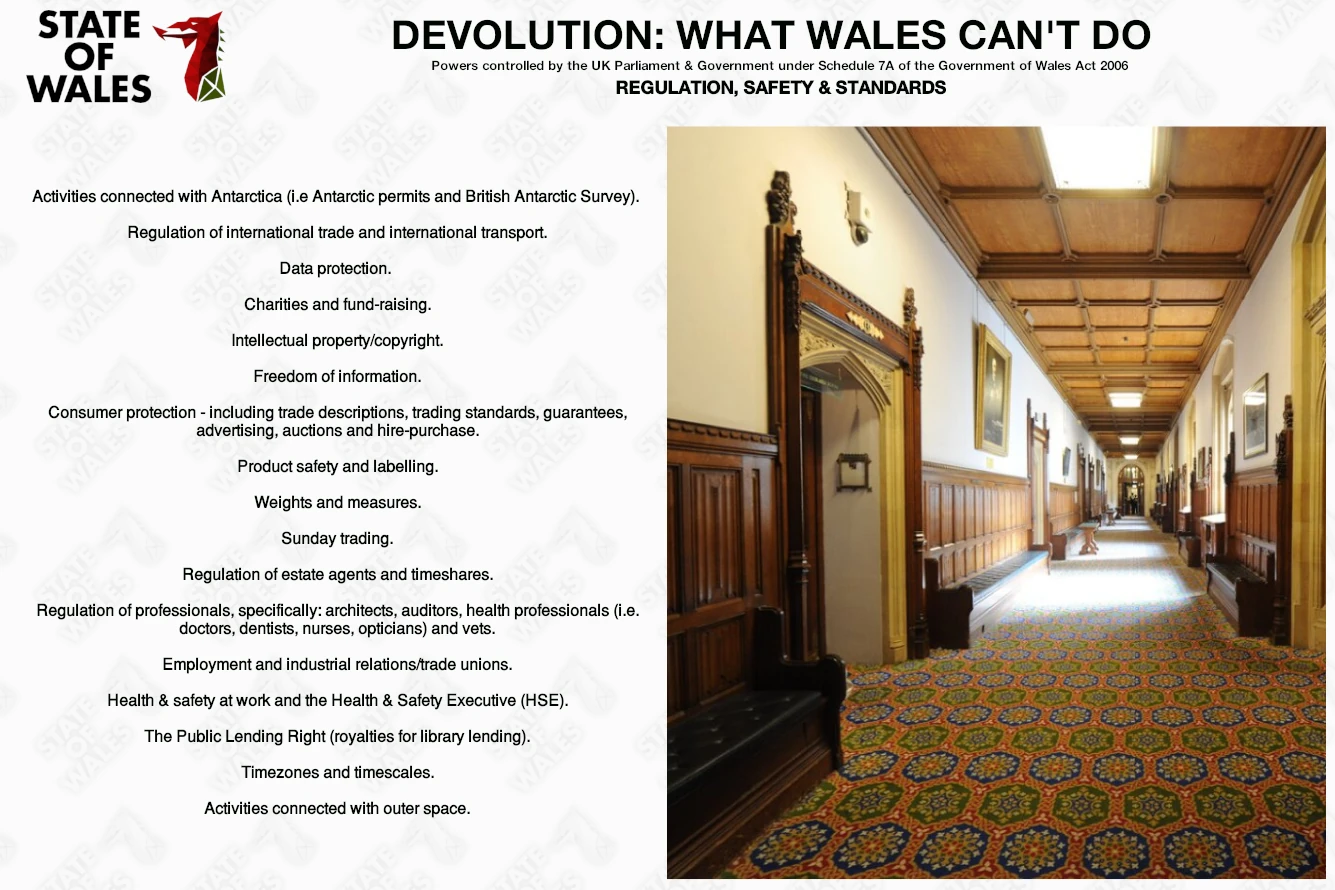
Product safety and standards are overseen by the Office of Product Safety and Standards, which is part of the UK Government’s Department for Business and Trade.

Their overall role is to ensure products and services sold in the UK are safe and match their description at the point of sale (such as the correct weight, size, etc).

British Standards Institute (BSI) is the internationally recognised national standards authority for the UK. They develop and maintain standards themselves, using input from businesses and industry.

Products which comply with national standards and product requirements have a conformity mark (aka “kite mark”). Since Brexit, this has been a UK Conformity Assessed (UKCA) mark (UKNI for Northern Ireland).

The European Union‘s Conformité Européenne (CE) mark, used in the European Economic Area/Single Market, is still recognised in the UK if the product complies with any EU rules retained in UK law.

Trading standards officers carry out enforcement. They are employed and managed by the 22 local authorities in Wales – either independently or jointly (such as Cardiff, Bridgend & Vale of Glamorgan’s Shared Regulatory Services). As of 2024-25, there were just under 300 trading standards officers in Wales1.

In March 2026, the UK Government announced that it wanted to review product regulations to “cut red tape” by up to 25% over the current parliamentary term2.

Does This Work for Wales?

For the most part, yes.

Changes to product regulations, and how they’re enforced, have been one of the biggest “red tape” headaches arising from Brexit. The situation would’ve been even worse had no deal been agreed between the UK and EU.

New complications have also arisen because of the unique position Northern Ireland finds itself in (which still has to apply EU rules in certain respects) – though that doesn’t directly impact Wales.

Enforcement is a bigger issue. According to Trading Standards Wales, the workforce has halved due to funding cuts, with skills gaps identified. They’ve called for an extra £15 million to be invested by 2031, claiming every £1 spent on trading standards prevents up to £12 being lost to consumers and businesses1.

What Would Be the Pros & Cons of Independence?

This is an administrative issue, so there are no “pros” or cons” as such.

The main thing to consider here is alignment to ensure trade is seamless. That could either be with England (or as part of a Great Britain free trade area), or with the EEA/European Single Market.

How trading standards are enforced is also worth considering. In particular, whether the current model (local authority managed services) is fit for purpose.

What Do Other Countries Do?

Ireland
Denmark
Finland
New Zealand
Ireland


NSAI is the national standards and certification authority. Their role is almost identical to that of the UK’s BSI. Irish companies are allowed to use UKCA marks for construction materials and medical equipment after being accredited by the UK.

NSAI has operating costs of €47.6 million (£41.2 million) in 2024 and employed 254 people3. As in the UK, trading standards enforcement is undertaken by local authorities.


Denmark

Danish Standards is the national standards and accreditation agency. Standards are drafted and set by sector-specific standardisation committees.

Trading standards and enforcement are the responsibility of multiple agencies, depending on the type of product or service. These include the Danish Business Authority, the Danish Competition & Consumer Authority and the Danish Consumer Ombudsman.

Finland

Finnish Standards (SFS) is the national standards and accreditation agency.

Enforcement of trading standards and complaints handling is undertaken by a mix of the Finnish Competition & Consumer Authority (KKV), which includes a Consumer Ombudsman, and local authorities.

New Zealand

Standards New Zealand acts as the national standards agency. Trading Standards New Zealand sets weights and measures and investigates the quality of fuel sold to the public.

In terms of product safety, this is handled by different government departments and agencies. These include Work Safe New Zealand (New Zealand’s equivalent of the Health & Safety Executive) and New Zealand’s Environmental Protection Authority (amongst others).
What Options Does Wales Have?

The non-negotiable matter is that Wales would need its own national standards and accreditation body: “Standards Cymru” for the sake of giving it a name. This body would be the Welsh representative on the International Organisation for Standardisation (ISO).

As for enforcement and monitoring:

Local authority-managed trading standards (with collaboration)
An all-Wales trading standards agency
A stand-alone Consumer Ombudsman
Local authority-managed trading standards (with collaboration)

This is what happens now. Council would employ trading standards officers to enforce rules, with them sharing services where possible or necessary. Trading standards could become a responsibility of a regional tier of local government in the future, with services run regionally (which might better pool resources).

An all-Wales trading standards agency

Trading standards would be run centrally by the Welsh Government on an all-Wales basis. This might lead to better use and targeting of resources, with officers sent where they are most needed at short notice. But it could also mean officers potentially losing the relationships they build up with local businesses and contacts.

A stand-alone Consumer Ombudsman

The office would act as a single point of contact to deal with consumer complaints, instead of going directly to trading standards or an industry body. We already have something similar in the UK in the form of the Financial Services Ombudsman, though having a Consumer Ombudsman seems to be common practice in the Nordic countries.

What's at Stake?

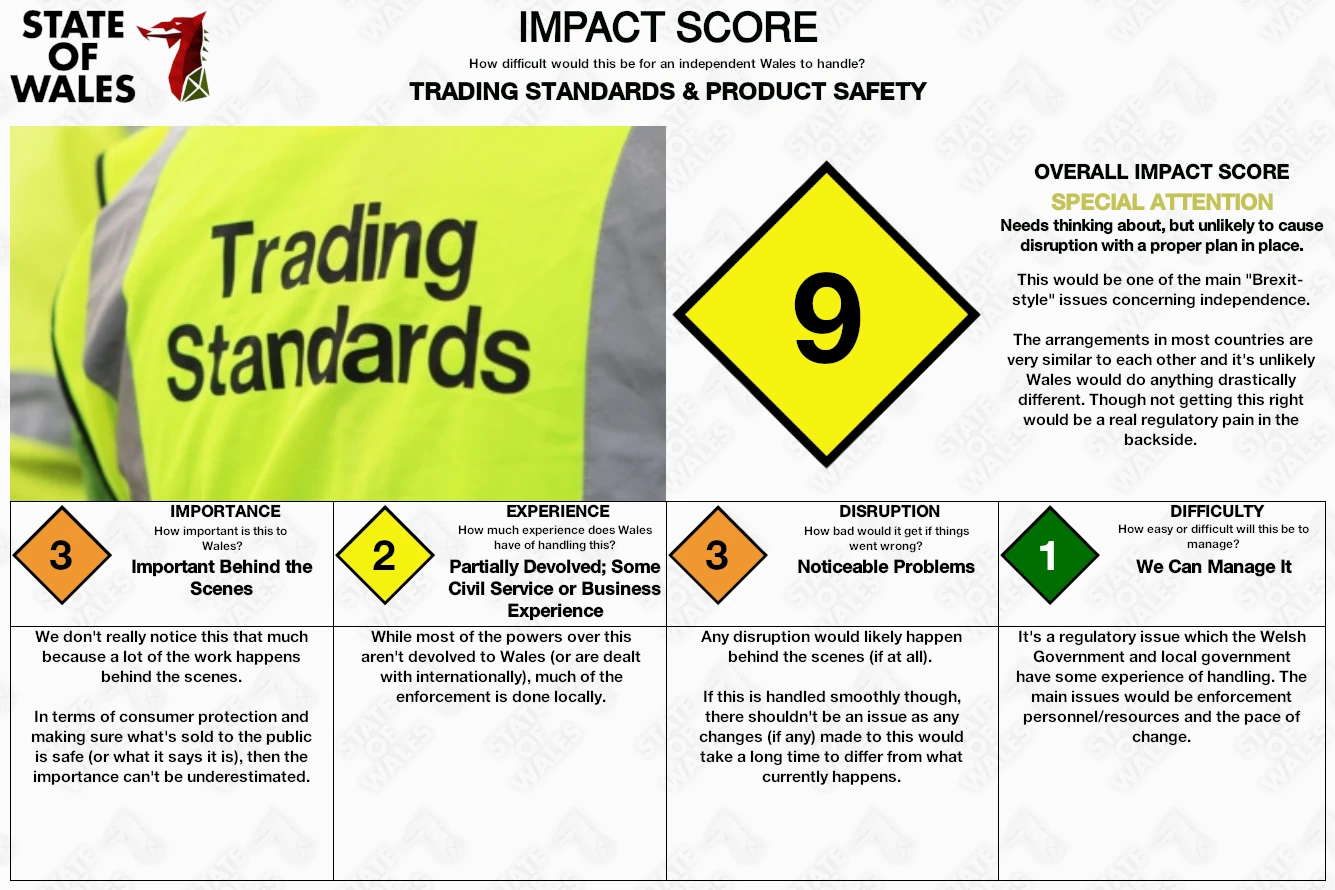
The overall score (out of 20) is the total of the scores for the four mini-categories (out of 5 each).

How Would This Be Run?

This was looked at under the options section. Politically, this is likely to fall under the remit of the Welsh Government minister/department responsible for business and the economy. 

How Much Will This Cost?

Headline: Likely to be cost-neutral overall.

Standards agencies are usually self-financing because they generate income from fees. Any shortfall in running costs could be covered by an annual Welsh Government grant.

There’s a fee for full membership of the ISO. It’s likely Wales would pay something similar to Ireland, but the exact figure is hard to estimate as these decisions are made in private.

In 2024-25, trading standards services in Wales cost £15.5 million a year to run, with a desire within the sector to increase funding closer to £30 million.

A Consumer Ombudsman, with similar staffing and budget requirements as the Public Services Ombudsman, would likely cost around £6.3 million to run each year4.

Would any new taxes need to be introduced?

No, though any fees and fines could be set by the responsible agency (or minister).

Who will pay for this?

Businesses seeking ISO accreditation. When it comes to trading standards, businesses found in breach would pay fines.

How Long Would This Take?

Setting up a national standards agency should be straightforward enough, though it may require regulations (or something similar) to be tabled at the Senedd. The issue will be finding enough people with the right skills to fill new roles.

The barebones/current trading standards system is already in place (because it’s run by local authorities). If we wanted to change this to another option, such as an all-Wales trading standards agency, then it would take time to set up – maybe up to a year.

Ideally, any new system would be in place during any independence transition period. 

People & Work

Who does this impact?

Any business selling or providing products or services which require standardisation. So it would be particularly keenly felt in manufacturing, R&D/product development, utilities, construction, training and personnel management.

Would any jobs be created or lost?

Based on Ireland’s example, a Welsh standards agency could employ up to 50 staff. The BSI currently doesn’t have any staff working in Wales as far as I can tell.

According to Trading Standards Wales, if we want to reach the same level of capacity as there was several years ago, then the number of trading standards officers would need to double, creating up to 300 extra jobs. This might need to happen regardless, but it would depend on funding.

If we decided to establish a Consumer Ombudsman, it could create up to 90 jobs if the office is similar in size to the Public Services Ombudsman4.

You Might Also Like....

How would an independent Wales regulate professionals like architects and auditors?
Featured

How would an independent Wales regulate professionals like architects and auditors?

by Owen Donovan
July 6, 2026
0

...

Read moreDetails
What time zone would an independent Wales have?

What time zone would an independent Wales have?

June 4, 2025
What weights and measures would an independent Wales use?

What weights and measures would an independent Wales use?

June 4, 2025
What would independence mean for health and safety?

What would independence mean for health and safety?

June 4, 2025
Who would be responsible for national statistics and the census after independence?

Who would be responsible for national statistics and the census after independence?

June 4, 2025
What would independence mean for freedom of information?

What would independence mean for freedom of information?

June 4, 2025
Will businesses have more rules to follow after independence?

Will businesses have more rules to follow after independence?

June 3, 2025
The Public Services Ombudsman

The Public Services Ombudsman

June 3, 2025
How would Wales join the EU as an independent country?

How would Wales join the EU as an independent country?

May 20, 2025
Could an independent Wales join the Single Market but stay outside of the EU?

Could an independent Wales join the Single Market but stay outside of the EU?

May 20, 2025
Could an independent Wales stay outside of the EU and Single Market?

Could an independent Wales stay outside of the EU and Single Market?

May 20, 2025
Brexit

Brexit

May 17, 2025
The European Union (EU)

The European Union (EU)

May 17, 2025
The European Free Trade Association (EFTA)

The European Free Trade Association (EFTA)

May 17, 2025
Load More
    1. Trading Standards Wales. “Trading Standards Wales Manifesto 2026”.

    2. UK Government, Department for Business & Trade (31st March 2026). “The UK’s new product safety framework”

    3. National Standards Authority Ireland. “Annual Report & Accounts 2024”.

    4. Public Services Ombudsman. “Annual Report & Accounts 2024”.

Use of AI

No AI tools were used to draft this post.

Donations Welcome
Tags: BrexitBusinessDenmarkEnvironmental HealthEuropean UnionFinlandHealth & SafetyIndustry & ManufacturingIrelandLocal GovernmentNew ZealandProduct Safety & StandardsREG 106
Previous Post

Senedd 2026 After Action Report: Greens, Lib Dems & Others

Next Post

How would an independent Wales regulate professionals like architects and auditors?

Owen Donovan

Owen Donovan

Archive

Categories

Copyright

Creative Commons Licence

State of Wales by Owen Donovan is licensed under a Creative Commons Attribution-NonCommercial-NoDerivatives 4.0 International License.

Subscribe by Email

Search

No Result
View All Result
No Result
View All Result
  • Go To Senedd Home
  • Go To Oggy Bloggy Ogwr
  • About & Contact
    • About State of Wales
    • Comments Policy
    • Complaints Policy
    • Contact & Subscribe by Email
    • Disclaimer
  • Features
    • After the UK
    • Chinny Reckon
    • Devil’s Advocate
    • How Wales Works
    • Road to Brexit
  • The Independence Index
    • The Independence Index (full)
    • Economics & Money
      • Business & Economy
      • Currency
      • Tax & Spending
      • Transport & Infrastructure
    • Society
      • Communities & Housing
      • Culture & Sport
      • Education
      • Health
      • Media & Communications
      • Science & Technology
    • The State
      • Environment & Natural Resources
      • Justice
      • Local Government
  • Elections Centre
  • Wales FAQ
    • How is Wales funded?
    • How are laws in Wales made?
  • Support & Donate