


The first half of this series focused on general transport issues – not only those that need to be addressed under devolution but are key to managing transport after independence too.
These final five parts are what you’ve been waiting for. It’s time for specifics, including a look at some of the transport policies available to us after independence.
The first stop on that journey is roads and active travel.

Firstly, the similarities.
Roads are generally managed the same way. The national government manages state/national roads (what we call trunk roads), while local roads and active travel routes are usually handled by local or regional governments.
Also, the number of registered vehicles is generally proportional to the population. No surprises there. It roughly averages out as 2 registered vehicles for every 3 people, though the number of vehicles is proportionally higher in Denmark, Switzerland and New Zealand.
Cycling rates are low across the board, except in Denmark and Switzerland; the Danish figures will be boosted by very high urban cycling rates. Walking rates are also similar, except in Switzerland (where walking and hiking are popular pastimes).
Of the six, New Zealand has the most proportionally dangerous roads in terms of the number of people killed or seriously injured per head (5.1-per-10,000). Wales (3.3-per-10,000) has the second-safest roads of the six, just behind Ireland (2.9-per-10,000).
Another key difference is road network density, with Wales, New Zealand and Scotland having low lengths of motorway/restricted roads compared to the other countries.
Part of this will be down to population density, though Ireland has invested heavily in its motorway network over the past 20 years despite often being as sparsely populated as Scotland and Wales (outside of the Dublin metropolitan area).
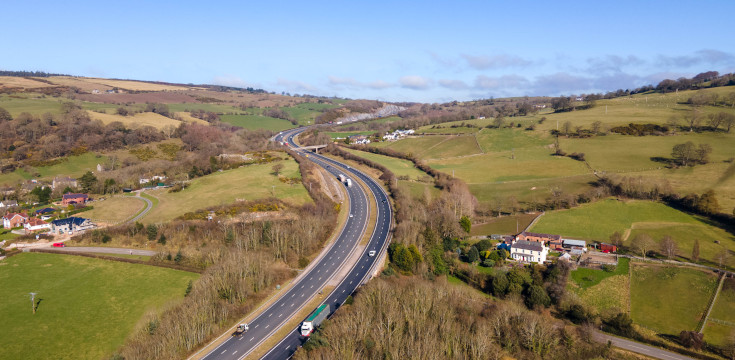
Wales also has stretches of trunk road that are motorway-standard/motorways in all but name (large sections of the A55, most of the A465 and the Coryton-Abercynon stretch of the A470).

