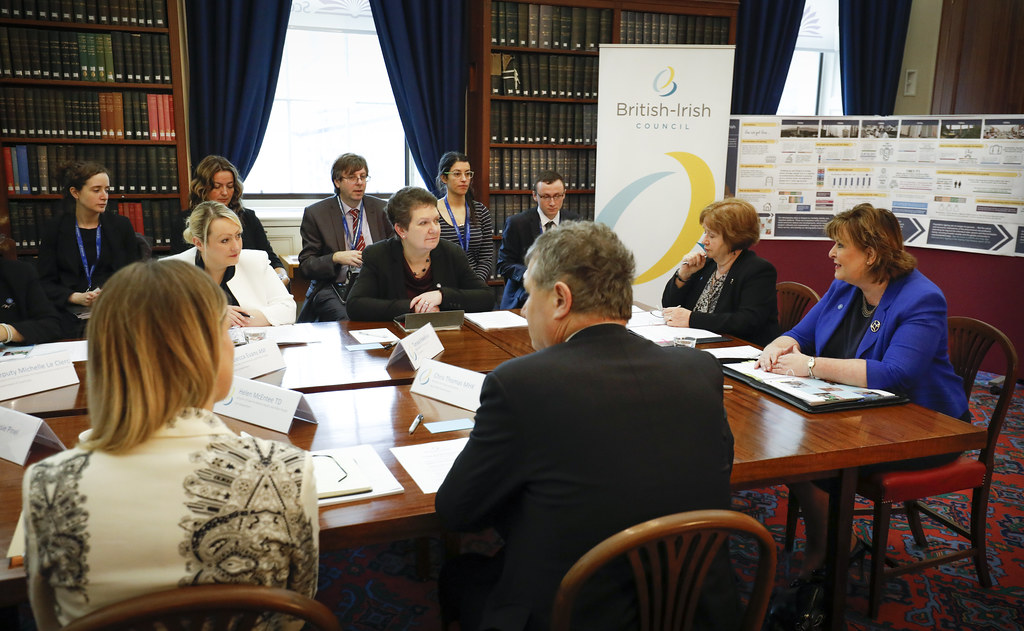
Image Source: Scottish Government under Creative Commons Licence BY-SA-2.0
Donations keep this site going. If you like what I’m doing here and think this work is important to the independence movement, consider a donation. One-off or monthly; as little or as much as you want. Click the links below, or full details are available here.
The British-Irish Council was formed as part of the Good Friday Agreement in April 19981, which secured a political settlement to end “The Troubles” in Northern Ireland.
The members of the British-Irish Council include:
- The two independent nation-states of Great Britain & Ireland (United Kingdom & Republic of Ireland).
- The devolved nations (Northern Ireland, Scotland and Wales).
- The three largest Crown Dependencies (Isle of Man, Jersey, Guernsey).
England is represented by the UK Government.
The British-Irish Council has no real political power and can’t make binding decisions. The main aim of the British-Irish Council is to allow the member governments to talk to each other and work together.
There are three main areas of focus (“pillars”2): climate & decarbonisation, culture & heritage (including the protection and promotion of minority languages) and economic & social inclusion.
The heads of government of each of the member countries and states meet twice a year, though government ministers working in specific areas may meet more often.
A permanent secretariat/headquarters was set up in Edinburgh in 2012.
The British-Irish Parliamentary Assembly
The British-Irish Parliamentary Assembly (BIPA) is separate from, but closely related to, the British Irish Council.
Unlike the British-Irish Council, the BIPA wasn’t founded as part of the Good Friday Agreement and dates back to 1990.
Similarly to how the British-Irish Council encourages government-to-government cooperation, the BIPA does the same thing for parliaments.
50 members (25 each) are selected from the UK Parliament and Irish Parliament. 5 representatives are chosen from the devolved parliaments (Northern Ireland Assembly, Scottish Parliament, Senedd Cymru) and one representative is chosen from each of the three parliaments of the Crown Dependencies.
The BIPA meets twice a year.
Similar International Organisations
![]()
Full Members: Belgium, Luxembourg, Netherlands.
Summary: Works as a political and economic union, even though all three member states are EU members as well.
Powers & Role: It can make legally binding decisions and has its own court. It runs a joint copyright/intellectual property office and guarantees citizens of the member states certain rights (for example, cross-border commuting).
![]()
Full Members: Denmark, Finland, Sweden, Norway, Iceland.
Associate Members: Greenland, Faroe Islands, Aland Islands.
Summary: A body of 87 members appointed by the parliaments of the member nations and autonomous territories. Meets once or twice a year. There’s a separate Council of Ministers for government representatives.
Powers & Role: No formal decision-making power, but it does run several cultural awards and also funds research and investment in certain areas (like energy and science).
![]()
Full Members: Estonia, Latvia, Lithuania.
Summary: A parliament comprising a total of 60 members, 20 of whom are appointed by each of the three national parliaments.
Powers & Role: The focus is on cross-border working and joint projects. They also award cultural prizes. There’s a separate Council of Ministers for government representatives.
You Might Also Like....
The Belfast Agreement: An Agreement Reached at the Multi-Party Talks on Northern Ireland (April 1998). “Strand Three: British-Irish Council”.
British-Irish Council, “Our Work“.
No AI tools were used to draft this post.