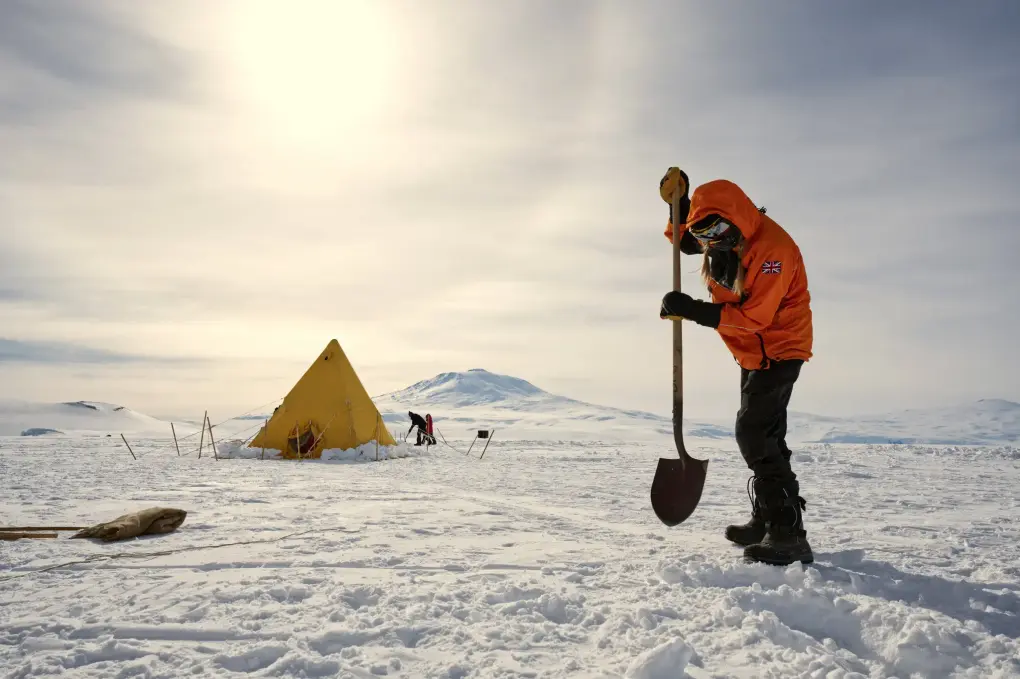
Image Source: Ole Zeising (distributed via imaggeo.egu.eu) under Creative Commons Licence BY-NC-ND 3.0
Donations keep this site going. If you like what I’m doing here and think this work is important to the independence movement, consider a donation. One-off or monthly; as little or as much as you want. Click the links below, or full details are available here.
What Happens Now?
Antarctica (or rather, a chunk of it) counts as one of the British Overseas Territories. Yes, really.
There are two things to consider when it comes to the UK’s Antarctic policy: the geopolitical element and the science element.
First, the geopolitics. The UK is a signatory to the Antarctic Treaty. The treaty banned military activity on the continent (except for peaceful means) and governs scientific research. It doesn’t formally recognise any territorial claims to the land and seas in and around Antarctica, but doesn’t dismiss any claims either. No new territorial claims can be made.
Countries that are full/original signatories to the Antarctic Treaty have a territorial claim (or want the right to make a claim) to part of Antarctica and were active on the continent around the time the treaty was signed.
Parties to the treaty can take part in meetings – some can even vote – and want to be involved in scientific research there.
As for the science bit, the UK’s scientific research body is the British Antarctic Survey (BAS), headquartered in Cambridge. It’s part of the UK’s Natural Environment Research Council (NERC).
Around 500 people are employed by BAS – not just scientists, but support workers. BAS also has its own polar research vessel, RRS Sir David Attenborough, as well as the research drone, Boaty McBoatface.
Does This Work for Wales?
If you’re an astronomer, earth scientist, climate scientist or marine biologist working at a Welsh university, it probably does.
Academics from Welsh universities have been involved in at least a half dozen or so Antarctic research projects. Welsh academics working elsewhere in the UK in the same fields will benefit too.
Spending by UK Research Councils in Wales has historically been low, said to be 2.6% of total UK spending in 2024 – around half what a population-based share would be1.
For everyone else, I doubt you’ve given it much thought unless you’ve watched The Thing too many times or are a massive fan of Pingu.
IndyWales & Antarctica: Pros & Cons
This probably isn’t a case of pros and cons, as such. We either have access to the Antarctic in our own right or we make some other kind of arrangement (if need be).
What Do Other Countries Do?
The signatories to the Antarctic Treaty can be divided into a few broad categories.
2 countries have either a claim or a right to make a claim to land in Antarctica (includes the UK).
An additional 17 countries have what’s called “consultative status”. This means they can take part in meetings and vote on decisions because they have research interests in Antarctica (such as a research station).
A further 29 countries have signed the treaty and can attend meetings, but can’t take part in decisions.
The remaining countries that haven’t signed the Antarctic Treaty.
What Options Does Wales Have?
Under the terms of the Antarctic Treaty2, an independent Wales wouldn’t be able to make a territorial claim to the Antarctic. I’m sure you’re all disappointed.
Given the research projects undertaken by Wales-based academics, we’ve probably done enough to justify “consultative status” if Wales signed the Treaty. That’s because we’ve shown a genuine scientific/research interest. That would mean Wales can attend meetings and vote on decisions.
Wales would contribute a proportional amount to the budget and operations of BAS in exchange for full participation on the same terms as we have now.
Universities and the Welsh Government would partner with national research organisations working on the continent when they feel the need to. This would give more freedom to universities to decide what projects they want to contribute to.
This could mean that researchers from or in Wales could work with any nation’s research projects on the continent, not just BAS.
This would mean setting up a base, a supply route and the academic/research teams and governance needed to staff a service. Of all of the options, this is probably more of a “nice to have”.
Some smaller countries do have research stations or posts in the Antarctic – notably Czechia, New Zealand and Norway. Norway and New Zealand also have territorial claims.
The “do minimum” would be a desk-based research service that works with other national research organisations (on a project-by-project basis, mentioned earlier).
What's at Stake?
The overall score (out of 20) is the total of the scores for the four mini-categories (out of 5 each).
How Would This Be Run?
The Antarctic Treaty is overseen by the Antarctic Treaty Secretariat, headquartered in Buenos Aires, Argentina.
The signatories of the Antarctic Treaty usually meet annually.
The British Antarctic Survey is run by an executive team and specialist science management teams. If an independent Wales were directly involved, you would expect Welsh representation on leadership teams and committees.
How Much Will This Cost?
Headline: Zero if we don’t sign the Antarctic Treaty; around £6 million a year if we want at least a partnership with BAS.
The BAS’s annual budget as of 2024-25 is £116 million3. You would expect a proportional Welsh share (around 5%) to be somewhere in the region of £5.8 million.
This cost would be a result of becoming a party to the Antarctic Treaty. The maximum amount payable by any party in 2025-264 is a little over $60,000 (£45,000).
A desk-based service without an independent research station would be a more practical option and would probably cost something similar (or less) than what we would pay to be a partner in the British Antarctic Survey.
A full research service would cost significantly more. A basic research station accommodating up to 20-30 people at a time, similar to the Czech Eco-Nelson station, may cost a few million pounds to build and there would also be a cost to keeping it supplied.
Something more advanced and capable of year-round living – like the British Antarctic Survey’s Halley IV station – would cost anything between £30-40 million (at current prices).
Any permanent base would likely have to be built in Wales and then transported to the site. We would probably need access to specialist research ships too.
Would any new taxes need to be introduced?
No.
Who will pay for this?
A mix of general taxation (all taxpayers) – which would likely come out of a Welsh equivalent of a research council or science fund. There’s also the option of research grant funding (some of which may come from private companies or international funds), university funding and private or charitable donations.
How Long Would This Take?
If we decide to abandon research in the Antarctic or not become a party to the Antarctic Treaty then it doesn’t matter.
If Wales does want to become a party to the Antarctic Treaty, then we would need to firstly be a member of the United Nations and then ratify the treaty5. The timing/timetable of that would likely be left to the Welsh Government and Senedd.
People & Work
The scientific community in Wales and any Welsh people working for the British Antarctic Survey at the time of independence.
There shouldn’t be any issue with Welsh citizens being able to work for the British Antarctic Survey if we had a full partnership. The BAS also works with foreign universities and governments6.
A separate Welsh Antarctic research body would create the full range of research and support jobs – possibly anything between 50-100 – but it would cost more to set up and run.
You Might Also Like....
Prof. DJ Evans, Business Live (13th September 2024). “Research council funding needs to be devolved to boost Welsh economy”.
Antarctic Treaty (1959), Article IV.
UK Parliament, House of Commons, Written Questions (25th February 2025). “British Antarctic Survey: Finance”.
Antarctic Treaty Secretariat (2024). “Secretariat Programme 2025-26” (p8).
Antarctic Treaty (1959), Article XIII.
British Antarctic Survey. “Applying BAS sciences to global challenges”.
No AI tools were used to draft this post.