


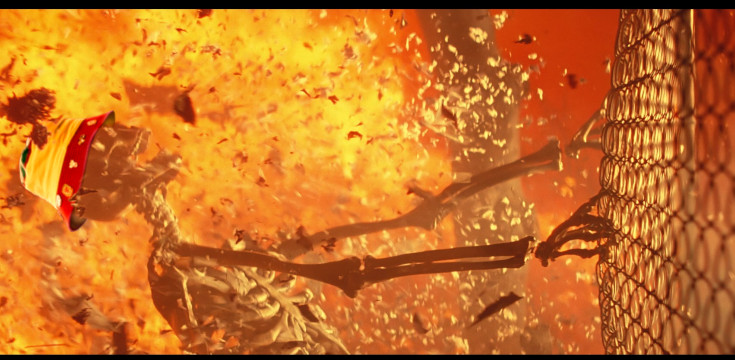
In the last couple of days, the five permanent members of the UN Security Council agreed to a joint statement (pdf) – the first of its kind, apparently – agreeing that nuclear war is unwinnable and should never be fought, as well as renewing commitments to limit the spread of nuclear weapons.
The statement is unlikely to do much to dampen tensions between NATO and Russia over Ukraine (and what Russia considers to be interference by the western powers in its “sphere of influence”) and the emerging threat of hypersonic missiles. It does, however, suggest that we’re not quite back to where we were during the peak of the Cold War.
Within living memory, the threat of a nuclear war sparked by tensions in central and eastern Europe was a very real possibility. It’s something governments actively prepared for – some more thoroughly than others. What follows is an idea of what would’ve happened in the UK and (by extension) Wales.

Once “Transition to War” arrangements were underway, the next step would be to tell Mr and Mrs Bloggs how they can protect themselves from the Soviet Union’s nuclear arsenal like true Brits.
By the mid-1970s, this advice would come in the form of the (now infamous) Protect & Survive campaign – a series of booklets, public information films and radio advertisements. The booklet would’ve been distributed to all households when it was deemed necessary to do so and it was expected to have been printed in newspapers too.
While the more famous Protect & Survive booklet is the one on how to deal with a nuclear attack and the living conditions afterwards, there were less well-known booklets on how to construct garden nuclear shelters and the general principles behind civil defence.
The Swiss (and other nations) have mandated nuclear shelters in every home or organised public shelter and evacuation programmes. In the UK and Wales, unless you were pre-selected for a government bunker you would be left to sort it out yourself.
If you couldn’t build a suitable outdoor shelter (because you don’t have a garden or don’t have the necessary materials), then the advice was to create a makeshift “inner refuge” out of doors leaned against the innermost wall and covered in heavy objects.
If you were far enough away from a target it might provide a minimum level of protection, but the truth is that all the stuff you would be piling on top of yourselves was more likely to act as kindling to cremate you (if it all collapsed) and prevent the spread of disease after an attack.
Amidst inevitable price gouging and runs on supermarkets, people would be expected to obtain and store enough water and food (ideally tinned and able to be eaten cold) to last for two weeks. For an average family of four, that’s a lot of baked beans, spam and rice pudding which would somehow have to be stored in such a way as to protect it from contamination.
Under the Broadcasting Act 1980, the UK Government retains the right to take control of all radio and television stations during a national emergency. This would probably be put off until the last minute to keep morale up, but by this point most programmes would have been suspended anyway, replaced with rolling news and Protect & Survive films.
Once the situation has deteriorated to such an extent that an attack was deemed likely within 48 hours, all television stations would close down and be replaced with a single BBC national radio service – the Wartime Broadcasting Service (WBS). In Wales, it would’ve been broadcast on the same wavelengths as Radio 3 and Radio 4.
Naturally, it’s assumed this would all be in English. There was never a Welsh language version of Protect & Survive produced as far as I can tell and S4C would’ve closed down with the other TV stations. Welsh language opt-outs could’ve been provided on the WBS on a regional basis, but it’s unlikely.

During the Second World War, the policy was to evacuate major population centres – particularly children. However, during a nuclear war, it would be the opposite. The official advice from the government would be to stay where you are. If you did move, authorities in that area you’re travelling to would be under no obligation to help.
Despite that, given that Wales (and places like Cornwall, Cumbria and northwest Scotland) would be seen as a low priority for nuclear attack, it’s probable that people from the major cities would have attempted to travel north or west if an attack seemed just days away.
Whether they would be able to get to where they were going was another matter. Most plans included the commandeering of motorways by the military, government and police as “essential service routes” (though the idea was dropped by the 1980s). It’s a certainty that rail services would’ve long stopped by this point too.
It’s probable that refugees would either be forcibly turned back, waved through due to the sheer weight of numbers (causing a humanitarian crisis) or would face the prospect of dying in traffic jams.

