


In the last couple of days, the five permanent members of the UN Security Council agreed to a joint statement (pdf) – the first of its kind, apparently – agreeing that nuclear war is unwinnable and should never be fought, as well as renewing commitments to limit the spread of nuclear weapons.
The statement is unlikely to do much to dampen tensions between NATO and Russia over Ukraine (and what Russia considers to be interference by the western powers in its “sphere of influence”) and the emerging threat of hypersonic missiles. It does, however, suggest that we’re not quite back to where we were during the peak of the Cold War.
Within living memory, the threat of a nuclear war sparked by tensions in central and eastern Europe was a very real possibility. It’s something governments actively prepared for – some more thoroughly than others. What follows is an idea of what would’ve happened in the UK and (by extension) Wales.

The first line of civil defence immediately before and after an attack would be the Royal Observer Corps (ROC) – a voluntary organisation established in the 1920s to originally monitor conventional air raids but by the 1950s switching to monitoring a nuclear attack.
In addition to the major regional ROC bases, most work would be carried out by three or four-person crews assigned to smaller underground monitoring posts (some of which are still around today). By my count using the available information, there were at least 36 ROC posts located across Wales, largely in open countryside or rural areas that weren’t expected to be the target of a direct attack.
These crews would be responsible for monitoring the yield, altitude and direction of a blast and also monitoring fallout after an attack.
Aside from those fortunate to have been wiped out instantly or buried under their own houses and/or makeshift door shelter, the biggest problem would be fallout.
Fallout is debris that’s been irradiated as a result of a nuclear explosion and it contaminates anything it touches. If the explosion occurs close to or on the ground, then more fallout will be created with higher levels of radiation compared to explosions that occur higher up in the atmosphere.
The prevailing winds come from the south or southwest and aside from southern targets in Wales itself, it’s unlikely that large amounts of fallout would be generated from that direction. Problems would arise when the wind blows from a different direction – easterly winds, for example, might blow fallout from parts of England or mainland Europe over Wales and towards Ireland.
The following is based on the strength of an average Russian missile – 800 kilotons – exploding over Cardiff at about 4,000 metres.

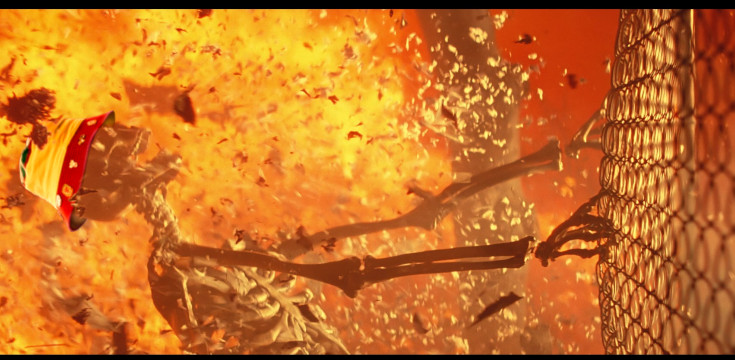
Everything in the innermost circle would be vaporised, with almost total destruction in the second circle. In the outer two circles, people would suffer third-degree burns at the very least and even as far away as Pontypridd or Cowbridge people could be blinded by the explosion and homes would be moderately damaged or even catch fire.
It would probably kill up to 170,000 people and injure up to 230,000. An explosion at ground level would produce a more intense fireball and generate more fallout but it would kill slightly fewer people outright.
That’s just one explosion of moderate strength. It’s quite likely that some areas would’ve been targeted by several weapons. Additionally, some weapons would overshoot, be intercepted beforehand or not go off at all.
Square Leg projected that more than half of the UK’s population at the time (around 30million people) would die instantly and the eventual number of short-term survivors would be around 20million. Given England’s population density, these numbers are perhaps optimistic.
If you were unfortunate enough to survive two weeks having resisted the temptation to go and have a look outside and not died of radiation sickness, you would be able to leave your inner refuge and designated shelter room. You would likely be seriously malnourished, probably dehydrated, wanting to kill everyone you’ve spent time in there with and stinking of piss and farts – a bit like the Principality Stadium on a match day.
If something isn’t burning it would be broken. The instinct would be to try and find other people, water and food. Aside from anything you can salvage from the ruins, any supplies not destroyed by the attack would almost certainly be under the control of the government and military.

