


In the last couple of days, the five permanent members of the UN Security Council agreed to a joint statement (pdf) – the first of its kind, apparently – agreeing that nuclear war is unwinnable and should never be fought, as well as renewing commitments to limit the spread of nuclear weapons.
The statement is unlikely to do much to dampen tensions between NATO and Russia over Ukraine (and what Russia considers to be interference by the western powers in its “sphere of influence”) and the emerging threat of hypersonic missiles. It does, however, suggest that we’re not quite back to where we were during the peak of the Cold War.
Within living memory, the threat of a nuclear war sparked by tensions in central and eastern Europe was a very real possibility. It’s something governments actively prepared for – some more thoroughly than others. What follows is an idea of what would’ve happened in the UK and (by extension) Wales.

While there would still be a central government – assuming they hadn’t been wiped out or specifically targeted – most responsibilities would be delegated to regional centres of government, with Wales being Home Defence Region 8.
Wales would be further split into subregions: 8.1 covering the former counties of Gwynedd and Clwyd and 8.2 covering the rest of the country. A third subdivision covering the former county of Dyfed was ruled out.
The regional seat of government for Wales was intended to be based in Brecon Barracks, with at least two sub-regional centres (Regional Government Headquarters/RGHQs) at Borras, Wrexham (8.1) and Brackla, Bridgend (8.2) – though seemingly Brackla would have ended up being the sole HQ for all of Wales. When the conversion of the former Brackla munitions store to a RGHQ took place in 1982, it attracted a sizable protest from the Campaign for Nuclear Disarmament (CND) and other peace campaigners.
The regional governments would largely be made up of local government officers and senior civil servants (as well as some BBC staff), managed by a Regional Commissioner who would be given absolute power. Individual officers would be assigned to run local equivalents of government ministries. It’s quite likely that many of them wouldn’t have received any training beforehand.
Below the regional control centres, county councils – many of whom maintain their own bunkers and emergency control rooms – would be responsible for gathering information on the state of their local area and trying to assist on the ground. Their main responsibilities would include dealing with the homeless and overseeing reconstruction. The Chief Executive of the local authority would act as District/County Controller and would be answerable to their respective Regional Commissioner.
All of this would be backed up by what remained of the police and the military, with the Wartime Broadcasting Service acting as the sole means of public communication. So it’s somewhat ironic that in the ultimate defence of free democracies, the UK would be reduced to a loose alliance of dictatorships.

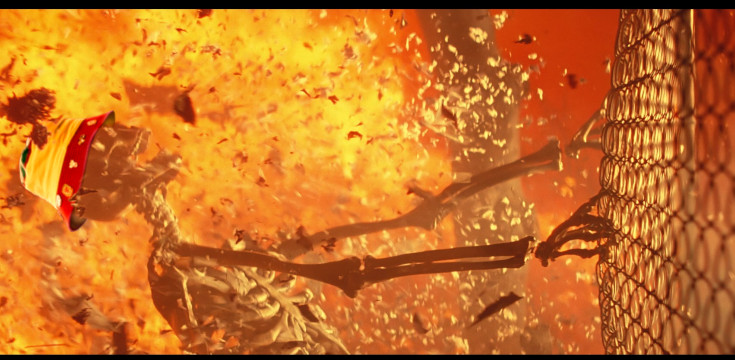
It’s quite possible that nobody would want the role. There would be millions of unburied bodies to deal with and the public health issues that come with that. Most of the country will be on fire for days. There would be daily incidents of survivors trying to break their way into supply stores because they’re not given enough to live on.
There’s a debate to be had over how long a hypothesised nuclear winter would last or whether it would even happen at all. Crop growing could become difficult and agriculture – perhaps even the entire economy – would increasingly revolve around animals and animal products, mushrooms and certain hardier crops like seaweed and potatoes.
If contact is made with other nations then you might see limited international trade restart; though the military, police and regional governorships would be sure to take their cut.
Once the situation stabilises you might see a return of limited education (perhaps only to a rudimentary level, with the children of elites educated to take over the running of what’s left of the government) and minimal utilities running on dwindling supplies of fossil fuels. Brawn would beat brains.
There would be no significant healthcare of any kind. Within a few weeks of an attack, medicine would reduce to making people as comfortable as possible with no real ability to treat anything more serious than minor burns and wounds. The population would gradually decline to the point where the only people left are able-bodied people aged from the late teens to early 50s. The only currencies with any value would be food, water and labour and the very idea of a welfare state would be long gone.
Radio would still be there and perhaps a rudimentary postal and telephone service but you wouldn’t have any other source of information other than word-of-mouth and whatever the government tells you on the WBS. It’s not that criticism and scrutiny of the government would be a high priority given it’s where your only source of food and water would be coming from.
There would be no transport other than your feet, bicycles or any surviving horses. Military and police vehicles would be seen for the first few years until they become impractical due to dwindling petrol supplies.
Most crimes would likely be punishable by death with judgements made on the spot – but there would at least be some semblance of order. You wake up, work, get your rations at a designated feeding centre, then sleep. No complaints. No comments to the manager.
Even if Wales ought to be well placed compared to the rest of the UK because of simple geography, there would be the ongoing long-term problem of food and water contamination and radiation-induced birth defects.

