


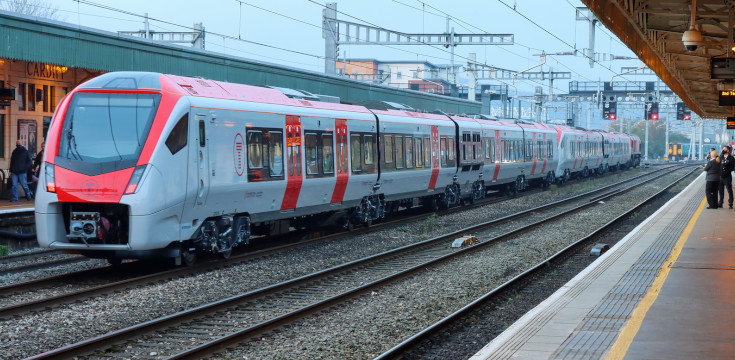
Now, onto what I’m expecting to be the most popular post in this series: the rail network.
This was a nightmare to write to the point that I considered packing it in halfway through. Constructive criticism is welcome but keep that in mind.

While there’s a lot that can stay the same, but a lot that can change too.
(Re)Nationalisation?
This is one thing most of the people reading this will want, but the railways in Wales (aside from freight, London and CrossCountry services) are nationalised; Network Rail is a publicly-owned company as is Transport for Wales.
Those on the right might argue that the Wales & Borders franchise should be awarded to a private operator again, much as there are calls for Cardiff Airport to be sold.
Considering TFW Rail was nationalised by the Welsh Government in an emergency move in 2020 – not the first or last such example in the UK – the direction of travel is towards undoing privatisation.
Similarly, few people argue that Network Rail should be re-privatised. Its immediate post-privatisation predecessor, Railtrack, was a private monopoly created by the UK Government. Its own cost and corner-cutting led to several serious fatal accidents in the late 1990s/early 2000s before it was renationalised.
Uniting track and train
Rail services and rail infrastructure are run separately from each other as things stand. You will have gotten an impression of how complicated that arrangement is in the previous section’s graphic.
Despite this, there’s a lot of coordination between Network Rail, TOCs and FOCs of course – particularly on timetabling.
“Uniting track and train” is used as a substitute phrase for renationalisation for those too scared to say it. The main benefit would be train operators and infrastructure agencies (Network Rail in our case) working on the same page and not prioritising their own needs in isolation. That could lead to better project management and more joined-up thinking on the timing of engineering works, for example.
There would be disadvantages too, such as confusion over responsibilities and maintaining control over spending (largely the ORR’s job).
Infrastructure and services have been reunited within the South Wales Metro area. Transport for Wales (and contractors) is responsible for delivering upgrades, managing the track infrastructure and running services on it.
The question is whether that should happen across the whole rail network. The options include:
- Maintain a separate rail infrastructure agency – This is similar to what we have now and is also used in the Netherlands and France. Whether it’s as a continuation under “Network Rail Cymru” or a completely new publicly-owned agency is a matter for debate. Infrastructure would remain in public ownership while train operators concentrate on running services.
- Full integration between tracks and trains – Rail infrastructure and rail services would be managed by the same agency or company. Infrastructure would be the role of an internal department rather than a separate agency. This would be the maximum level of integration and is similar to Iarnród Éireann and Germany’s Deutsche Bahn.
- Joint working – This is used in Italy and Switzerland. Network Rail (or a successor agency) would continue to exist as a separate entity but would run infrastructure as part of a joint group with train operators.
Fare reform
I’m not going to suggest free rail travel because railways are a money pit as it is. If you want to look at the pros and cons – Radical Wales: Free Public Transport.
There’s room for reform, though.
- Demand-based pricing (aka. “surge pricing”) – Instead of the traditional peak and off-peak times, prices would rise and fall depending on demand at any particular time of day and capacity on trains running at that time. LNER have trialled this. It could make travelling by rail in rural areas, for example, more affordable. The big downside is you won’t know precisely how much you will be paying until the day of travel.
- Distance-based pricing – Passengers pay a set price per route km. The further you travel, the more you pay but it also means short to medium-length journeys by rail might become cheaper.
- Single-leg pricing – Abolition of return ticket prices with passengers charged one fare for one leg. It’s an option being considered by the Rail Delivery Group.
- Zonal fares – Passengers would be charged a set price for each zone they travel within/through. This is similar to the pricing system in Greater London, the Merseyrail network and the Tyne Wear Metro, while it was also used by the former Valley Lines franchise.
- A maximum fare cap – This is best aimed at long-distance travel. For argument’s sake, nobody can be charged more than £30-40 for a single journey anywhere on the Wales & Borders network.
- Cross-subsidy and levies – Using charges and levies from car parks, top-ups to council tax and business rates and congestion/emissions-based charging to further subsidise public transport fares. A similar system is used in Paris called Versement Transport.
Improving the passenger experience

Transport for Wales is already experimenting with features such as live tracking of trains, mobile ticketing and carnet/multiple flexible tickets. Also, the delay repayment system for claiming compensation has been simplified (other train operators also use it).
Other than improving service levels, frequency, reliability and comfort, what other areas could benefit from improvement?
Minimum train capacity – All trains running on the Wales and Borders network could/should, for argument’s sake, have a minimum of three carriages. Though there’s a risk this would set a ceiling for train capacity, not a higher floor. “Increasing capacity” isn’t just about the number of passengers you can fit on a train, but the frequency of the services too.
A rating/accreditation system for stations – All stations would be given a star rating or colour (i.e. platinum, gold, silver, bronze, green [minimum acceptable standard], red [unacceptable]) based on disabled accessibility, available facilities (i.e. toilets, vending machines, ticket machines vs ticket office), crime and ASB levels, staffing levels and ease of transfer to other forms of public transport.
This would give the public (and tourists) a better idea of which stations to use and which stations to avoid. Targets could be set for stations to achieve a minimum rating.
Review of station staffing – The future of ticket offices has been discussed recently, though Transport for Wales has ruled out closures in Wales. Only around 12% of tickets are bought from ticket offices8 and most stations now have ticket machines.
It’s not about tickets though. It’s a wider issue of assisting people with extra needs, providing additional security, preventing crime (CCTV only goes so far) and ensuring passenger safety. The RMT union says only 10% of railway stations are fully staffed. For argument’s sake, there should be gatelines and one member of staff per 100,000-200,000 annual passengers for every station with a minimum half-hourly service.
Better coordination of cancellations and long delays – Some things can happen unexpectedly that cause trains to be cancelled, like a mechanical fault or fatality. What isn’t unavoidable is train operators knowing beforehand about the risk of cancellations or long delays and not communicating that quickly enough to passengers.
While bus operators are sometimes asked to accept rail tickets if there’s a sudden cancellation, in Wales that only ever seems to happen in and around Cardiff. It ought to be standard practice.
A review of underused (or poorly located) stations
This won’t be popular, but there’s a logic to it. At the moment, it’s very difficult to close a station or line. There’s a formal process and extensive consultation and study required.
In 2021-22, 47 stations in Wales were used by fewer than 5,000 passengers and a further 30 were used by fewer than 15,0009.
A lot of these stations are request stops along lines that see infrequent services anyway (Heart of Wales, Conwy Valley, Pwllheli branch – Part V).
There ought to be a presumption against closing stations, with the process being difficult anyway. This leads to things like “parliamentary trains” where a station might only be served once or twice a week (we don’t have any parliamentary trains in Wales at the moment).
Each stop might add anything between 30 seconds to 2 minutes to a journey and request stops often require a train to slow to a crawl to stop in time.
There may be some stations that:
- Are poorly located and could benefit from being moved somewhere better along the same line (i.e. TfW’s plan to move Treforest Estate station closer to Nantgarw).
- Have a good argument in favour of closure because there are better alternative stations nearby (i.e. Gilfach Fargoed).
- Would be better off replaced at a merged location (i.e. a merged “Heath” station replacing the separate Heath High and Low Levels; rationalisation of stations along the Coryton branch in Cardiff).
In these circumstances, the process ought to be quicker and easier if it can be proven to improve services. Though this requires full power over rail infrastructure.
Rail policing & security

I went over this in the above, but in short:
- Retain the “British” Transport Police (BTP) as a specialist/separate national unit (Status Quo): Their remit could be extended to include ports, harbours and airports, effectively becoming national transit police. Assuming it would continue to be paid for by the rail/transport industry then there would be no impact on policing budgets (in principle).
- Each territorial police force has its own specialist rail/transport unit: This is what happens in most Australian states. You would assume the respective police force would take over funding and training for dedicated rail units, but they would be part of the regular police force and would be able to respond to incidents outside their jurisdiction like a normal police officer.
- Municipal transit police: Each manned transport hub (including major bus stations) in Wales with passenger use above a certain number would have a small unit of transit police paid for by airlines, bus, train and ferry operators, but operationally part of local government.
8. Hansard, UK House of Lords (12th July 2023). “Rail Ticket Offices”. Transcript available at: https://hansard.parliament.uk/lords/2023-07-12/debates/660D5F08-A969-488B-B05E-1E6C0F3E362D/RailTicketOffices
9. Stats Wales. “Number of rail station entries and exits in Wales by station and year”. Available at: https://statswales.gov.wales/Catalogue/Transport/rail/Rail-Station-Usage/numberofrailstationentriesandexitsinwales-by-station-year

