Senedd Home
Oggy Bloggy Ogwr
State of Wales
Monday, August 17, 2026
  • About & Contact
    • About State of Wales
    • Comments Policy
    • Complaints Policy
    • Contact
    • Disclaimer
  • Elections Centre
  • The Independence Index
    • The Independence Index (Full)
    • Foreign Policy
      • Relations with the former UK & Ireland
      • Relations with Europe
      • Foreign Policy (General)
      • International Organisations & Law
      • Overseas Aid
    • Defence
      • Defence Policy
      • NATO
      • Armed Forces
      • National Security
      • Civil Defence
    • Rules & Regulations
      • Safety & Standards
      • Intellectual Property
    • Economics & Money
      • Business & Economy
      • Currency
      • Tax & Spending
      • Transport & Infrastructure
    • Society
      • Communities & Housing
      • Culture & Sport
      • Education
      • Health
      • Media & Communications
      • Science & Technology
    • The State
      • Environment & Natural Resources
      • Justice
      • Local Government
  • Support & Donate
No Result
View All Result
  • About & Contact
    • About State of Wales
    • Comments Policy
    • Complaints Policy
    • Contact
    • Disclaimer
  • Elections Centre
  • The Independence Index
    • The Independence Index (Full)
    • Foreign Policy
      • Relations with the former UK & Ireland
      • Relations with Europe
      • Foreign Policy (General)
      • International Organisations & Law
      • Overseas Aid
    • Defence
      • Defence Policy
      • NATO
      • Armed Forces
      • National Security
      • Civil Defence
    • Rules & Regulations
      • Safety & Standards
      • Intellectual Property
    • Economics & Money
      • Business & Economy
      • Currency
      • Tax & Spending
      • Transport & Infrastructure
    • Society
      • Communities & Housing
      • Culture & Sport
      • Education
      • Health
      • Media & Communications
      • Science & Technology
    • The State
      • Environment & Natural Resources
      • Justice
      • Local Government
  • Support & Donate
No Result
View All Result
State of Wales
No Result
View All Result
Home Independence: Transport & Infrastructure

Wales on the Move VIII: Wales on the Rails

Rail is the focus for a lot of current transport investment in Wales, but is it always the answer?

Owen Donovan by Owen Donovan
September 4, 2023
in Independence: Transport & Infrastructure, Transport & Infrastructure
Wales on the Move VIII: Wales on the Rails

Jeremy Segrott under Creative Commons Licence BY-SA-2.0

Share on FacebookShare on TwitterShare on RedditShare on BlueskyShare by email

Now, onto what I’m expecting to be the most popular post in this series: the rail network.

This was a nightmare to write to the point that I considered packing it in halfway through. Constructive criticism is welcome but keep that in mind.

8. Rail & Decarbonisation

  • 1. What are the main issues?
  • 2. How are railways run in other countries?
  • 3. Rail, Devolution & Independence: What could stay the same?
  • 4. Rail, Devolution & Independence: Policy Changes
  • 5. Rail, Devolution & Independence: Enhancing the existing rail network
  • 6. Rail, Devolution & Independence: New railway lines
  • 7. Light Rail: Is it worth it?
  • 8. Rail & Decarbonisation
Previous
Next
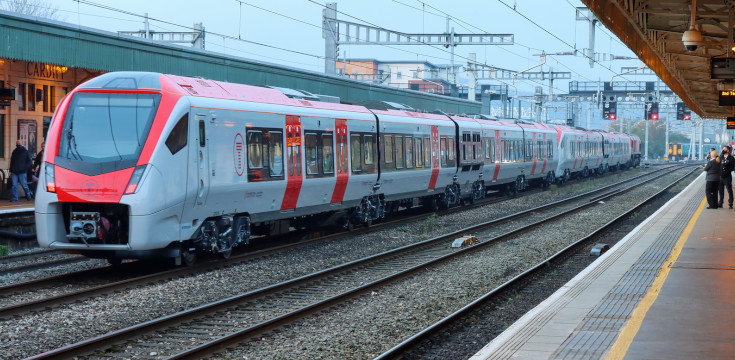
Is rail electrification the best us of resources when road and air transport are a bigger problem when it comes to emissions? (Pic: Transport for Wales via railadvent.co.uk)


Here’s a controversial comment for you: we don’t need to worry too much about decarbonising the railways. The focus has to be on road and air transport because that’s where most of the problems and emissions are coming from.

Total emissions from rail transport are comparatively small – no more than 1% of all transport-related emissions in 2016 according to the Welsh Government12. Also, duel fuel (or even tri-fuel), trains have proven to be cost-effective and flexible (reliability seems to depend on the model). A mix of diesel and battery power might be the way forward for the medium to long term. If that’s the case, the argument for installing direct/overhead electrification everywhere becomes weaker.

Electrification is good not necessarily because it reduces emissions but because it lowers the railway’s running costs. Electric trains and trams accelerate faster, are quieter, cause less wear and tear on the track and have fewer moving parts so are easier to maintain.

If we’re going to spend capital funding on the railways, I’d prefer it to go towards new stations, improving station facilities, increasing track capacity, replacing old trains and increasing service frequencies.

How can Wales move more freight to rail?

© Copyright Gareth James and licensed for reuse under Creative Commons Licence BY-SA-2.0.


Making more use of rail freight is perhaps more important to decarbonising transport than rail electrification.

For as long as I can remember, politicians have argued that “more freight needs to move from road to rail”. While Wales does OK on this (primarily because of trains carrying steel and chemicals), we can do better.

Protecting freight train paths – Even I’m guilty, as you’ve seen, of pushing for new stations or lines without thinking about how it impacts freight paths. There are only so many trains that can run along certain lines at any given time and every new station opened along a mainline will disadvantage freight traffic. Meanwhile, slow-moving freight trains will delay passengers. Passenger service frequency will have to be sacrificed to protect freight traffic – but can be offset by using longer trains/increasing capacity or increasing the number of tracks.

A nationalised railfreight operator – Freight is arguably the one area of rail privatisation that’s worked as intended. It’s done so well that few people argue that rail freight should be nationalised. As there are enough operators to provide genuine competition, a nationalised freight operator in Wales doesn’t need to be high up the agenda. There’s the potential for a freight-based commercial spin-out of TFW Rail based on the Swiss or German state-run companies, but the business case would need to be strong.

Improved container/intermodal capacity – AFAIK we only have one dedicated intermodal rail freight terminal in Wales (Wentloog). Some ports handle container traffic, but there’s the potential to further develop “lift-on, lift-off” container capacity at Holyhead, Port Talbot and Barry. This could cut the number of HGVs using the A55 and M4 if the loads were destined for freight terminals in England by rail.

There are provisional plans for a new deepwater container terminal at Avonmouth, though Port Talbot could potentially be an alternative given it handles some of the heaviest cargo ships.

Protecting sidings at mothballed or closed industrial sites for future freight use – When major employers close, the sidings used to supply them will be at risk when they could be used for freight – for example, Aberthaw power station, the former Anglesey Aluminium site at Holyhead, the former Ford engine plant in Bridgend, some of the lines around major ports.

Improved gauge clearance – This means ensuring there’s enough room between the top of a train and the bottom of an overhead structure like a bridge or tunnel. This can matter as much as electrification as it’ll determine the size of trains and wagons allowed to run on a particular line. It’s more important on main lines, but freight traffic on branch lines could be restricted because of this.

12. Welsh Government (June 2019). “Transport: Sector emission pathway” (p2). Available here: https://www.gov.wales/sites/default/files/publications/2019-06/transport-sector-emission-pathway-factsheet.pdf


8. Rail & Decarbonisation

  • 1. What are the main issues?
  • 2. How are railways run in other countries?
  • 3. Rail, Devolution & Independence: What could stay the same?
  • 4. Rail, Devolution & Independence: Policy Changes
  • 5. Rail, Devolution & Independence: Enhancing the existing rail network
  • 6. Rail, Devolution & Independence: New railway lines
  • 7. Light Rail: Is it worth it?
  • 8. Rail & Decarbonisation
Previous
Next
Tags: Bus ServicesCivil ServiceClimate & Climate ChangeCorporate Joint Committees & City RegionsDenmarkEnglandGermanyIndependenceIrelandNationalisationNew ZealandPrivatisationProperty & ConstructionPublic SectorRail TransportRoad TransportScotlandSwitzerlandTourismTradeUK GovernmentWelsh Government
Previous Post

Wales on the Move VII: Wales on the Buses

Next Post

Wales on the Move IX: Wales on the Water

Owen Donovan

Owen Donovan

Archive

Categories

Copyright

Creative Commons Licence

State of Wales by Owen Donovan is licensed under a Creative Commons Attribution-NonCommercial-NoDerivatives 4.0 International License.

Subscribe by Email

Search

No Result
View All Result
No Result
View All Result
  • Go To Senedd Home
  • Go To Oggy Bloggy Ogwr
  • About & Contact
    • About State of Wales
    • Comments Policy
    • Complaints Policy
    • Contact & Subscribe by Email
    • Disclaimer
  • Features
    • After the UK
    • Chinny Reckon
    • Devil’s Advocate
    • How Wales Works
    • Road to Brexit
  • The Independence Index
    • The Independence Index (full)
    • Economics & Money
      • Business & Economy
      • Currency
      • Tax & Spending
      • Transport & Infrastructure
    • Society
      • Communities & Housing
      • Culture & Sport
      • Education
      • Health
      • Media & Communications
      • Science & Technology
    • The State
      • Environment & Natural Resources
      • Justice
      • Local Government
  • Elections Centre
  • Wales FAQ
    • How is Wales funded?
    • How are laws in Wales made?
  • Support & Donate