Senedd Home
Oggy Bloggy Ogwr
State of Wales
Monday, August 10, 2026
  • About & Contact
    • About State of Wales
    • Comments Policy
    • Complaints Policy
    • Contact
    • Disclaimer
  • Elections Centre
  • The Independence Index
    • The Independence Index (Full)
    • Foreign Policy
      • Relations with the former UK & Ireland
      • Relations with Europe
      • Foreign Policy (General)
      • International Organisations & Law
      • Overseas Aid
    • Defence
      • Defence Policy
      • NATO
      • Armed Forces
      • National Security
      • Civil Defence
    • Rules & Regulations
      • Safety & Standards
      • Intellectual Property
    • Economics & Money
      • Business & Economy
      • Currency
      • Tax & Spending
      • Transport & Infrastructure
    • Society
      • Communities & Housing
      • Culture & Sport
      • Education
      • Health
      • Media & Communications
      • Science & Technology
    • The State
      • Environment & Natural Resources
      • Justice
      • Local Government
  • Support & Donate
No Result
View All Result
  • About & Contact
    • About State of Wales
    • Comments Policy
    • Complaints Policy
    • Contact
    • Disclaimer
  • Elections Centre
  • The Independence Index
    • The Independence Index (Full)
    • Foreign Policy
      • Relations with the former UK & Ireland
      • Relations with Europe
      • Foreign Policy (General)
      • International Organisations & Law
      • Overseas Aid
    • Defence
      • Defence Policy
      • NATO
      • Armed Forces
      • National Security
      • Civil Defence
    • Rules & Regulations
      • Safety & Standards
      • Intellectual Property
    • Economics & Money
      • Business & Economy
      • Currency
      • Tax & Spending
      • Transport & Infrastructure
    • Society
      • Communities & Housing
      • Culture & Sport
      • Education
      • Health
      • Media & Communications
      • Science & Technology
    • The State
      • Environment & Natural Resources
      • Justice
      • Local Government
  • Support & Donate
No Result
View All Result
State of Wales
No Result
View All Result
Home Education

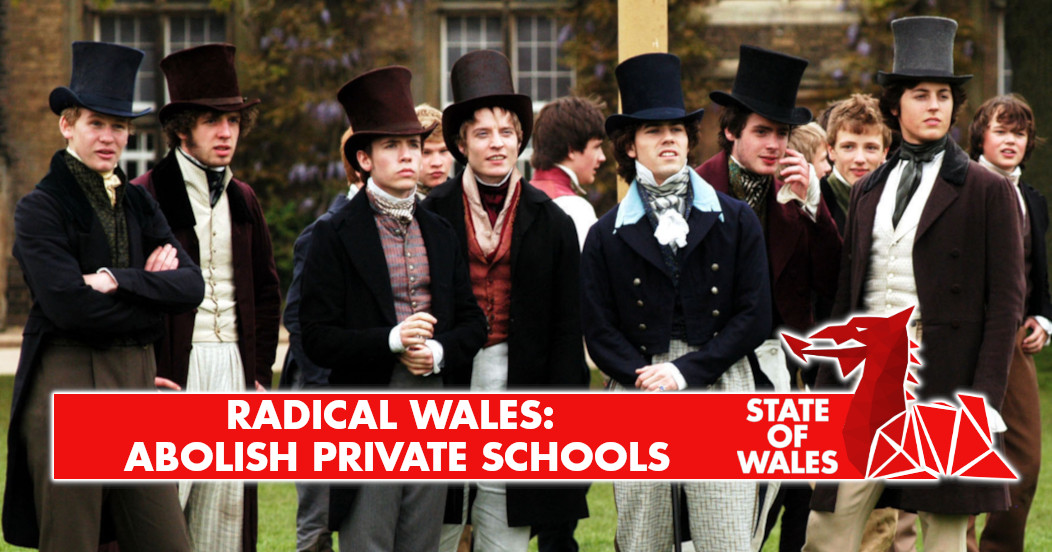
Radical Wales: Abolish Private Schools

Would abolishing private schools in Wales be a brazen act of class warfare, or have little impact at all?

Owen Donovan by Owen Donovan
November 20, 2023
in Education, Independence: Education
Radical Wales: Abolish Private Schools
Share on FacebookShare on TwitterShare on RedditShare on BlueskyShare by email
This site is best viewed in landscape mode on smartphones.
Support IndyWales? Support State of Wales!

Donations keep this site going. If you like what I’m doing here and think this work is important to the independence movement, consider a donation. One-off or monthly; as little or as much as you want. Click the links below, or full details are available here.

Private Education in Wales

The idea of abolishing private schools and giving all those future Camerons, Cleggs, Johnsons and Rees-Moggs “a bally good thrashing” does have a certain attraction to it.

In practice, maybe it’s not that easy or clear-cut.

The government’s definition of a “private school” falls under the broader category of “independent schools”. Independent schools are schools which charge a fee or are otherwise funded by charities or private organisations.

As of 2022-231 in Wales:

  • There were 79 independent schools, though the vast majority of these (92%) are “day schools”.
  • There were only 6 boarding schools.
  • A total of 9,780 full-time pupils (all ages) attended independent schools – 1,835 of whom were boarders – alongside 1,185 full-time equivalent teachers.
  • 2,274 pupils attending independent schools were categorised as having additional learning needs.
  • 24 pupils at independent schools were taught Welsh as a first language, peaking at 68 in 2014-15.
  • 11 independent schools were gender-specific (6 being exclusively for boys; 5 being exclusively for girls), the remainder being mixed.
  • There was a mean average of 4 independent schools per county. Cardiff had the most independent schools at 16, with Powys being the next highest at 8.
  • Five local authorities – Ceredigion, Rhondda Cynon Taf, Merthyr Tydfil, Blaenau Gwent and Torfaen – didn’t have any independent schools.

While independent schools can follow their own curriculum, they still need to be registered with the Welsh Government and are subject to Welsh Government regulations.

In addition to “private”/independent schools, there are certain school categories that are run independently but are still state-funded to a certain degree (grant-maintained, voluntary controlled and voluntary aided schools). This includes the bulk of faith-based schools in Wales.


Abolishing Private Schools: Case Studies

You’ll struggle to find many (if any) examples of developed nations that have completely abolished private education or private schools. So in that context, abolishing private schools altogether is one of the most radical ideas out there.

Finland is often said to have no private schools – up to and including a ban – but that’s wrong. For one, Finland never banned or abolished private schools; there are still around 80 of them, all charging fees.

The main differences are in the rules. In Finland, you can’t charge fees for mainstream education (which results in a qualification) to make a profit. Also, all schools – private and state – follow the same curriculum and are part of the same regulatory system.

There are some developed nations with proportionally low levels of attendance at fee-paying private schools (including the UK).

The German-speaking countries of Europe (Germany, Austria, Switzerland, Liechtenstein) have relatively low levels of attendance at private schools – though most areas maintain a grammar school-like system (gymnasium). It’s a similar, but not completely identical, situation in the Nordic countries (including Finland).

Abolishing Private Schools: Arguments For & Against

Arguments For
Arguments Against
Arguments For

Privately-educated children (and their parents) hoard social capital – This doesn’t appear to be that much of an issue in Wales itself, but at the UK level, those who’ve attended fee-paying mainstream private schools (confusingly named “public schools”) often dominate professional and managerial positions (such as politics, journalism, law, academia, medicine, the arts and creative sectors such as advertising and architecture) compared to their share of the population.

The Social Mobility Commission’s 2019 report “Elitist Britain”2 found that 39% of the “professional elites” attended an independent school, even though only 7% of all students attended such a school. A further 20% of elites went to a (selective) grammar school, compared to 5% of the school population.

Private school attendees are also far more likely to have studied at an “elite” university, with around half (49%) attending a Russell Group university and around half of those (24%) attending either Oxford or Cambridge (“Oxbridge”). 29% of MPs attended a private school and 24% went to Oxbridge.

If one group “hoards” positions of power, wealth and influence then the people making those decisions are less likely to “know how the other half live”. It makes social mobility – the ability for people to move up a social class or make a better life for themselves based on their abilities alone – much more difficult. Access to private education may well be one of the reasons why that’s the case.

Are private schools value for money? – Flipping the above on its head, parents might be wasting their money sending their children to private schools. Look at the untold disaster private schools and elite universities have unleashed on us over the last 30-40 years.

A capable student should be able to get straight As at a state school. Private school is just as much about buying access to higher social networks and instilling (over)confidence than it is about the quality of the education. While they provide a leg-up, private schools don’t quite have the same status they used to.

They’re supposed to educate the best of the best. What we’ve got is cruelty, incompetence, base populism, warmongering and foreign policy blunders of historic proportions. If it’s that bad amongst the politicians who’ve gone through the private school system, then we can only imagine how bad things have got in high finance, the civil service, the media and the judiciary.

That said, at least 6 sitting MSs3 have been wholly or partially privately educated, while most are university-educated. There’s a lot of talk about quotas and fair representation at the Senedd, but the current Senedd remains unrepresentative of the population in terms of class and education, let alone other categories.

A ban on mainstream private schools would probably have little impact in Wales – The proportion of the school population in Wales who attended an independent school at the start of January 2023 was relatively small at a minimum of 2.1%4, which is less than half the UK figure (~7%).

A sizable proportion of the independent schools in Wales are special schools too.

So abolishing mainstream private schools (“public schools”) shouldn’t put that much strain on the state sector. The projection is for the number of school-age children in Wales to fall by over 67,000 by 20395 due to demographic changes – and that doesn’t include all the surplus spaces that already exist.

Arguments Against

Denying parental choice – This is one of the core arguments against a ban. While there’s no explicit right to private education, in principle, parents should be allowed to send their children to whatever school they want as long as the school is properly regulated.

A ban on private schools might conflict with the European Convention on Human Rights Article 8 (the right to family life) and the First Protocol Article 2 (right to education, specifically the “right of parents to ensure….education and teaching conform with their own religious and philosophical convictions”).

Even in Wales, private schools rank towards the top in terms of performance in external exams. So it’s understandable that well-off families might seek to give their children a further advantage by sending them to one of those schools, instead of risking it at the local comp with a variable track record.

Private schools have other clear advantages over state schools. They usually have smaller class sizes and higher staff:student ratio6. There’s also a perception – true or not – that they commit far more time and resources towards extracurricular activities compared to state schools.

Not all private and independent schools are for “toffs” – As noted, there’s a sizable number of children with additional learning needs (many special schools are independent – at least 36 according to Estyn). Some military families may send their children to a boarding or day private school under the continuity of education allowance.

Perhaps Wales’ most well-known private school – Atlantic College – was founded on internationalist principles, having educated numerous future politicians and alike. So in that respect, it does (sort of) add to Wales’ “soft power”.

Would abolition be effective? – There are always ways around the rules. The obvious option would be for parents to simply send their children out of Wales to a private school in England, Scotland or elsewhere. No government would be able to ban that.

Also, the wealthiest parents could simply move to the catchment area with the best state schools (as happens to an extent now). Those schools would eventually become oversubscribed – assuming they don’t have a large number of surplus spaces.

Also, abolishing private schools wouldn’t mean a ban on private tuition. In some cases, private tuition may help students – or those with mild learning disabilities – who need extra help to get a good passing grade at GCSE or A-Level.

What Are The Alternatives?

Private schools could no longer have charitable status
A Finland-style bar on profiting from mainstream education
More "social purpose" regulations
Raise standards in state schools
Private schools could no longer have charitable status

According to a UK Parliament research briefing, a census of independent schools suggests that up to 70% are registered charities7. Charitable status means independent schools don’t have to pay certain taxes (like business rates) as they “provide a public benefit” (in this case education). They may or may not also offer scholarships to less well-off pupils or have partnerships with state schools.

There was discussion at the UK level earlier in 2023 that Labour may strip private schools of charitable status, and make them liable to charge VAT on fees. However, this policy proposal was eventually abandoned.

As for the Welsh Government’s current powers in this area, it’s another grey area. Powers over charities are non-devolved but education and regulation of independent schools are devolved; the Welsh Government also controls business rates. There’s been a similar discussion in Scotland, where the necessary powers are devolved.

Taxing private school profits and fees probably wouldn’t raise that much – and in the case of VAT, the money would just go to the UK Treasury anyway.


A Finland-style bar on profiting from mainstream education

This would allow mainstream private schools to remain open, but they would have to be run on a not-for-profit basis.


More "social purpose" regulations

Private schools could have greater “social purpose” responsibilities placed on them through regulations.

This could include regulation of fees (similar to universities), offering a minimum number of scholarships each year to students ordinarily resident in Wales, enhanced mentoring with state schools or regulating so that independent schools follow the Welsh National Curriculum.


Raise standards in state schools

The aim here would be to ensure local state schools are so good that no parent/guardian would want to send their children to a private school. As for precisely how to do this at a classroom level, it’s beyond the scope of anything here – you’ll need to ask education experts.

One option would be the re-introduction of grammar schools (based on the mainland European gymnasium) – or a grammar school-like “stream” within existing secondary schools – where students aiming for university are separated from those seeking to undertake advanced vocational training.

How Could Wales Abolish Private Schools?

There were some short-lived discussions around abolishing private schools during the fallout of a sexual harassment and safeguarding scandal at Ruthin School in 2019.

Partially as a result of that scandal, the regulations governing independent schools in Wales were updated during 2023 to strengthen safeguarding and complaints handling (amongst other things).

As noted, education is devolved so this isn’t a matter directly relating to independence. Nonetheless, it would have some implications on issues like social mobility, rights and the constitution.

Closing or suspending individual private/independent schools is relatively straightforward – the Welsh Government just removes them from the register (a measure Ruthin School was threatened with in 2019).

Closing them all at once would be far more difficult – probably requiring a law/Bill. You would also assume that independent special schools would be exempt from any “ban”, which might complicate things if certain types of schools are given special treatment.

As for the possible options:

A ban on charging fees for mainstream education
Convert mainstream "public schools" into selective-entry schools
Convert mainstream "public schools" into English-style academies
State boarding schools
A ban on charging fees for mainstream education

As mentioned earlier, you’ll struggle to find many examples of total bans on private schools. All current private mainstream schools in Wales would either close or have to convert to voluntary-aided or mainstream state schools.

Convert mainstream "public schools" into selective-entry schools

With this option, private schools would effectively become state grammar schools. They wouldn’t be allowed to charge fees (though allowances could be made for administrative costs) but would be allowed to restrict entry based on academic performance.

This might work as a compromise/alternative to an outright ban. The risk is that these “super schools” would harvest all of the best-performing students from state schools.


Convert mainstream "public schools" into English-style academies

Wales never adopted the academy system introduced by the UK Government in England during the 2000s or the free school system introduced in England during the 2010s.

In essence, academies are “half-in, half-out” of the state system. They’re often run as not-for-profit trusts usually in tandem with a corporate sponsor. They’ve produced mixed results (enough for an entire post by itself).

State boarding schools

Private schools would be part-nationalised and would offer places based on “excellence” (whether that’s academic, sporting or other talent) or “need”. “Need” could include looked-after children, persistently bullied children or children for whom a residential school could be the best learning environment.

In principle, everyone would have a fair chance to secure a place and the charge for boarding costs could be means tested. There are around 30 such schools in England.

You Might Also Like....

Radical Wales: No Military
Armed Forces

Radical Wales: No Military

by Owen Donovan
December 10, 2025
0

...

Read moreDetails
Radical Wales: Conscription/National Service

Radical Wales: Conscription/National Service

December 10, 2025
Radical Wales: Open Source Nation

Radical Wales: Open Source Nation

January 20, 2025
Radical Wales: Liquid Democracy

Radical Wales: Liquid Democracy

November 11, 2024
Radical Wales: Democracy by Lottery

Radical Wales: Democracy by Lottery

November 4, 2024
Radical Wales: Legalise Drugs

Radical Wales: Legalise Drugs

July 15, 2024
Radical Wales: Direct Democracy

Radical Wales: Direct Democracy

May 13, 2024
Load More
  1. Stats Wales, School Census, Independent Schools. 
  2. Social Mobility Commission & Sutton Trust (2019), “Elitist Britain“ (p11-16). 
  3. At the very least: Jane Hutt, Julie Morgan, Eluned Morgan, Gareth Davies, Andrew RT Davies & Mark Isherwood.
  4. Welsh Government (19th September 2023). “Schools’ census results: January 2023“. Note: The exact figure is hard to pin down as several independent schools didn’t take part in the Welsh Government’s school census, but is likely no more than 3-4%.
  5. Stats Wales (August 2023). “Pupil projections, 2023-2039, number of full-time equivalent pupils (thousands)“.
  6. JK Educate. “What’s the difference?: State school vs private school“. 
  7. UK Parliament, Research Briefing (14th June 2023). “Charitable status and independent schools“.
Use of AI

No AI tools were used to draft this post.

Donations Welcome
Tags: AustriaClass PoliticsDevolutionDisabilityEnglandFinlandGermanyRadical WalesSchools & TeachingSeneddSocial AttitudesSocial MobilityThird SectorUniversitiesWelsh GovernmentWelsh Law
Previous Post

Five Steps to Independence

Next Post

Devil’s Advocate: We can’t do anything about the “Brain Drain”

Owen Donovan

Owen Donovan

Archive

Categories

Copyright

Creative Commons Licence

State of Wales by Owen Donovan is licensed under a Creative Commons Attribution-NonCommercial-NoDerivatives 4.0 International License.

Subscribe by Email

Search

No Result
View All Result
No Result
View All Result
  • Go To Senedd Home
  • Go To Oggy Bloggy Ogwr
  • About & Contact
    • About State of Wales
    • Comments Policy
    • Complaints Policy
    • Contact & Subscribe by Email
    • Disclaimer
  • Features
    • After the UK
    • Chinny Reckon
    • Devil’s Advocate
    • How Wales Works
    • Road to Brexit
  • The Independence Index
    • The Independence Index (full)
    • Economics & Money
      • Business & Economy
      • Currency
      • Tax & Spending
      • Transport & Infrastructure
    • Society
      • Communities & Housing
      • Culture & Sport
      • Education
      • Health
      • Media & Communications
      • Science & Technology
    • The State
      • Environment & Natural Resources
      • Justice
      • Local Government
  • Elections Centre
  • Wales FAQ
    • How is Wales funded?
    • How are laws in Wales made?
  • Support & Donate