Image Source: Defence Imagery via Flickr under Creative Commons Licence BY-NC-ND-2.0
Donations keep this site going. If you like what I’m doing here and think this work is important to the independence movement, consider a donation. One-off or monthly; as little or as much as you want. Click the links below, or full details are available here.
What Happens Now?
The UK has officially banned the use, stockpiling and development of chemical1 and biological2 weapons.
In practice, the UK still maintains a research capability. Most of that work is undertaken at the Defence Science & Technology Laboratory (DSTL) at Porton Down in Wiltshire, England, with satellite laboratories in Hampshire and Newcastle.
The UK is also one of 9 countries which are known to have nuclear weapons. Nuclear weapons are, in principle, heavily restricted under international law.
The UK is one of the parties to the Non-Proliferation Treaty. This is supposed to ban non-nuclear states from developing nuclear weapons capability in exchange for nuclear-armed states helping other countries use nuclear technology for peaceful means (like nuclear energy).
The UK is also a party to a treaty banning nuclear weapons testing.
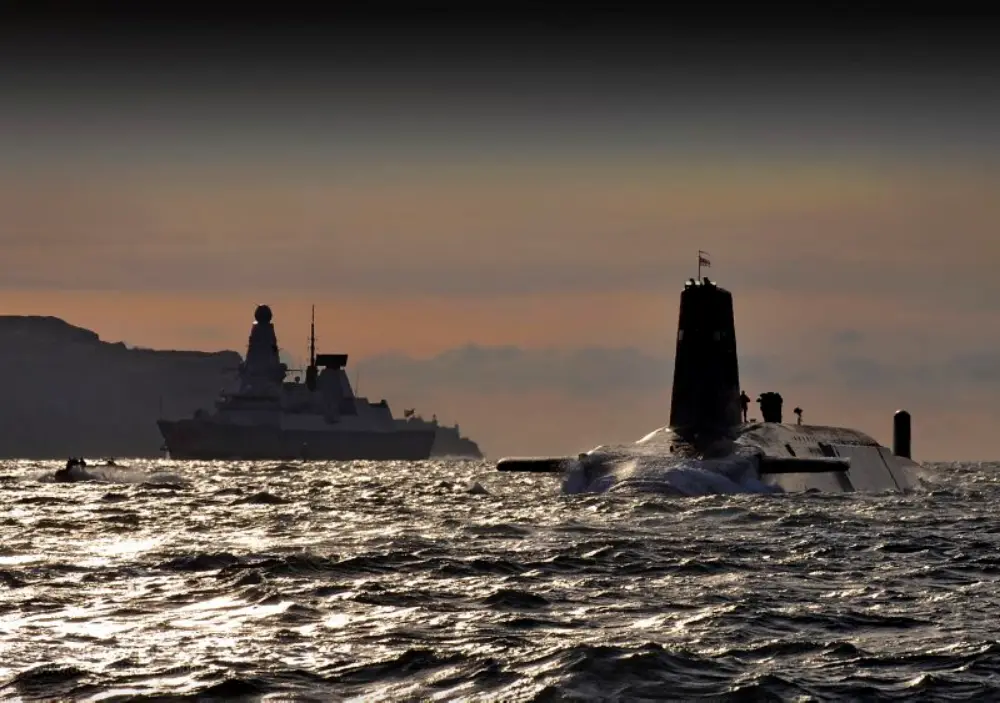
The UK’s nuclear deterrent currently consists of Vanguard-class submarines and Trident II missiles. The submarines are set to be replaced by a new Dreadnought-class during the 2030s, and the life span of the missiles is to be extended. The budget set aside for this work totals around £56 billion3.
The UK’s nuclear deterrent could be described as semi-independent. While the UK can decide to use Trident missiles, and manufactures the nuclear warheads for them (estimated to total around 225), only the Americans can maintain and repair the missiles themselves4.
France’s nuclear deterrent is completely independent with French-made and maintained submarines, aircraft, warheads and missile systems.
Does This Work for Wales?
There’s nothing controversial about the UK’s stance on chemical and biological weapons. In that case, it does work for us and likely matches the policy an independent Wales would have.
Most of the debate here would be around Trident. Does Wales – in isolation, based on our own defence needs – need to be under a nuclear umbrella (which we pay for as part of the UK)?
Given increased Russian aggression, you can certainly make an argument that it’s a good thing to have even if it’s never going to be used (and is very expensive). Though in practical terms, the money “Wales” spends on Trident would be better spent on something else.
There are, of course, moral arguments around nuclear weapons. You can picture a sizable number of people in Wales – particularly from the pacifist tradition and those on the left – supporting a global ban on nuclear weapons or would be in favour of making Wales a nuclear-free zone.
This debate flared up in 2013 when former First Minister, Carwyn Jones, suggested Wales could host the UK’s nuclear submarine fleet if Scotland voted for independence in 2014. The current UK nuclear submarine base is at Faslane to the north-west of Glasgow.
Independence & Weapons of Mass Destruction Policy: Pros & Cons
Wales wouldn’t have to contribute to the ongoing cost of maintaining the UK’s nuclear weapons. As of 2022-23, this is said to be around £3 billion per year (Welsh share: approximately £150 million per year)5.
Wales would have the power to completely rule out hosting nuclear weapons.
Likewise, Wales would be able to make our own arrangements for stationing or sharing nuclear weapons (if that’s what we decide we want to do).
Most of the hard (legal) work has already been done as a result of major international treaties. Wales can simply sign and ratify them.
Idealism won’t protect Wales or Welsh citizens from an attack by WMDs; even a limited nuclear war would have global impacts, regardless of what Wales does or doesn’t think is morally right.
Unless Wales joins NATO, we would be outside the NATO “nuclear umbrella”, meaning if Wales were attacked (in isolation) by nuclear weapons (which would be very random, but hypothetically possible), there would be no obligation on England or France (as part of NATO) to retaliate. Though in practice this may be different.
Despite international bans and treaties on chemical, biological and nuclear weapons, many countries maintain programmes or have used them. In that light, having a scientific service like DSTL makes sense – and Wales would lose direct access to that through independence.
Ruling out the principle of nuclear weapons may make it impossible for Wales to join (or play a full part in) NATO and could lead to disagreements with the United States (as has happened with New Zealand) and potentially England and France.
What Do Other Countries Do?
![]()
Ireland supports full nuclear disarmament and played a role in laying the groundwork for what would become the Nuclear Non-Proliferation Treaty6. Ireland is a founding member of the New Agenda Coalition, seeking global nuclear disarmament. They’ve also played a similar role in policing and outlawing chemical and biological weapons.
![]()
As a NATO member, Iceland supports the principle of nuclear weapons being used as a deterrent on its behalf. Iceland is a party to the Chemical and Biological Weapons Conventions.
![]()
As a NATO member, Finland supports the principle of nuclear weapons being used as a deterrent on their behalf. Despite this, the manufacture, possession and detonation of nuclear weapons is banned under Finnish law7.
The University of Helsinki has taken the lead in developing verification methods concerning the disposal of chemical weapons (VERIFIN). Finland is also a party to the Chemical and Biological Weapons Conventions.
![]()
Switzerland abandoned its nuclear weapons programme in the 1980s. In 2017, Switzerland voted at the UN in favour of a total ban on nuclear weapons, but as of 2024, the Swiss government doesn’t believe in a total ban8. There are early plans to gather enough signatures for a referendum on the issue.
The Swiss have signed the Chemical and Biological Weapons Conventions.
![]()
New Zealand supports a total global ban on nuclear weapons. Under New Zealand law9, the country is a “nuclear-free zone”, with a ban not only on nuclear weapons being used or stationed in New Zealand but also a ban on nuclear-powered ships entering New Zealand’s territorial waters.
This led to a dispute with the Americans, and New Zealand has been partially suspended from the ANZUS defence agreement with the United States and Australia.
New Zealand has signed the Chemical and Biological Weapons Conventions.
What Options Does Wales Have?
Chemical & Biological Weapons
Unless we decided to play Bond villains, it’s a certainty that Wales would sign and ratify the Chemical and Biological Weapons Conventions fairly early on after independence. That would ban their development, stockpiling and production in Wales – though it wouldn’t prevent an attack.
It may be worth considering setting up a government laboratory or scientific research facility of some kind (an equivalent of DSTL but on a much smaller scale).
Nuclear Weapons
“Kim Jong Un, is it?”
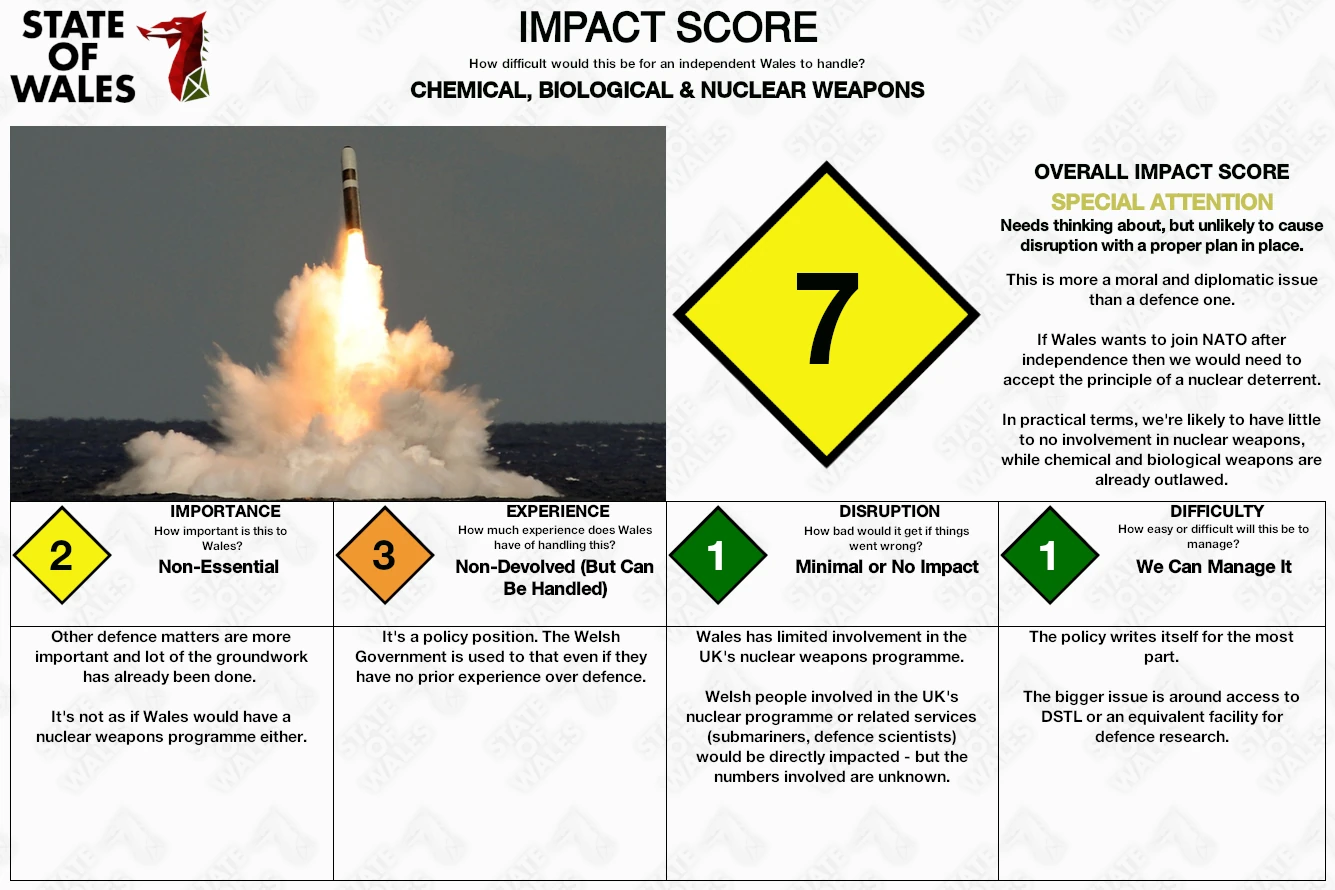
There’s no reason for Wales to have an independent nuclear weapons programme. Sorry to disappoint. The question here concerns potential Welsh NATO membership and what that would mean for (in principle) hosting nuclear weapons on Welsh territory or supporting their use as a deterrent. That will be looked at separately.
There’s probably enough material at the former nuclear power stations in north-west Wales to make a crude radiological weapon (aka “dirty bomb”). Nuclear decommissioning is an issue in its own right, but it could be considered a potential security risk.
If a future post-independence Welsh Government were firmly opposed to nuclear weapons of any kind, then we could go further and join groups like the New Agenda Coalition. The Coalition is pushing for global nuclear disarmament and includes Ireland, Brazil, Egypt, Mexico, New Zealand and South Africa as members.
Wales could go one step further and, as in New Zealand, pass a law banning nuclear weapons and nuclear-powered vessels from being hosted, used or stationed on Welsh territory – though that would almost certainly prevent Wales from joining NATO.
What's at Stake?
The overall score (out of 20) is the total of the scores for the four mini-categories (out of 5 each).
How Would This Be Run?
How Wales would sign/ratify the major international treaties on chemical, biological and nuclear weapons was looked at separately.
Our overall stance on nuclear, biological and chemical weapons would be led and shaped by the Senedd. It’s more a moral issue than a practical military one when Wales is concerned.
How Much Will This Cost?
Headline: No longer contributing to the upkeep/replacement of the UK’s nuclear weapons would save an independent Wales around £150 million per year (based on current spend).
This would form part of any savings from a lower defence budget overall.
If Wales met the current NATO spending commitment of 2% of GDP, our defence budget would be £1.86 billion – up to £1 billion less than what’s spent on Wales’ behalf within the UK.
Would any new taxes need to be introduced?
No.
Who will pay for this?
No direct cost implications, as it’s a policy position more than anything.
How Long Would This Take?
The process for ratifying treaties would either be included in a written Welsh constitution, Welsh constitutional law and/or official government guidance. So the procedure would likely be in place either before or shortly after Wales becomes independent.
Our policy on nuclear weapons would depend on things like NATO membership.
People & Work
Those most directly impacted would be Welsh Royal Navy submariners and anyone from Wales working in the UK’s nuclear weapons programme (based in Berkshire) or for the DSTL. More below.
Indirectly, as it’s a defence matter it affects everyone.
Any Welsh people working on the (what would become) the English nuclear weapons programme and DSTL would almost certainly have to leave their jobs unless they changed citizenship; similarly, Welsh people serving on the Royal Navy’s submarine fleet.
These are high-security/restricted roles which are not open to dual nationals or foreign citizens. It’s impossible to tell how many people would be affected as, for obvious reasons, the Royal Navy don’t publish submariner statistics (you wouldn’t expect it to be that many in Wales’ case, but there will be some).
Those affected would have transferable skills, and some of these jobs may be replicated as a Welsh military develops, but many roles wouldn’t (Wales wouldn’t have a submarine fleet or nuclear weapons programme, for example).
You Might Also Like....
Chemical Weapons Convention (1993).
Biological Weapons Act 1974 & Biological Weapons Convention (1975).
UK House of Commons Library (25th June 2025). “Research Briefing, Nuclear weapons profile: United Kingdom” (p5).
M. Messmer, O. O’Sullivan, Chatham House (24th March 2025). “The UK’s nuclear deterrent relies on US support – but there are no other easy alternatives”.
UK House of Commons Library (12th August 2025). “The cost of the UK’s strategic nuclear deterrent”.
Government of Ireland, Department of Foreign Affairs & Trade “International Priorities: Disarmament and Non-Proliferation“.
Nuclear Energy Act 1987, Section 4.
Swissinfo.ch (28th March 2024). “Swiss government again declines to sign nuclear weapons treaty“.
New Zealand Nuclear Free Zone, Disarmament and Arms Control Act (1987)
No AI tools were used to draft this post.