
Image Source: BBC iPlayer
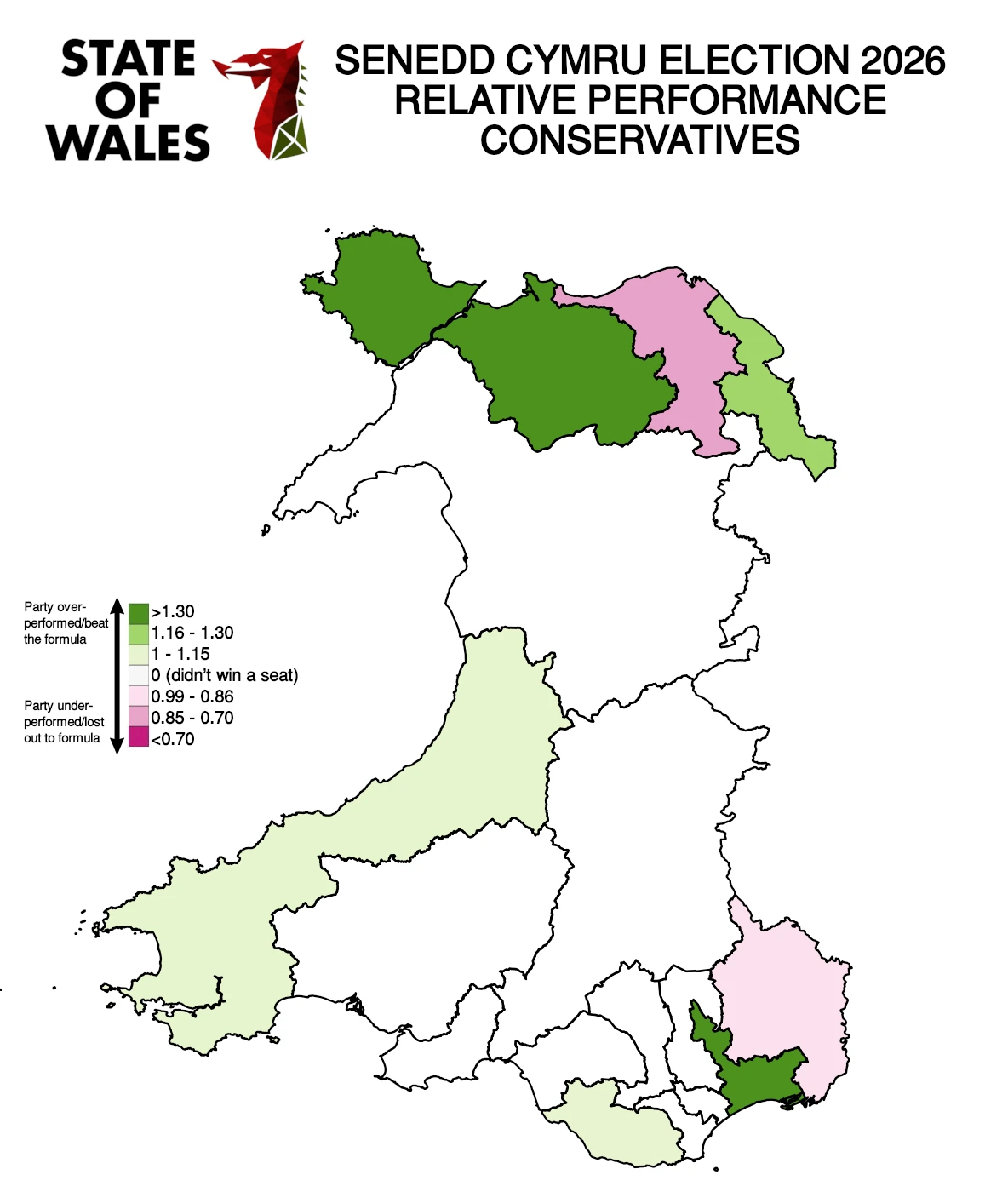
The relative performance (below) is calculated using a seats-to-votes ratio. It’s a measure of how proportional a result in a constituency is, but also gives you an idea as to whether a party has “beaten the D’Hondt formula” and over-performed (or the opposite).
The formula used for each constituency is:
(Seats won by a party ÷ 6*) ÷ (Votes received by a party ÷ total votes cast)
*Number of seats available in each constituency.
Did the Conservatives get away with one here?
The Good News
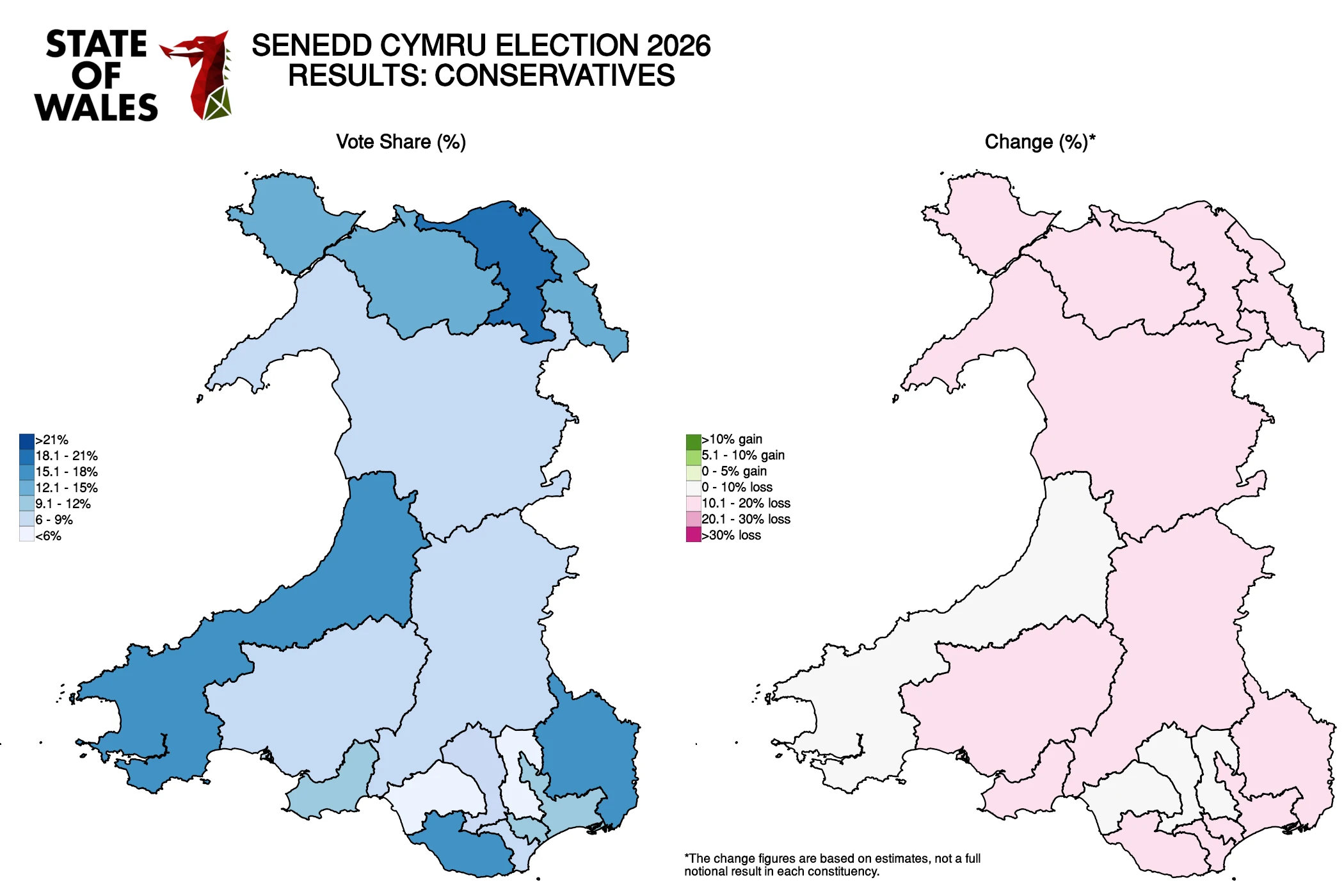
Yes, on the surface, they took another hiding. Though coming out of this with 7 seats is a good result (relatively speaking).
They still did OK in the “Costa Geriatrica”, and managed to hold on to seats in places like Pen-y-bont Bro Morgannwg, Clwyd, Casnewydd Islwyn and Fflint Wrecsam; all of which might’ve been under threat from Reform.
All returning MSs have previous Senedd experience. So it has the makings of being a fairly tight-knit group.
The Bad News
The underlying numbers are bad. They lost vote share in every single seat, often by double digits. The scaling I’ve used on the graphic doesn’t show it as well as it should – but that’s laziness on my part.
They were “victims” of the D’Hondt method in the Clwyd seat. They also performed noticeably poorly in Cardiff where, under normal circumstances, the Tories should’ve been able to win a seat in the new Caerdydd Ffynnon Taf constituency.
Being pushed into fourth place is a pretty sharp fall from grace, with the group losing some effective MSs like Sam Kurtz.
What happens next?
What does this leave the Conservatives in the Senedd?
A much smaller group, but a group nonetheless. The risk is that they end up getting overshadowed by Reform. But that also presents opportunities if the Tories can present themselves as the “reasonable right” voice. At the first meeting though, it came across as though the opposite was the case.
There will be implications in terms of backroom staff and finances – losing dozens of staff positions and possibly hundreds of thousands of pounds in back office allowances. This will make them less effective in the long run.
What does this result mean for the party leadership?
The only issue you could see arising is disagreement over whether to “out-Reform Reform” (which you can picture the likes of Andrew RT Davies advocating), or moving to becoming more moderate and less devosceptic to rebuild what they’ve lost since 2021.
What went well for them during the campaign?
That they were left to run their campaign themselves, and the UK party kept its distance. I don’t think their campaign really cut through to any great degree, but managing to keep enough of their voters on side, in light of the threat from the right by Reform, was good going in challenging circumstances.
What lessons do they need to learn for next time?
They need to decide once and for all what their policy on devolution is and what role and place they see Wales having in the Union (and the Tories having in Wales). If they want to go back to their pre-Nick Bourne days of wanting another referendum on devolution, then come out and say it. Defend that position.
They also need something a bit better than targeting “wasteful spending” and ID politics. Where are their “big ideas”? What’s their vision beyond bean-counting and shouting at clouds? What are they for, not against?


