Image Source: BBC iPlayer
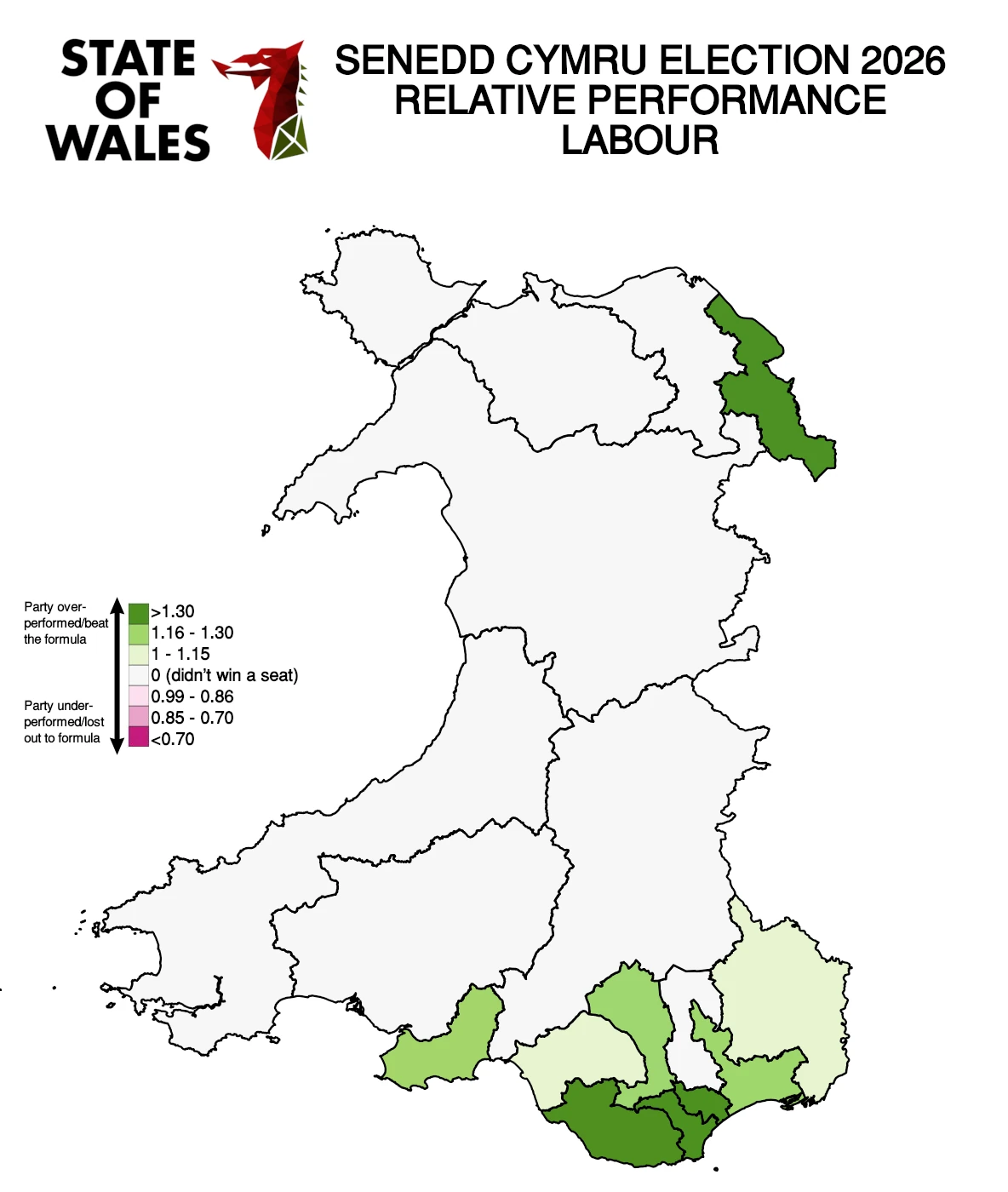
The relative performance (below) is calculated using a seats-to-votes ratio. It’s a measure of how proportional a result in a constituency is, but also gives you an idea as to whether a party has “beaten the D’Hondt formula” and over-performed (or the opposite).
The formula used for each constituency is:
(Seats won by a party ÷ 6*) ÷ (Votes received by a party ÷ total votes cast)
*Number of seats available in each constituency.
It’s probably best to get this out of the way first. Labour will no doubt, in good time, hold their own inquests into what happened last week.
The Good News
You can see from the relative performance graphic above that there is one good outcome: this could’ve been worse. Labour “beat” the D’Hondt method’s maths in all but one of their 9 seats (Afan Ogwr Rhondda, where they scored the “perfectly proportional” figure of 1). So, it looks as though they secured 9 seats by the skin of their teeth; it could very easily have been 1 or 2.
They still finished in third place – albeit a very, very distant third (though they were only a few thousand votes away from fourth). An optimistic view would be that this might be their “floor”. This voting system could easily lead to big swings towards them in the future (assuming we keep it).
One small crumb of comfort is that the small number of MSs who did secure election are all experienced – ex-ministers, ex-council leaders, union officials and so on. The average age has seemingly dropped as well. They can be an effective opposition group (on paper), but so were the Lib Dems at one point and look at where they are now.
The Bad News
The catastrophic drop in vote share. Labour has been thumped in European Parliament elections before (which used the same voting system), but this is at least twice as bad as any of those results.
The only comparison in Welsh politics I can think of is the collapse in the UKIP vote between 2016 and 2021 (-20-30%). That’s how bad this is. The only constituencies where this didn’t happen are those areas where Labour has never done particularly well anyway (Gwynedd Maldwyn, Bangor Conwy Môn, Ceredigion Penfro).
And it could get worse before it gets better. There are council elections next year.
What happens next?
What does this leave Labour in the Senedd?
In a bad place, obviously. They may be looking at one committee chair, maybe two. It’s like one of them will end up a Senedd Commissioner too.
The biggest impact will be felt behind the scenes. They’ll lose dozens of staff and hundreds of thousands of pounds in office and backroom allowances. There’s the loss of their usual access to the civil service, media and more; they’re the biggest “small” party now.
In the space of 48 hours, Labour has gone from an entitled position of access, resources and influence in Wales to next to nothing outside of local government (and that might not last much longer).
What does this result mean for the party leadership?
They don’t have a leader, though at the time of posting Ken Skates MS (Lab, Fflint Wrecsam) has taken on the role on an interim basis.
With Huw Irranca-Davies MS (Lab, Afan Ogwr Rhondda) appointed as Llywydd yesterday, you would expect Ken Skates to take on the role permanently. I mean, who else is there?
What went well for them during the campaign?
Eluned Morgan had a decent campaign. This result isn’t on her. She conducted herself with dignity and composure even when it was obvious that most people in the party knew something bad was coming. Based on merit, she was perhaps one of the few Labour MSs who deserved to be re-elected – and I’m saying that as someone who’s not a fan.
Anecdoteally, Labour were active, if not to their usual levels. They gave the impression of caring about this, even if many of those taking part in canvassing were councillors with one eye on next year. I don’t think anything went particularly wrong there, and they still have/had an effective on-the-ground operation.
They were the only party to come anywhere close to publishing their costings (and that wasn’t a full costings document). But in the end, that didn’t matter.
What lessons do they need to learn for next time?
Learn the right lessons, for one.
The story here isn’t Reform finishing second, it’s people turning to Plaid Cymru as the “anti-Reform vote” over Labour. They need to ask themselves where that “trust” has gone and why. They should start with the assumption that this isn’t going to be a one-off.
It would be too simplistic to pin this on Keir Starmer’s unpopularity, or single unpopular policies like 20 mph or the “Nation of Sanctuary” (which Plaid Cymru have backed too, and it didn’t hurt them). Nor the UK Government’s Blairite “tough decisions” crap like winter fuel allowance and PIP reform. It’s all of that, yes.
It’s just as much about Labour overseeing a managed decline of Wales since the 1980s – in and out of government at UK and Welsh levels – and the sense of being taken for granted (i.e. parachuting in MPs with minimal connections to Wales to win safe seats in 2024, and not taking demands for extra devolution seriously).
“Fairness you can feel” feels like waiting months and years for treatment, not being able to find an NHS dentist, waiting to be unloaded from ambulances (if an ambulance turns up), teachers working 50+ hour weeks (because the education system gets chopped and changed every few years due to PISA panic), and paying twice as much (or more) in council tax as London boroughs.
That’s a warning to Plaid Cymru too, because they’re not going to have 27 years to deliver meaningful change. They’re going to have 3, seeing as the first year’s budget has largely been set.
The gradual hollowing out of Labour’s talent base stagnated ideas and policies, so they attempt the same things over and over again, whilst expecting different outcomes. This has long been a party of time-serving, middle managers and patronage. The dam holding back decades of disappointment and disillusionment finally burst, but a lot of us saw a result like this potentially coming years ago – though maybe not to this extent.