
Image Source: BBC iPlayer
The relative performance (below) is calculated using a seats-to-votes ratio. It’s a measure of how proportional a result in a constituency is, but also gives you an idea as to whether a party has “beaten the D’Hondt formula” and over-performed (or the opposite).
The formula used for each constituency is:
(Seats won by a party ÷ 6*) ÷ (Votes received by a party ÷ total votes cast)
*Number of seats available in each constituency.
Your new lead opposition party.
The Good News
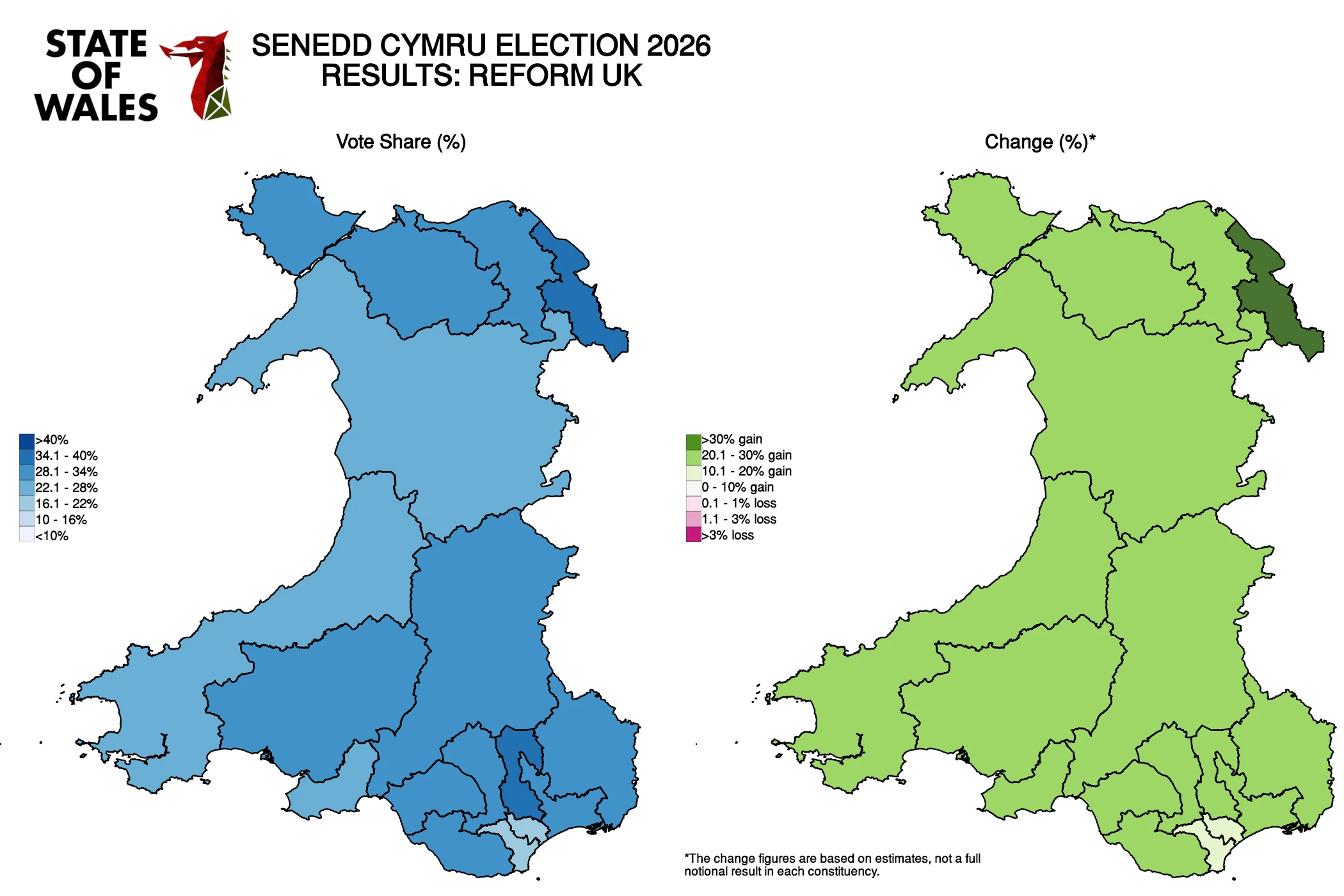
Reform secured the biggest increase in vote share of any party, including Plaid Cymru. They are now, unquestionably, the dominant party of the right in Wales.
They performed remarkably consistently across all of Wales (nearly all of their results were between 27-32% of the vote). Though they managed to do a bit better than that in Blaenau Gwent Caerffili Rhymni and Fflint Wrecsam.
They also seem to have benefited from D’Hondt, securing some of the most “disproportionate” results in their favour. These include three seat gains in Sir Gaerfyrddin and Brycheiniog Tawe Nedd.
Depending on how things play out over the next year, next year’s local elections could prove very fruitful for Reform in Wrexham, Flintshire and the Valleys.
The Bad News
They might’ve fallen short of seat expectations because both Labour and the Conservatives did a bit better than expected under the D’Hondt method.
As much as they benefited from the new PR system, Reform was a victim in some cases. They effectively “under-performed” in constituencies where they might’ve expected to pick up three seats, such as Afan Ogwr Rhondda, Pen-y-bont Bro Morgannwg and Fflint Wrecsam.
The only constituencies where they didn’t do well overall were the two Cardiff ones. You wouldn’t expect Cardiff to be a favourable ground for Reform anyway.
The consistent results also suggest they have a support ceiling of around 30%; this feels like it’s a “maxed out” vote rather than being something they can build upon. If there was any election for wavering Tories and small-c conservative ex-Labour supporters to back Reform, it was this one – and they probably did anyway.
What happens next?
What does this leave Reform UK in the Senedd?
Dan Thomas MS (Ref, Casnewydd Islwyn) is Leader of the Opposition. That means (provisionally), more airtime, more committee chairs available, more resources/money.
As said immediately following the results, they’re in a perfect position: minimal responsibilities with an open mic, and free shots at Plaid.
What does this result mean for the party leadership?
It’s hard to tell. If this is true to form for Reform, the first resignations and defections will likely happen before the end of the year. Rumours are doing the rounds already that some of the “paper candidates” who were unexpectedly elected aren’t happy with their new employment situation.
The fact that many of them are ex-Conservatives might be a good thing, as it suggests that at least some of them are familiar with the concept of party discipline. All it will take is one big mouth, one stupid comment to derail it all, though. Let’s face it: it’s a case of when, rather than if.
What went well for them during the campaign?
That it was fairly low-key. They didn’t go out of their way to push their policies (because they didn’t have very many). It was about feeding off disillusionment, shoring up the support they already had (likely from older men) and hoovering up protest votes.
Dan Thomas also went from an unknown in Welsh politics to a slightly better-than-unknown in the space of a few weeks.
What lessons do they need to learn for next time?
Farage needs to play a background role. This has to be a Welsh party, standing up for Welsh interests (in the UK), if they want to stand any chance of sticking around in a meaningful way after 2030. They need to learn more from the Tories than anyone else and have their “Bourne” moment.
Yes, Reform is a party of Anglo-British interests. But “foreign speaker” jibes, and sheep-shagger jokes on the eve of the election – while likely going down well with a certain quarter – will have reminded that big “anyone but Reform” bloc why they’re right not to vote for them.
That’s despite their underlying message about being frustrated with the established parties resonating with more people outside of their target base of support that they might’ve thought.


