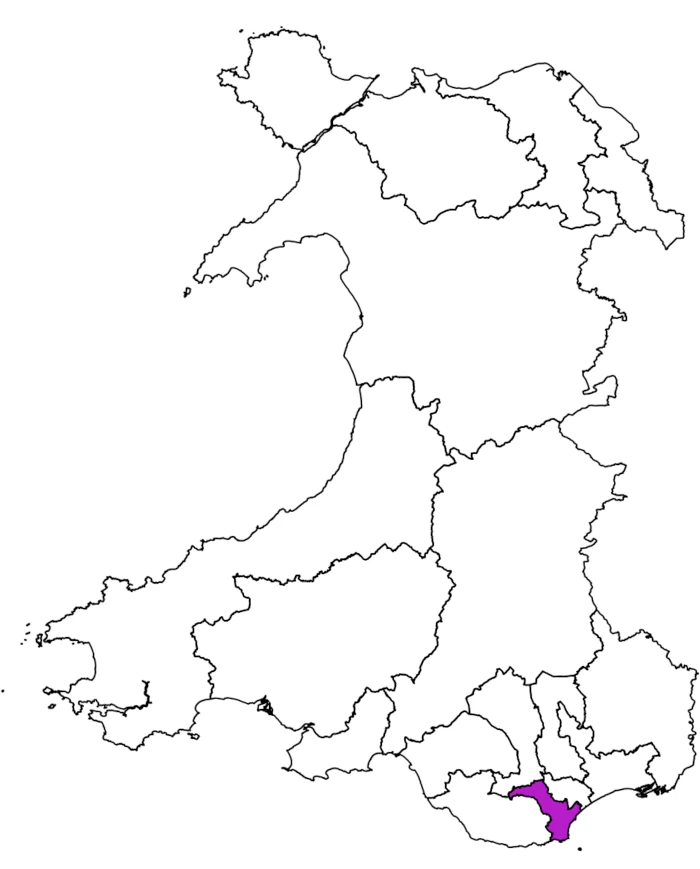

Image Source: Google Earth (taken November 2022)
Map data from OpenStreetMap under Open Data Commons Open Database Licence. Senedd constituency borders provided by DataMapWales under Crown Copyright.
Data Overview
| Measure | Value | Rank |
|---|---|---|
| % population aged 65 or over | 14.8% | 16th |
| Average Life Expectency at Birth (Male) | 79.3 | 9th |
| Average Life Expectency at Birth (Female) | 82 | 11th |
| Employment Rate | 71.7% | 12th |
| Economic Inactivity Rate | 23.6% | 8th |
| Median Weekly Earnings | £731.50 | 3rd |
| % of Secondary school pupils entitled to free school meals | 24.0% | 2nd |
| People employed by businesses headquartered in this constituency | 78,600 | 1st |
| % population aged 3 and over who can speak Welsh | 12.9% | 7th |
| Adult population with a limiting long-term illness | 32.0% | 14th |
*Constituencies are ranked from 1 to 16 based on Senedd Cymru constituency data.
Source: Welsh Government, Data for the Senedd Constituency Areas (28th January 2026). https://www.gov.wales/data-senedd-cymru-constituency-areas-2026
Geographic Profile
Urban – Most people live in (or close to) a single, densely-populated built-up area.
WISERD Understanding Welsh Places Settlement Profiles
Scroll to the notes section for a full explanation.
Independent (1), Interdependent (4)
Local Government Political Control
Cardiff (Labour), Vale of Glamorgan (Labour–Independent coalition).
Candidates
Confirmed as of 09/04/2026
Unlike previous Senedd elections, you will have one vote (for a party, not a candidate) and one ballot paper at this election. A full explanation of how the new new voting system works is avalable in the video to the left.
Candidates will be elected in the order they appear on their party lists. Sitting MSs seeking re-election are in italics.
If you can view this correctly (desktop/landscape view), the six parties expected to win seats are are listed from left to right. Firstly, by the number of seats they won at the 2021 Senedd election; secondly, by the number of votes they received at the 2021 Senedd election. Click on the mini party logos below to open/close the drop down tab.
Labour
- Huw Thomas
- Ruba Sivagnanam
- Peter Bradbury
- Steve Brooks
- Mutale Merrill
- Kanaya Singh
- Laura Rochefort
Liberal Democrats
- Cadan ap Thomas
- Irfan Latif
- Elinor Dixon
- Barry Southwell
- Chris Cogger
- Ashley Wood
Conservatives
- Calum Davies
- James Hamblin
- Dominic Davies
- Judith Child
- Archie Draycott
- Eddy Oko-Jaja
Greens
- Anthony Slaughter
- Tessa Marshall
- Rowan Stanger
- Tavgar Bulbas
- Max O’Hara
- Iwan Sinclair
Plaid Cymru
- Anna Brychan
- Kiera Marshall
- Leticia Gonzalez
- Malcolm Phillips
- Matthew Hawkins
- Tomos Stokes
Reform UK
- Joe Martin
- Mark Reckless
- Robert Thomas
- Rachel Finn
- Paul Campbell
- Ruth Hancock
Independents & Other Parties
- Communist: Robert Griffiths
- Heritage Party: Rhiannon Morrissey
- Independent: Rhys ab Owen
Propel
- Neil McEvoy
- Ceri McEvoy
Favourability
Demographics
The population in this constituency leans younger than the Welsh average, which is likely to favour parties focused on cost-of-living, climate change and issues such as housing and childcare. You would expect this to favour parties on the left (Labour, Plaid Cymru, Greens).
Education
The proportion of people with Level 4 (the equivalent of the first year of university) qualifications is much higher than the Welsh average. This could boost support for parties with a “big ideas” mindset, such as the Greens and Lib Dems. The constituency includes a large student population which may advantage parties which appeal to younger voters such as the Greens, Plaid Cymru and to an extent Labour.
Employment
Average levels of economic inactivity is unlikely to correlate with support for any particular party, or would lean towards support for keeping things as they are. High average earnings is also likely to lead to greater support for parties that want to keep things as they are, but the high proportion of children eligible for free school meals may mask in-work poverty.
Health
The population is generally healthier than the Welsh average. This doesn’t mean that issues such as health and social care won’t matter, but they may be lower priorities if local services are running well.
Geographic Make-Up
Urban areas with a youthful population usually trend with stronger support for liberal and progressive parties, such as the Greens, Lib Dems, Labour and Plaid Cymru.
Identity & Language
An average proportion of Welsh-speakers would normally disadvantage Plaid Cymru, but they have historically been successful in places such as Dinas Powys. The western and central areas of Cardiff include a large student population, while places such as Penarth are likely to lean more conservatively.
Brexit
The area leans towards Remain in the 2016 referendum, which would favour parties such as the Greens, Lib Dems and Plaid Cymru.
Election Ratings
- Labour
- Conservatives
- Plaid Cymru
- Liberal Democrats
- Reform UK
- Greens
- Others
1+1
0+1
1+1
0+1
1+1
1
(Propel) 0+1
Expected to win 1 seat, could win a second if they overperform.
Could win a seat if they overperform.
Expected to win 1 seat, could win a second if they overperform.
Could win a seat if they overperform.
Expected to win 1 seat, could win a second if they overperform.
Expected to win 2 seats, could win a third if they overperform.
Could win a seat if they overperform.
Notes
WISERD Understanding Welsh Places Model (link)
Independent – An independent place (including the independent to interdependent category) has many important things such as hospitals, businesses, and community facilities. It also has a mix of different kinds of jobs. People living there can easily go to work or use services nearby, and people from other communities go there too. Constituencies with a large number of independent places are likely to have stronger local economies and act as important regional centres.
Dependent – A dependent (including the dependent to interdependent category) place has fewer important things like hospitals, businesses, and community facilities. It may rely on one kind of job or a single major employer. People living here are more likely to commute out of the community to work or to use services. Constituencies with a large number of dependent places are reliant on services provided in other communities.
Interdependent – An interdependent (including the interdependent to independent and interdependent to dependent categories) place is somewhere in between independent and dependent places. It has a mix of important facilities and services, but not as many as an independent place. Residents will equally commute to other settlements to work, as well as work locally. Constituencies with a large number of interdependent places are likely to have a mix of dormitory towns/villages and important local centres (i.e. industrial estates, retail parks, general hospitals).


