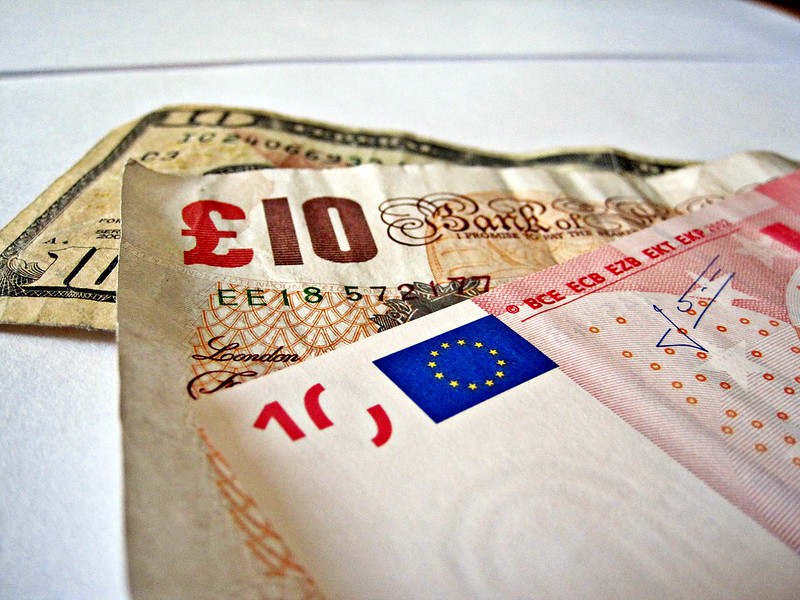
Image Source: Images Money via Flickr under Creative Commons Licence BY-SA-2.0
Donations keep this site going. If you like what I’m doing here and think this work is important to the independence movement, consider a donation. One-off or monthly; as little or as much as you want. Click the links below, or full details are available here.
In principle, it shouldn’t matter as long as Wales can meet the economic and financial checklist laid out by the EU1.
The issue with keeping the pound is that we wouldn’t be able to change our monetary policy to meet the EU’s rules if and when we need to. Those policies – such as interest rates – would continue to be set by the Bank of England and would likely have England’s needs in mind.
If Wales kept using the pound we probably wouldn’t be able to take part in the EU’s Exchange Rate Mechanism (ERM II) – which fixes currency exchange rates. Taking part in ERM II is something a country must do for at least two years before joining the eurozone.
So keeping the pound would make it less likely that an independent Wales could join the eurozone rather than the EU.
As mentioned here (Would an independent Wales be forced to use the euro if we joined the EU?) all countries seeking to join the EU need to commit to using the euro2. However, how to do this and how long it takes is entirely up to the country.
If an independent Wales was unable to commit to the euro because we want to keep the pound, it might hold up negotiations to join the EU.
One way to avoid that would be to negotiate an opt-out like Denmark. Though that only happened because Danish voters rejected the Maastricht Treaty in a referendum3.
That doesn’t mean there aren’t advantages to keeping the pound too.
You Might Also Like....
Treaty on the Functioning of the European Union, Title VIII: Economic & Monetary Policy, Article 140.
European Commission. Enlargement of the euro area, “Who can join and when?”.
Danish Parliament, “European Union referenda“.
No AI tools were used to draft this post.