Senedd Home
Oggy Bloggy Ogwr
State of Wales
Sunday, August 9, 2026
  • About & Contact
    • About State of Wales
    • Comments Policy
    • Complaints Policy
    • Contact
    • Disclaimer
  • Elections Centre
  • The Independence Index
    • The Independence Index (Full)
    • Foreign Policy
      • Relations with the former UK & Ireland
      • Relations with Europe
      • Foreign Policy (General)
      • International Organisations & Law
      • Overseas Aid
    • Defence
      • Defence Policy
      • NATO
      • Armed Forces
      • National Security
      • Civil Defence
    • Rules & Regulations
      • Safety & Standards
      • Intellectual Property
    • Economics & Money
      • Business & Economy
      • Currency
      • Tax & Spending
      • Transport & Infrastructure
    • Society
      • Communities & Housing
      • Culture & Sport
      • Education
      • Health
      • Media & Communications
      • Science & Technology
    • The State
      • Environment & Natural Resources
      • Justice
      • Local Government
  • Support & Donate
No Result
View All Result
  • About & Contact
    • About State of Wales
    • Comments Policy
    • Complaints Policy
    • Contact
    • Disclaimer
  • Elections Centre
  • The Independence Index
    • The Independence Index (Full)
    • Foreign Policy
      • Relations with the former UK & Ireland
      • Relations with Europe
      • Foreign Policy (General)
      • International Organisations & Law
      • Overseas Aid
    • Defence
      • Defence Policy
      • NATO
      • Armed Forces
      • National Security
      • Civil Defence
    • Rules & Regulations
      • Safety & Standards
      • Intellectual Property
    • Economics & Money
      • Business & Economy
      • Currency
      • Tax & Spending
      • Transport & Infrastructure
    • Society
      • Communities & Housing
      • Culture & Sport
      • Education
      • Health
      • Media & Communications
      • Science & Technology
    • The State
      • Environment & Natural Resources
      • Justice
      • Local Government
  • Support & Donate
No Result
View All Result
State of Wales
No Result
View All Result
Home Foreign Policy

How might the old UK countries work together after independence?

Owen Donovan by Owen Donovan
May 19, 2025
in Foreign Policy, Relations with the former UK & Ireland
How might the old UK countries work together after independence?

Credit: European Union, Copernicus Sentinel-3 imagery

Share on FacebookShare on TwitterShare on RedditShare on BlueskyShare by email

Image Source: European Union, Copernicus Sentinel-3 imagery

This site is best viewed in landscape mode on smartphones.
Support IndyWales? Support State of Wales!

Donations keep this site going. If you like what I’m doing here and think this work is important to the independence movement, consider a donation. One-off or monthly; as little or as much as you want. Click the links below, or full details are available here.

What Happens Now?

Great Britain and Ireland currently have two independent nation-states: the United Kingdom (made up of the countries of England, Scotland, Wales, Northern Ireland and Cornwall) and the Republic of Ireland.

Additionally, there are several self-governing island states (the Crown Dependencies) which are not part of the UK. These include the Isle of Man and the Channel Islands.

Even though the Crown Dependencies are not part of the UK, they use the pound as their currency and residents are British citizens. The UK is also responsible for their defence and foreign affairs.

The British-Irish Council – established following the Good Friday Agreement – has representatives from the devolved countries (Wales, Scotland, Northern Ireland) and the Crown Dependencies. The Republic of Ireland also runs a consulate in Wales.

Does This Work for Wales?

Only the UK and Ireland can interact with each other as independent nations; the UK does this on Wales’ behalf because Wales doesn’t have any foreign policy powers.

Wales doesn’t take part in British-Irish Intergovernmental conferences, which discuss how to work together on things like cross-border travel.

While Wales has representation on the British-Irish Council and British-Irish Parliamentary Assembly, it carries less weight; Wales only has 5 members of the parliamentary assembly compared to 25 each from the UK and Irish parliaments.

Welsh Independence & Our Neighbours: Pros & Cons

Pros of Independence
Cons of Independence
Pros of Independence

Five/six voices on the international stage are stronger than two.

An independent Wales would be able to work with our neighbouring countries on an equal basis in a way we can’t now because we can’t set our own foreign policy.

The Common Travel Area would maintain free movement of people between Wales and England.

It would make it easier to handle cross-border issues like the Common Travel Area and ensure rules apply equally across Great Britain and Ireland. This is important if an independent Wales decides to rejoin the EU.

It could develop into a free trade area or agreement outside the EU (similarly to the EFTA) or even a customs union. It also wouldn’t complicate the potential future reunification of Ireland.

It would maintain close working relations between the peoples of Britain and Ireland. The idea that Wales would, should or could “cut itself off” from England (and vice-versa) is a load of nonsense.

Cons of Independence


As a former superpower, the UK still has a lot of “clout” in international affairs that Wales would potentially lose through independence.

Welsh independence may be seen as a “betrayal” or “rejection” of Britishness – both within England and amongst English people living in Wales – souring relations a bit.

The British-Irish Council and British-Irish Parliamentary Assembly (as they are now) are talking shops with no real power. They would need power to become relevant – and that’s something England and Ireland may not want to happen.

An independent England may not take a “beefed-up” British-Irish Council seriously if they are bigger than the other members combined.

The Northern Irish Unionist community are unlikely to accept anything that isn’t a full political union with England, potentially threatening the Northern Irish peace process.

A referendum may be needed on a new cross-border relationship (as there was with the Good Friday Agreement).

What Do Other Countries Do?

Benelux Union
Nordic Council
Baltic Assembly
Benelux Union

Full Members: Belgium, Luxembourg, Netherlands.

Summary: Works as a political and economic union, even though all three member states are EU members too.

Powers & Role: It can make legally binding decisions and has its own court. It runs a joint copyright/intellectual property office and guarantees citizens of the member states certain rights (for example, cross-border commuting).


Nordic Council

Full Members: Denmark, Finland, Sweden, Norway, Iceland.

Associate Members: Greenland, Faroe Islands, Aland Islands.

Summary: A body of 87 members appointed by the parliaments of the member nations and autonomous territories. Meets once or twice a year. There’s a separate Council of Ministers for government representatives.

Powers & Role: It can’t make any binding decisions, but it runs several cultural awards and also funds research and investment in certain areas (like energy and science).


Baltic Assembly


Full Members: Estonia, Latvia, Lithuania.

Summary: A parliament comprising a total of 60 members, 20 of whom are appointed by each of the three national parliaments.

Powers & Role: The focus is on cross-border working and joint projects. They also award cultural prizes. There’s a separate Council of Ministers for government representatives.
 

What Options Does Wales Have?

The default option would be for Wales to continue to take part in an unchanged British-Irish Council (as is).

A Soft Confederation ("Mini EU")
A British-Irish Council modelled on Benelux
A British Free Trade Area
A Soft Confederation ("Mini EU")


  • England, Scotland, Wales, Northern Ireland and the Crown Dependencies remain in a voluntary political union, but the UK would end as we know it1.
  • The union would have full control over certain areas including the Common Travel Area, trade agreements, any currency/customs union, competition rules and standards.
  • There may be some policy areas where the union and countries share powers (i.e. agriculture and fisheries).
  • The member states can leave at any time under a process similar to “Brexit“; they would also need to leave if they want to join the EU.
A British-Irish Council modelled on Benelux
  • The Good Friday Agreement is renegotiated to turn the British-Irish Council into a formal multi-national union modelled on Benelux.
  • The British-Irish Council’s decision-making powers would be expanded (i.e. it would control the Common Travel Area, cross-border policing, and security co-operation).
  • In principle, it wouldn’t impact EU membership if Wales wanted to join as an independent country.
A British Free Trade Area
  • England, Wales, Scotland and Northern Ireland would sign a free trade agreement and become a single “trade bloc” similar to the EFTA.
  • The agreement could guarantee free movement of money, people, goods and services.
  • It could include a customs and monetary union.
  • Member states would have to leave the “bloc” to join the EU. Certain policies – like the Common Travel Area policy – may be left outside the scope of a free trade agreement so the Republic of Ireland and Crown Dependencies can take part.

What's at Stake?

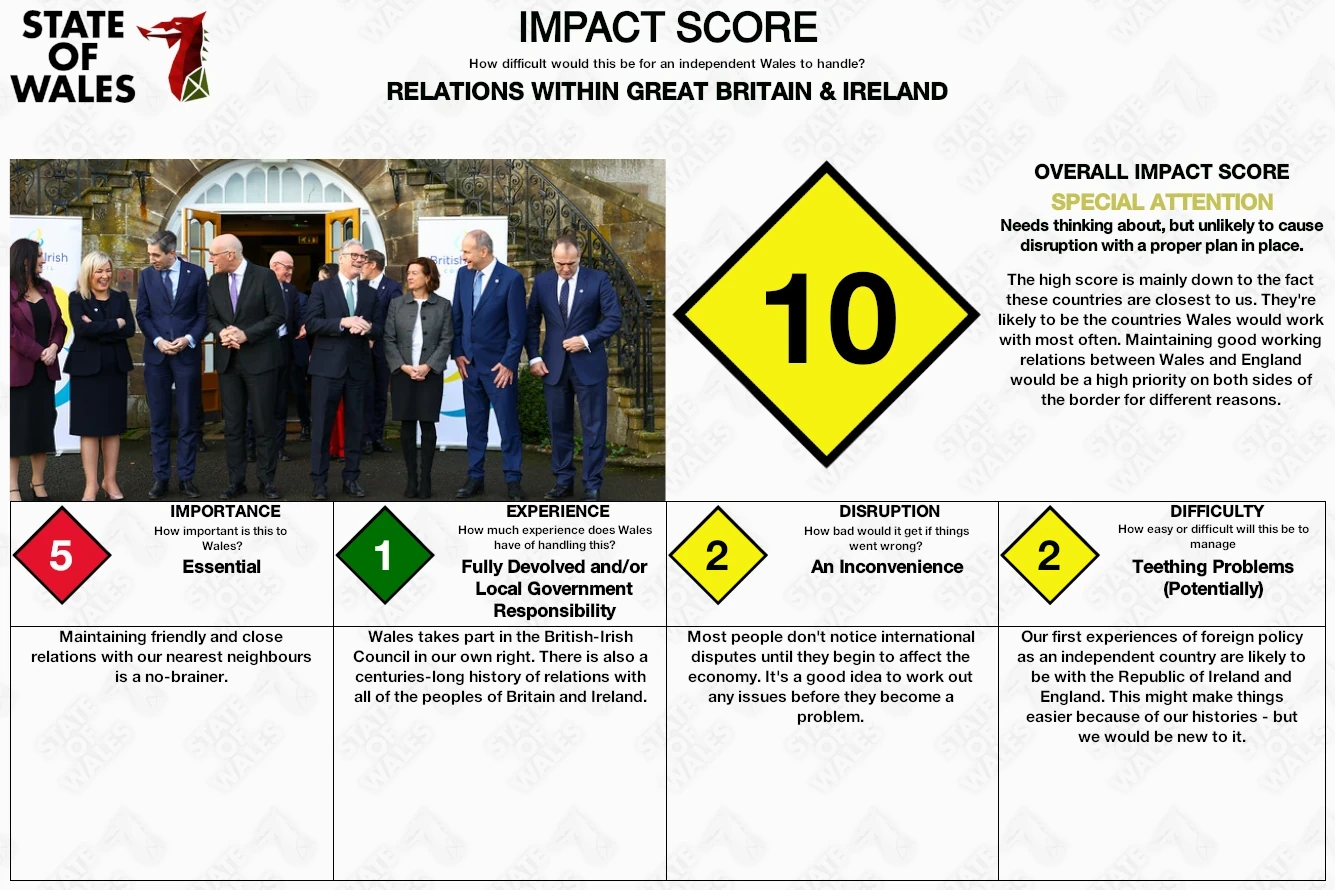
The overall score (out of 20) is the total of the scores for the four mini-categories (out of 5 each).

How Would This Be Run?

The default option would be for Wales to continue to take part in an unchanged British-Irish Council (as is).

Soft Confederation
Benelux Model
British Free Trade Area
Soft Confederation
  • There would be a “Commission” made up of at least one appointee from each of the member states. This would act as a “government” similar to the EU Commission.
  • Laws for the union would be made by its own parliament, with a set number of members elected from Wales.
  • There would be a court to handle disputes and interpret any laws passed by the parliament.
Benelux Model
  • A British-Irish Council of Ministers would propose binding decisions.
  • The role of the British-Irish Parliamentary Assembly would be expanded, possibly giving them the power to veto or change decisions made by the Council of Ministers.
British Free Trade Area
  • Decisions would be made on a “one-member, one-vote” basis at meetings between government ministers (“Council of Ministers” or alike)
  • A court would be set up to deal with disputes.

How Much Will This Cost?

Headline: There are big differences depending on the chosen option.

British-Irish Council (as is)
Soft Confederation
Benelux Model
British Free Trade Area
British-Irish Council (as is)

The British-Irish Council’s Secretariat cost just under £122,000 to run in 20232, a Welsh contribution would work out at around £16,000. There would be a cost to hosting summits too.

Soft Confederation

Based on the EU, a financial contribution based on a proportion of GDP (£hundreds of millions).

Benelux Model

Funding raised from member states as and when required.

British Free Trade Area

A contribution from member states to cover running costs.

If a British Free Trade Area had an annual operating budget of (for argument’s sake) £100 million, a Welsh contribution based on its share of the population within the free trade area would be around £5 million a year.

Would any new taxes need to be introduced?

No, though a “confederation” would likely have the power to set certain taxes like VAT.

Who will pay for this?

General government funding (all taxpayers).

How Long Would This Take?

British-Irish Council as is
Soft Confederation
Benelux Model
British Free Trade Area
British-Irish Council as is

No specific timeframe; an independent Wales would need to sign the Good Friday Agreement.

Soft Confederation

This would need negotiation and a treaty. This might take a full parliamentary term (4-5 years) and possibly a referendum.

Benelux Model

“Strand 3” of the Good Friday Agreement3 would need to be renegotiated; an agreement could be quick depending on what’s on the table. Maybe one or two summits (6 months to a year).

British Free Trade Area

Based on free trade agreements the UK has signed since Brexit4, anything up to 18 months. This may be quicker given the number of standards and institutions shared between the countries of Great Britain.

People & Work

Who does this impact?

Any agreement would affect everyone living in the (present-day) UK, Ireland and the Crown Dependencies: around 76 million people.

Would any jobs be created or lost?

It would be tied to setting up a Welsh “foreign office/department” but no specific jobs would be created or lost.

You Might Also Like....

Would an independent Wales share security intelligence with other countries?
Defence

Would an independent Wales share security intelligence with other countries?

by Owen Donovan
January 19, 2026
0

...

Read moreDetails
What would Welsh independence mean for defence and national security in the rest of Britain?

What would Welsh independence mean for defence and national security in the rest of Britain?

September 29, 2025
Would people from Wales serving in the British military have to join a Welsh armed forces?

Would people from Wales serving in the British military have to join a Welsh armed forces?

September 29, 2025
What military threats does Wales need defending from?

What military threats does Wales need defending from?

September 29, 2025
Would an independent Wales join the Commonwealth?

Would an independent Wales join the Commonwealth?

July 29, 2025
The Commonwealth

The Commonwealth

July 26, 2025
Our Global Twins: Which independent countries are like Wales?

Our Global Twins: Which independent countries are like Wales?

May 17, 2025
The British-Irish Council

The British-Irish Council

May 17, 2025
Load More
    1. Glyndwr Cennydd Jones (2022), A League-Union of the Isles.

    2. British-Irish Council, “Annual Report 2023-24” (p12).

    3. The Belfast Agreement: An Agreement Reached at the Multi-Party Talks on Northern Ireland (April 1998). “Strand Three: British-Irish Council”

    4. UK House of Commons Research Library (16th December 2024). “Progress on UK free trade negotiations” (p3-5).

Use of AI

No AI tools were used to draft this post.

Donations Welcome
Tags: Baltic AssemblyBeneluxBorder ControlsBritish-Irish CouncilChannel IslandsCommon Travel AreaEnglandFP 101Free MovementInternational OrganisationsIrelandIsle of ManNordic CouncilNorthern IrelandPolitical HistoryScotlandThe Good Friday AgreementTrade
Previous Post

Our Global Twins: Which independent countries are like Wales?

Next Post

What role would an independent Wales have with the Crown Dependencies & Overseas Territories?

Owen Donovan

Owen Donovan

Archive

Categories

Copyright

Creative Commons Licence

State of Wales by Owen Donovan is licensed under a Creative Commons Attribution-NonCommercial-NoDerivatives 4.0 International License.

Subscribe by Email

Search

No Result
View All Result
No Result
View All Result
  • Go To Senedd Home
  • Go To Oggy Bloggy Ogwr
  • About & Contact
    • About State of Wales
    • Comments Policy
    • Complaints Policy
    • Contact & Subscribe by Email
    • Disclaimer
  • Features
    • After the UK
    • Chinny Reckon
    • Devil’s Advocate
    • How Wales Works
    • Road to Brexit
  • The Independence Index
    • The Independence Index (full)
    • Economics & Money
      • Business & Economy
      • Currency
      • Tax & Spending
      • Transport & Infrastructure
    • Society
      • Communities & Housing
      • Culture & Sport
      • Education
      • Health
      • Media & Communications
      • Science & Technology
    • The State
      • Environment & Natural Resources
      • Justice
      • Local Government
  • Elections Centre
  • Wales FAQ
    • How is Wales funded?
    • How are laws in Wales made?
  • Support & Donate