Senedd Home
Oggy Bloggy Ogwr
State of Wales
Tuesday, August 11, 2026
  • About & Contact
    • About State of Wales
    • Comments Policy
    • Complaints Policy
    • Contact
    • Disclaimer
  • Elections Centre
  • The Independence Index
    • The Independence Index (Full)
    • Foreign Policy
      • Relations with the former UK & Ireland
      • Relations with Europe
      • Foreign Policy (General)
      • International Organisations & Law
      • Overseas Aid
    • Defence
      • Defence Policy
      • NATO
      • Armed Forces
      • National Security
      • Civil Defence
    • Rules & Regulations
      • Safety & Standards
      • Intellectual Property
    • Economics & Money
      • Business & Economy
      • Currency
      • Tax & Spending
      • Transport & Infrastructure
    • Society
      • Communities & Housing
      • Culture & Sport
      • Education
      • Health
      • Media & Communications
      • Science & Technology
    • The State
      • Environment & Natural Resources
      • Justice
      • Local Government
  • Support & Donate
No Result
View All Result
  • About & Contact
    • About State of Wales
    • Comments Policy
    • Complaints Policy
    • Contact
    • Disclaimer
  • Elections Centre
  • The Independence Index
    • The Independence Index (Full)
    • Foreign Policy
      • Relations with the former UK & Ireland
      • Relations with Europe
      • Foreign Policy (General)
      • International Organisations & Law
      • Overseas Aid
    • Defence
      • Defence Policy
      • NATO
      • Armed Forces
      • National Security
      • Civil Defence
    • Rules & Regulations
      • Safety & Standards
      • Intellectual Property
    • Economics & Money
      • Business & Economy
      • Currency
      • Tax & Spending
      • Transport & Infrastructure
    • Society
      • Communities & Housing
      • Culture & Sport
      • Education
      • Health
      • Media & Communications
      • Science & Technology
    • The State
      • Environment & Natural Resources
      • Justice
      • Local Government
  • Support & Donate
No Result
View All Result
State of Wales
No Result
View All Result
Home Foreign Policy

What would happen if an independent Wales joins the EU, but England remained outside the EU?

Owen Donovan by Owen Donovan
May 20, 2025
in Foreign Policy, Relations with Europe
What would happen if an independent Wales joins the EU, but England remained outside the EU?

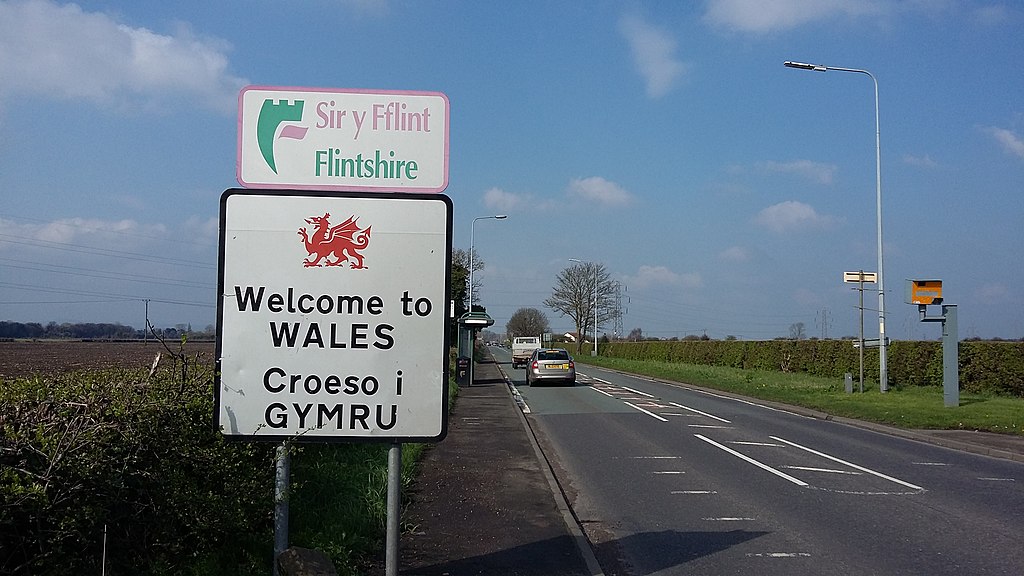
Llywelyn2000 under Creative Commons Licence BY-SA-4.0

Share on FacebookShare on TwitterShare on RedditShare on BlueskyShare by email

Image Source: Llywelyn2000 under Creative Commons Licence BY-SA-4.0

This site is best viewed in landscape mode on smartphones.
Support IndyWales? Support State of Wales!

Donations keep this site going. If you like what I’m doing here and think this work is important to the independence movement, consider a donation. One-off or monthly; as little or as much as you want. Click the links below, or full details are available here.

What Happens Now?

Wales and England are both part of the same nation state (the UK).

Wales and England are both outside the EU following the 2016 referendum and completion of the Brexit process.

As two countries within the UK they are both party to the Trade and Cooperation Agreement between the EU and UK.

Does This Work for Wales?

It’s a question as to whether Wales wants EU membership or not (and all that comes with that).

Recent polling has suggested a majority of people in Wales would support Welsh independence if it meant rejoining the EU1 – but that means this situation could play out: Wales in the EU; England sticking with Brexit.

There’s a chance – however remote – that the UK will rejoin the EU or Single Market before Wales becomes independent anyway, meaning this scenario won’t happen (or won’t happen in the same way).

It could also go the other way: an independent England rejoining the EU and Wales staying out or choosing a different option like EFTA membership.

Wales in the EU; England outside the EU: Pros & Cons

Pros of Independence
Cons of Independence
Pros of Independence

The Common Travel Area would maintain free movement of people between Wales & England as well as certain cross-border rights. There wouldn’t be any passport checks or alike at the Wales-England border because of this.

There would be no customs checks on goods moved between Wales and the rest of the EU (most importantly of all, Ireland).

Wales would become a party to the EU’s free trade deals.

Wales would have more say at EU level than we did when the UK was an EU member state. This would include electing more MEPs, appointing a Welsh EU Commissioner and a Welsh seat at the top decision-making tables (European Council).

Wales would have the benefits of EU membership, including a possible return of EU economic development funding, full access to things like Erasmus+ and the European Investment Bank.

Wales would be well positioned to act as a “bridge” for trade between the EU (particularly Ireland) and England, which may make Wales an attractive place to set up a branch factory or office. It may put more soft pressure on an independent England to rejoin the EU in its own right, which would solve a lot of the potential problems.

Cons of Independence

The Common Travel Area addresses a lot of cross-border concerns when it comes to people and accessing public services but it doesn’t cover everything (i.e. movement of animals/livestock). It’s not a free trade agreement either.

Would the EU fully trust us given Wales voted for Brexit and (rightly or wrongly) our historic close ties with England?

Keeping the pound as a currency. As far as I’m aware, in this scenario it would be the first time an EU member state shares a currency with a non-EU member. This may push Wales towards having our own currency or joining the euro (which raises many issues by itself).

Wales does more trade with the rest of the UK (£26.2 billion worth of imports and exports in 2019-202) than we do with the EU (£18.4 billion in 2023-243). If Wales joined the EU and England stayed out, it would mean a custom checks and declarations on goods moved between Wales and England.

Wales would have to share powers with the EU in certain policy areas and write EU directives into our laws. Laws between Wales and England would become more different more quickly.

Wales would have to open our territorial waters to the EU fishing fleet, which could be unpopular with the Welsh fleet.

England would have a different trading relationship with the rest of the world, so they might have lower tarrifs with certain countries or none at all. Wales would have to apply EU trade rules, including any rules for trade with England (currently the Trade & Cooperation Agreement).

What Do Other Countries Do?

The only example we can point to (and it’s a perfect example of how this might play out) is Ireland – a country that was formerly part of the UK, became independent, and is now in the EU while the UK (and Northern Ireland) are outside the EU. Ireland also switched from its own currency, pegged to the pound, to using the euro. It’s also part of the Common Travel Area.

There are special arrangements in place regarding Ireland and Northern Ireland as part of the Trade & Co-operation Agreement. This includes customs checks on certain good moving between Great Britain and the island of Ireland, as well as Northern Ireland needing to apply some EU rules.

While there has always been a cultural and political movement for Irish independence, it took decades for it to pay off economically. Ireland now has a far stronger economy than Wales, in part because they could make economic decisions to suit their own needs and strengths. Wales would not be able to repeat this “Celtic Tiger” phenomenon in the same way because it relied heavily on foreign investment (particularly tech companies) and low corporation taxes.

What Options Does Wales Have?

There are no options, as such. If Wales joins the EU and England remains outside then what happens will depend entirely on England-EU relations. Wales would have a say in those relations (and may be able to argue for the best possible outcome for ourselves), but so would the rest of the EU’s member states.

Scotland – if independent and in the EU at the same time – would be in the same boat too.

The Common Travel Area is separate from the EU so is unlikely to be affected. The British-Irish Council is also likely to still exist in some form.

What's at Stake?

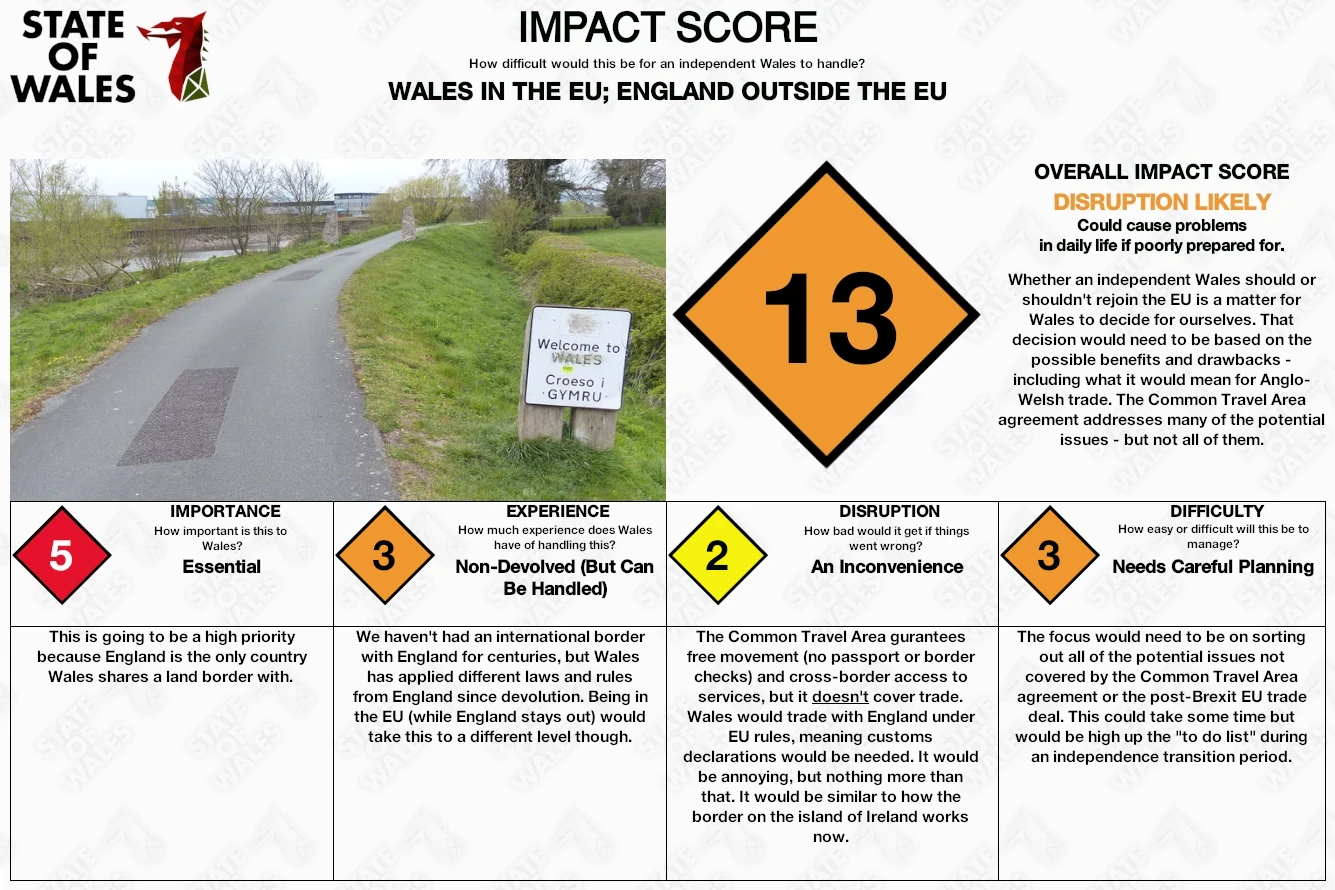
The overall score (out of 20) is the total of the scores for the four mini-categories (out of 5 each).

How Would This Be Run?

Wales-England International Relations
British-Irish Council modelled on Benelux
Trade & Cooperation Agreement Joint Committee
Wales-England International Relations
  • Formal and informal discussions between ministers.
  • “Soft Power”; culture, art, sport, cross-border study and healthcare, tourism, shared institutions (i.e. possibly the BBC).
  • If Wales retains the monarchy as head of state, then we would be in a personal union as a Commonwealth Realm (similar to New Zealand, Canada, Australia etc.).
British-Irish Council modelled on Benelux
  • A British-Irish Council of Ministers would proposing binding decisions.
  • The role of the British-Irish Parliamentary Assembly would be expanded, possibly giving them the power to veto or change and decisions made by the Council of Ministers.
Trade & Cooperation Agreement Joint Committee
  • This would be the successor to the UK-EU Joint Committee set up as part of the Trade & Cooperation Agreement.
  • In this scenario, Wales would be represented on the EU side on matters relating to the Brexit agreement.

How Much Will This Cost?

Headline: Up to £851 million per year (EU membership costs), but potentially cost neutral if we get back as much from EU programmes as we pay in.

Wales would make a yearly contribution to the EU’s budget.

This would be based on customs duties (on imports from outside the EU), a share of VAT and set figure based on the size of the economy. In 2014, Wales’ contribution to the EU budget was estimated to be £625 million5 (before the UK’s then rebate). At 2025 prices that would be around £851 million.

Wales would, however, receive some of this money back through farm payments, economic development funding and funding from other EU programmes. This figure may match what we pay in.

Would any new taxes need to be introduced?

No, but we would have to set VAT rates to match those of the EU.

Who will pay for this?

Based on how the EU budget is paid for: importers, anyone buying anyting with added VAT and general taxpayer funding.

How Long Would This Take?

Wales-England International Relations
British-Irish Council modelled on Benelux
Trade & Cooperation Agreement Joint Committee
Wales-England International Relations

Would happen from day one.

British-Irish Council modelled on Benelux

“Strand 3” of the Good Friday Agreement4 would need to be renegotiated; an agreement could be quick depending on what’s on the table. Maybe one or two summits (6 months to a year).

Trade & Cooperation Agreement Joint Committee

It would need the agreement of England (as the UK’s successor state) and probably approval by all of the EU’s member states as well as the EU Commission and EU Parliament. This could be done during the 18-24 month transition period of independence so it’s in place on day one.

People & Work

Who does this impact?

Mainly businesses that do a lot of cross-border trade.

It shouldn’t affect cross-border commuters as long as the Common Travel Area is still in place.

Would any jobs be created or lost?

There would need to be customs officials to inspect goods traded between Wales and England. These would likely be relocated from the Irish sea ports, so it’s unlikely that any extra posts would be created.

Elsewhere, it depends on the performance of the economy. Free movement would make it easier for Welsh citizens to find work in other EU member states. It may also make Wales more attractive for investment from EU companies.

There would be a some official jobs created for Welsh representatives at EU institutions (i.e. support staff for Welsh MEPs, Welsh EU administrators in Wales and Brussels, EU courts).

You Might Also Like....

EU Referendum: The Results
Elections Centre

EU Referendum: The Results

by Owen Donovan
June 24, 2016
0

...

Read moreDetails
Council of Europe

Council of Europe

July 26, 2025
How would Wales join the EU as an independent country?

How would Wales join the EU as an independent country?

May 20, 2025
Could an independent Wales join the Single Market but stay outside of the EU?

Could an independent Wales join the Single Market but stay outside of the EU?

May 20, 2025
Could an independent Wales stay outside of the EU and Single Market?

Could an independent Wales stay outside of the EU and Single Market?

May 20, 2025
Our Global Twins: Which independent countries are like Wales?

Our Global Twins: Which independent countries are like Wales?

May 17, 2025
Brexit

Brexit

May 17, 2025
Would keeping the pound after independence make it harder for Wales to join the EU?

Would an independent Wales be forced to use the euro if we joined the EU?

May 17, 2025
Would keeping the pound after independence make it harder for Wales to join the EU?

Would keeping the pound after independence make it harder for Wales to join the EU?

May 17, 2025
Load More
  1. Martin Shipton, Nation.Cymru (4th April 2025). “Majority would back independence for Wales if it meant we could rejoin the EU, says poll”. Cites Redfield & Winton poll of 1,000 Welsh adults, suggesting 51% support for independence (with don’t knows removed).

  2. Office of National Statistics (10th February 2025).” Interregional trade in goods and services, UK: 2019 and 2020.”

  3. Welsh Government (12th September 2024). “Welsh international goods trade: June 2023 to June 2024“.

  4. The Belfast Agreement: An Agreement Reached at the Multi-Party Talks on Northern Ireland (April 1998). “Strand Three: British-Irish Council”.

  5. G Ifan, RW Jones, EG Poole (May 2016). “Estimating Wales’s Net Contribution to the European Union” (p 6-7).

Use of AI

No AI tools were used to draft this post.

Donations Welcome
Tags: BeneluxBorder ControlsBrexitCommon Travel AreaEnglandEuropean CommissionEuropean Single MarketEuropean UnionFP 204International OrganisationsIrelandTradeTreaties
Previous Post

How would Wales join the EU as an independent country?

Next Post

The Public Services Ombudsman

Owen Donovan

Owen Donovan

Archive

Categories

Copyright

Creative Commons Licence

State of Wales by Owen Donovan is licensed under a Creative Commons Attribution-NonCommercial-NoDerivatives 4.0 International License.

Subscribe by Email

Search

No Result
View All Result
No Result
View All Result
  • Go To Senedd Home
  • Go To Oggy Bloggy Ogwr
  • About & Contact
    • About State of Wales
    • Comments Policy
    • Complaints Policy
    • Contact & Subscribe by Email
    • Disclaimer
  • Features
    • After the UK
    • Chinny Reckon
    • Devil’s Advocate
    • How Wales Works
    • Road to Brexit
  • The Independence Index
    • The Independence Index (full)
    • Economics & Money
      • Business & Economy
      • Currency
      • Tax & Spending
      • Transport & Infrastructure
    • Society
      • Communities & Housing
      • Culture & Sport
      • Education
      • Health
      • Media & Communications
      • Science & Technology
    • The State
      • Environment & Natural Resources
      • Justice
      • Local Government
  • Elections Centre
  • Wales FAQ
    • How is Wales funded?
    • How are laws in Wales made?
  • Support & Donate