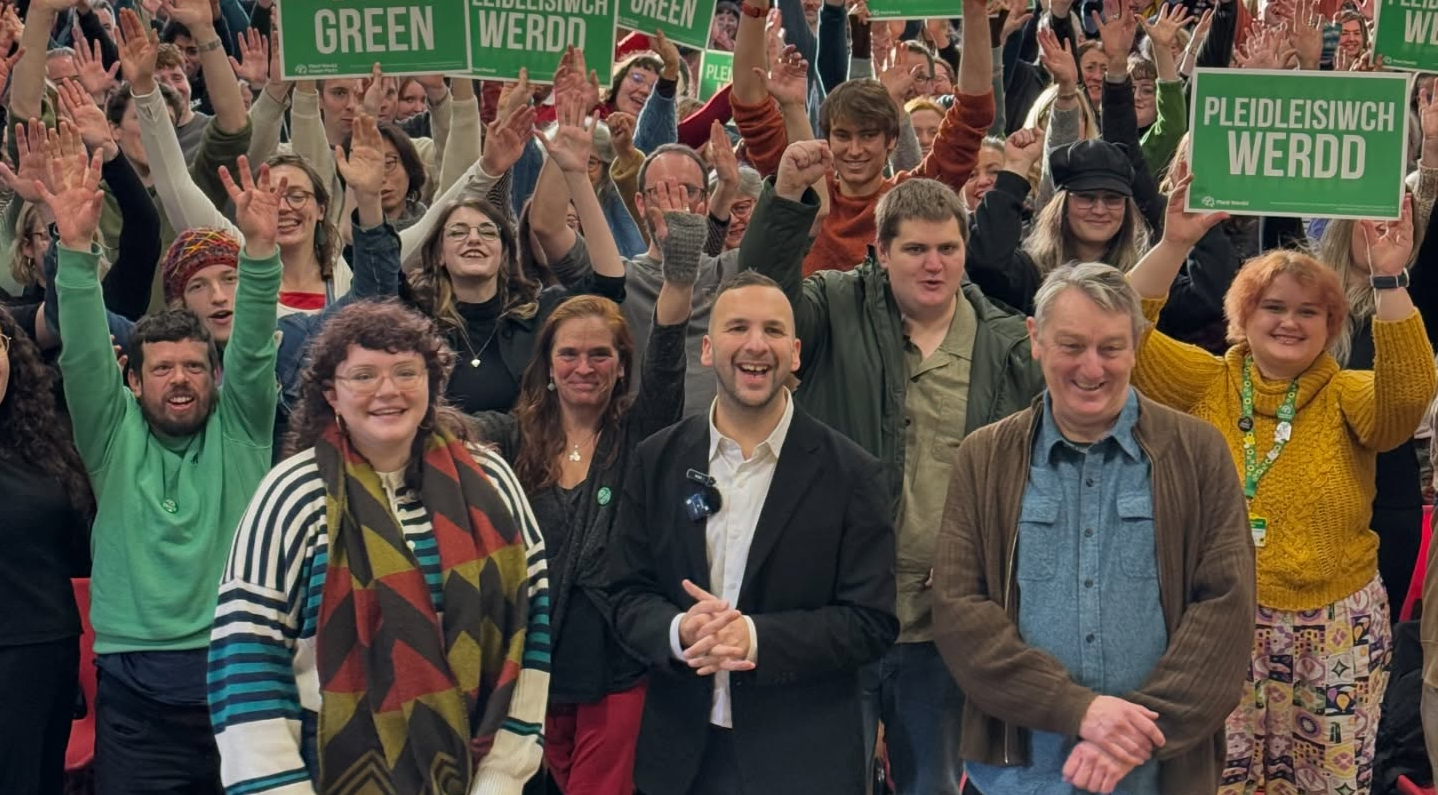
Image Source: Wales Green Party via Facebook
Historic Performances
Vote Share, Senedd Elections
The Greens didn’t stand any constituency candidates at the 2003 and 2007 Senedd elections.
Seats Won, Senedd Elections
Note: The Greens have never won a Senedd seat.
1999
2011
2003
2016
2007
2021
Independents
Independent politicians have a long history of influence in local government, but have had little impact at Senedd elections to date.
The Senedd has only ever had three elected Independent MSs, all elected by first-past-the-post in constituencies. Two defected from Labour (John Marek, Peter Law) and the third (Trish Law) stood under the banner of a local independent group (Blaenau Gwent People’s Voice).
There were some stand-out performances by Independents at the 2021 Senedd election, particularly in the constituencies of Islwyn (19.9%), Blaenau Gwent (11.4%) and Bridgend (10.8%). Until the voting system changes to something like STV, that feels like a “last hurrah”.
The change to a list-based electoral system now makes it very, very unlikely – but not impossible – that an Independent could be elected to the Senedd. To stand any chance of getting elected, they would need to secure 10-15%+ of the vote across a much bigger area. More often than not, Independents are focused on smaller local areas of support (i.e. a town or a few council wards in a county) making the task a lot more difficult.
Minor Parties
A full summary of the policy positions of the “other” parties is coming up soon.
Several minor parties have had a presence in the Senedd, largely because of defections or suspensions from the main parties. During the Fifth Senedd, there were MSs from Propel and Abolish the Assembly. Meanwhile, UKIP spin-off Reform UK (then called the Brexit Party), was itself a minor party at the time.
Perhaps the only candidate from a minor party who stands any realistic hope of getting elected is Propel‘s Neil McEvoy in Caerdydd Penarth. Even then, it’s going to be an uphill struggle. While he has a personal vote in western Cardiff, it’s hard to picture voters in places like Penarth, Radyr and Sully voting for him in great numbers. He could very well impact the final results (without winning a seat) if he can secure a significant share of the vote (4-5%).
The centre-right nationalist party Gwlad – which has one elected county councillor in Wales (Ceredigion) – has put up six candidates. If they’re going to perform well anywhere, it’s likely to be the constituencies in the south-west where they have something approaching a base of support (Ceredigion Penfro and Sir Gaerfyrddin).
Abolish the Assembly‘s flame has seemingly burned out, with a lot of their former big personalities – if you can call them that (Mark Reckless, Paul Ashton, Lee Canning) – now hitching their wagon to Reform. They don’t intend to stand to “avoid splitting the anti-devolution vote”. Read into that however you want. Oh dear, what a pity, never mind.
At the time of posting this, other minor parties with confirmed candidates include: the Heritage Party (an anti-devolution UKIP splinter party), the Welsh Communist Party , the Trade Union & Socialist Coalition (TUSC), Socialist Labour Party, SDP, Open Party, Christian Party and Monster Raving Loony Party.
The Lib Dem vote still holds up fairly well in central and western Wales. They also still have decent numbers of councillors in Cardiff and Swansea. If they can match the recovery the party has seen in England, there’s no reason why they couldn’t win a handful of seats.
The Greens have been polling consistently well for several months. Most polls have them down to win at least 2 seats. If they can boost their share of the vote to similar levels as recently seen in England, they might win a few more than that.
The Greens are perhaps best placed to secure votes from disillusioned voters from Labour’s left who can’t stomach voting for Plaid Cymru.
Neil McEvoy (Propel) has a large personal vote and a higher profile than some of the other candidates in the Caerdydd Penarth constituency.
Former Labour MP, Beth Winter (Independent candidate in Pontypridd Cynon Merthyr), has a relatively high profile too. The Independent candidate in the Blaenau Gwent Caerffili Rhymni constituency (Mike Whatley), polled well in the Blaenau Gwent constituency in 2021.
There are no signs of an English-style revival of the Lib Dems in Wales as things stand. It’s debateable whether their only sitting MS, Jane Dodds, has performed particularly well compared to her predecessors.
All of the smaller parties will have a problem getting their message through. Zack Polanski has partially addressed this as “EnglandandWales” Green leader, gaining a much higher media profile as a result. There’s a risk that, a bit like Farage and Reform, his higher profile will completely overshadow the party in Wales as they are.
The Greens and Plaid Cymru tread very similar ground, both politically and ideologically, with Plaid Cymru having long been in a much stronger position with a stronger “brand” and history of electoral success. It’s hard to see how the Greens avoid being crowded out, even with the new voting system.
All of the parties listed here, except the Lib Dems, have only ever won seats in local elections (if that).
As noted, all smaller parties and Independent candidates will get squeezed by the new voting system. Realistically, only the Lib Dems and Greens are likely to hit the kind of vote share needed to win seats, and only in a few constituencies.
Current Polling & Targets
Polling since the 2021 Senedd Election
Polls undertaken by YouGov, More in Common, Beaufort Research, Redfield & Wilson, Survation, Welsh Election Study & Find Out Now. Sample sizes range from 400 to 2,565. Polling data from before September 2024 is for the Regional List only; polling since 2024 is under the reformed electoral system (Senedd Members & Elections Act 2024).
Target Seats
What should Lib Dems, Greens, and Others' expectations be going into this election?
Lib Dems – Keep what they have. Yes, it’s a far cry from the days of them punching above their weight in the Senedd and working their way into positions of authority, but it’s better than nothing.
Greens – Make the long-expected Senedd breakthrough. Their leader in Wales, Anthony Slaughter, will be the top priority in Caerdydd Penarth. That said, it doesn’t matter where they win a seat/seats; it just needs to happen.
Others – Get on the scoreboard. A statistically-significant share of the vote in any constituency (5%+) would be a big achievement and could impact the result as a whole.
What would be a good result?
Lib Dems – Winning anything up to 3-4 seats. Winning enough seats to become an official Senedd group again (5 MSs) would be an outstanding result, all things considered.
Greens – The expected 2 seats in the new Cardiff constituencies and maybe one or two more elsewhere. Much like the Lib Dems, anything above 5 seats (official group status) would be excellent. Some polls have suggested they could win up to 10 seats, but that seems like wishful thinking – or a late surge, who knows?
Others – Winning any seat anywhere. As noted, perhaps the only realistic outside chance of this happening is Neil McEvoy (Propel) in Caerdydd Penarth and possibly Beth Winter (Independent) in Pontypridd Cynon Merthyr. I doubt either of the two sitting Independent MSs standing for re-election (Rhys ab Owen and Russell George) have enough of a personal vote to secure a seat.
What would be a poor result?
Lib Dems – Losing their only MS, completing the Lib Dems’ descent into irrelevance in Wales.
Greens – Not winning a seat. Given the expectations, that would count as a shock result.
Others – The good news is that nobody is expecting anything of them, so it doesn’t matter if they perform or not. If the high-profile “non/small party” candidates didn’t retain their deposits, there’s the potential for some short-term political embarrassment.