Senedd Home
Oggy Bloggy Ogwr
State of Wales
Monday, August 17, 2026
  • About & Contact
    • About State of Wales
    • Comments Policy
    • Complaints Policy
    • Contact
    • Disclaimer
  • Elections Centre
  • The Independence Index
    • The Independence Index (Full)
    • Foreign Policy
      • Relations with the former UK & Ireland
      • Relations with Europe
      • Foreign Policy (General)
      • International Organisations & Law
      • Overseas Aid
    • Defence
      • Defence Policy
      • NATO
      • Armed Forces
      • National Security
      • Civil Defence
    • Rules & Regulations
      • Safety & Standards
      • Intellectual Property
    • Economics & Money
      • Business & Economy
      • Currency
      • Tax & Spending
      • Transport & Infrastructure
    • Society
      • Communities & Housing
      • Culture & Sport
      • Education
      • Health
      • Media & Communications
      • Science & Technology
    • The State
      • Environment & Natural Resources
      • Justice
      • Local Government
  • Support & Donate
No Result
View All Result
  • About & Contact
    • About State of Wales
    • Comments Policy
    • Complaints Policy
    • Contact
    • Disclaimer
  • Elections Centre
  • The Independence Index
    • The Independence Index (Full)
    • Foreign Policy
      • Relations with the former UK & Ireland
      • Relations with Europe
      • Foreign Policy (General)
      • International Organisations & Law
      • Overseas Aid
    • Defence
      • Defence Policy
      • NATO
      • Armed Forces
      • National Security
      • Civil Defence
    • Rules & Regulations
      • Safety & Standards
      • Intellectual Property
    • Economics & Money
      • Business & Economy
      • Currency
      • Tax & Spending
      • Transport & Infrastructure
    • Society
      • Communities & Housing
      • Culture & Sport
      • Education
      • Health
      • Media & Communications
      • Science & Technology
    • The State
      • Environment & Natural Resources
      • Justice
      • Local Government
  • Support & Donate
No Result
View All Result
State of Wales
No Result
View All Result
Home Defence

What would a Welsh military be expected to do?

Marching up and down the square?

Owen Donovan by Owen Donovan
September 30, 2025
in Defence, Defence Policy
What would a Welsh military be expected to do?

UK Government, Crown Copyright

Share on FacebookShare on TwitterShare on RedditShare on BlueskyShare by email

Image Source: UK Government, Crown Copyright

This site is best viewed in landscape mode on smartphones.
Support IndyWales? Support State of Wales!

Donations keep this site going. If you like what I’m doing here and think this work is important to the independence movement, consider a donation. One-off or monthly; as little or as much as you want. Click the links below, or full details are available here.

What Happens Now?

Defence isn’t devolved. Defence policy is decided and set by the UK Government. As the UK is also a NATO member state, certain aspects of defence policy and strategy are decided at the NATO level.

Political responsibility for defence lies with the UK’s Secretary of State for Defence, who heads the UK’s Ministry of Defence (MoD).

As of 20251, the five core and enabling roles for the UK armed forces are:

  • To defend, protect, and enhance the resilience of the UK, its Overseas Territories, This includes protecting the UK itself from attack as part of NATO obligations2.
  • Deter and defend the Euro-Atlantic region (again as part of NATO), underpinned by nuclear weapons.
  • Support the UK’s global interests – particularly in the Middle East and Indo-Pacific regions (though the Euro-Atlantic region is the priority – to counter “growing links between Russia, China, Iran and North Korea”.
  • Support innovation and defence industries.
  • Maintain an “active presence across the four nations of the Union” to help build national resilience and civil preparedness (presumably this includes things like military aid to civil authorities) and “recruit and retain a workforce that represents the whole of British society”.

The Welsh Government doesn’t play any role in defence policy, though the Welsh Government is responsible for fisheries patrols in Welsh territorial waters (which is the responsibility of the navy in some countries, such as Ireland).

Does This Work for Wales?

The UK’s armed forces are more than capable of carrying out their role as long as they are properly resourced. This indirectly benefits Wales.

In practice, this isn’t a defence policy suited to a country of 3.1 million people. I can’t think of any strategic Welsh interest in, or benefit from, “countering China in the Indo-Pacific” or getting heavily involved in the Middle East.

Even the bit about maintaining a presence across the Union doesn’t quite ring true when it comes to Wales.

Only 1.7% of the British Army is based in Wales (set to increase at some point to 2.4%)3. I’m not sure if that figure includes reservists or not. The only significant air force base is RAF Valley (the RAF’s fast jet training facility), and Wales has no naval bases or stations of note.

There’s a bit more success in terms of the defence sector, with several major sites operated in Wales by major defence contractors and procurement spending in 2021-22 worth £744 million. This is said to support up to 5,400 jobs in the wider supply chain. However, the amount spent on military procurement per head in Wales (£240) was significantly lower than the UK average (£310) at the time.

Military Role & Independence: Pros & Cons

There are no pros and cons as such. Setting a role/”mission statement” for the military or military doctrine is an administrative task and would be closely tied to Wales’ defence and foreign policy more generally.

What Do Other Countries Do?

Ireland
Iceland
Finland
Switzerland
New Zealand
Ireland

In summary, the official role of the Irish Defence Forces is4:

  • To defend Ireland against armed aggression, based on the security and defence environment (i.e. current military threats).
  • Provide aid to the civil power and civil authorities (such as the police).
  • Take part in multinational peacekeeping and humanitarian relief missions under UN mandates.
  • Maritime security and fisheries protection.
  • Ceremonial duties (guards of honour, salutes, state funerals).
Iceland

Iceland doesn’t have a conventional military, though the Icelandic Coast Guard (officially a law enforcement agency) performs some of the roles expected of a military. These include5:

  • Fisheries patrols and maritime security/law enforcement (Iceland won three “Cod Wars” against the UK during the 1970s in a dispute over fishing rights).
  • Search and rescue (on land and at sea).
  • Operating military bases (mainly used by NATO air forces) and radar stations in Iceland.
  • Bomb disposal.
  • Maritime surveying.
Finland

The Finnish Defence Forces have five legally binding tasks6:

  • Military defence of Finland’s land, water and airspace to ensure territorial integrity, provide safe living conditions for the population and to lead military training.
  • Taking part in NATO’s collective defence.
  • Providing support to national authorities.
  • Participating in international aid missions.
  • Participating in international crisis management.
Switzerland


The Swiss Constitution7 states that:

“The armed forces serve to prevent war and to maintain peace; they defend the country and its population. They shall support the civilian authorities in safeguarding the country against serious threats to internal security and in dealing with exceptional situations. Further duties may be provided for by law.”

New Zealand

New Zealand law8 states that armed forces can be raised and maintained for (in summary):

  • The defence of New Zealand and any area New Zealand is responsible for (i.e. dependent territories).
  • Protection of the interests of New Zealand globally.
  • Contributing to forces under collective security agreements, treaties or arrangements, including to the United Nations.
  • Providing military assistance to the civil power.
  • “Provision of any public service”, subject to further provisions in law9.
What Options Does Wales Have?

Most “mission statements” for the militaries of Western democracies are similar to each other. In the case of an independent Wales, it’s likely to boil down to:

  • Defending Wales from armed or covert attack on land, sea, air or electronically and maintaining Welsh territorial integrity.
  • Fulfilling obligations towards security pacts or military alliances Wales is a part of, including missions under UN mandates and marine protection duties. This would include NATO if an independent Wales joined the alliance.
  • Providing military assistance to civil authorities under civil defence and national security arrangements (i.e. emergency management, search and rescue, bomb disposal, counter-terrorism).
  • Performing ceremonial duties as and when required.

What's at Stake?

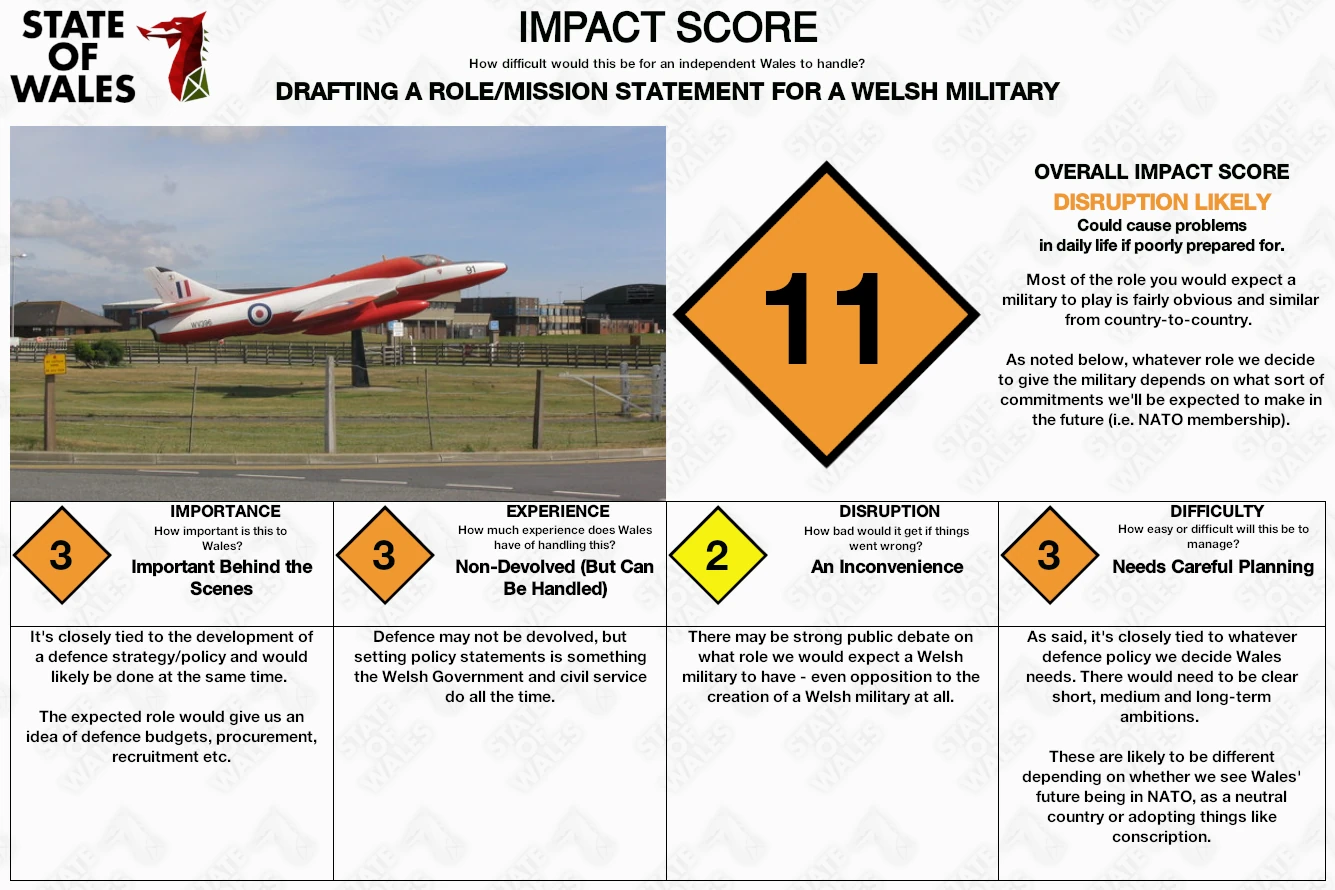
The overall score (out of 20) is the total of the scores for the four mini-categories (out of 5 each).

How Would This Be Run?

There are a few options for this (which will be looked at separately).


How Much Will This Cost?

Headline: No direct costs, though the expected role of the Welsh military would help decide how much Wales would spend on defence each year.

There could be further indirect costs. For example, if a Welsh military had an expanded role in civil defence or aiding civil authorities (i.e. activating reserve units during extreme weather), that would need to be budgeted for.

Would any new taxes need to be introduced?

No.

Who will pay for this?

General taxation (all taxpayers).

How Long Would This Take?

This would likely be one of the first things done during early work to establish a Welsh military (or something similar).


People & Work

Who does this impact?

Setting core goals for the military is unlikely to affect anyone other than the military itself.

Would any jobs be created or lost?

In terms of setting a mission statement/set of core goals, there are no direct job implications.

Indirectly, it would help determine things like the defence budget and the size and structure of a Welsh armed forces.

You Might Also Like....

What civil emergencies would an independent Wales need to prepare for?
I+ Defence

What civil emergencies would an independent Wales need to prepare for?

by Owen Donovan
January 19, 2026
0

...

Read moreDetails
What are the options for an independent Wales’ military?

What are the options for an independent Wales’ military?

November 26, 2025
How would an independent Wales join NATO (if we wanted to)?

How would an independent Wales join NATO (if we wanted to)?

October 27, 2025
NATO

NATO

October 26, 2025
If an independent Wales joined the EU, what would that mean for Welsh defence policy?

What would an independent Wales’ defence budget and equivalent of the MoD be?

September 30, 2025
What would Wales’ defence policy be?

What would Wales’ defence policy be?

September 30, 2025
How and when would a Welsh armed forces be deployed?

How and when would a Welsh armed forces be deployed?

September 29, 2025
What would Welsh independence mean for defence and national security in the rest of Britain?

What would Welsh independence mean for defence and national security in the rest of Britain?

September 29, 2025
Would people from Wales serving in the British military have to join a Welsh armed forces?

Would people from Wales serving in the British military have to join a Welsh armed forces?

September 29, 2025
What military threats does Wales need defending from?

What military threats does Wales need defending from?

September 29, 2025
Load More
    1. UK Government, Ministry of Defence (2nd June 2025). “Strategic Defence Review 2025” (p39-41).

    2. North Atlantic Treaty (1949), Article 3.

    3. UK Ministry of Defence (2023-24), “Written Evidence submitted to (unspecified) Committee”.

    4. Irish Defence Forces. “What we do”.

    5. Icelandic Coast Guard. “Our Services (English language version)”.

    6. Finnish Defence Forces. “Finland’s Defence (English language version)”.

    7. Federal Constitution of the Swiss Confederation, Article 58, Section 2.

    8. Defence Act 1990, Part 1, Section 5

    9. Defence Act 1990, Part 1, Section 9

Use of AI

No AI tools were used to draft this post.

Donations Welcome
Tags: Airspace & Aviation SecurityCivil DefenceDF 102Employment & SkillsFinlandGibraltar & British Overseas TerritoriesIcelandIrelandMaritime PolicyMilitaryNATONew ZealandPublic SectorSwitzerlandUK GovernmentWMDs
Previous Post

What would Wales’ defence policy be?

Next Post

What would an independent Wales’ defence budget and equivalent of the MoD be?

Owen Donovan

Owen Donovan

Archive

Categories

Copyright

Creative Commons Licence

State of Wales by Owen Donovan is licensed under a Creative Commons Attribution-NonCommercial-NoDerivatives 4.0 International License.

Subscribe by Email

Search

No Result
View All Result
No Result
View All Result
  • Go To Senedd Home
  • Go To Oggy Bloggy Ogwr
  • About & Contact
    • About State of Wales
    • Comments Policy
    • Complaints Policy
    • Contact & Subscribe by Email
    • Disclaimer
  • Features
    • After the UK
    • Chinny Reckon
    • Devil’s Advocate
    • How Wales Works
    • Road to Brexit
  • The Independence Index
    • The Independence Index (full)
    • Economics & Money
      • Business & Economy
      • Currency
      • Tax & Spending
      • Transport & Infrastructure
    • Society
      • Communities & Housing
      • Culture & Sport
      • Education
      • Health
      • Media & Communications
      • Science & Technology
    • The State
      • Environment & Natural Resources
      • Justice
      • Local Government
  • Elections Centre
  • Wales FAQ
    • How is Wales funded?
    • How are laws in Wales made?
  • Support & Donate