Senedd Home
Oggy Bloggy Ogwr
State of Wales
Sunday, August 16, 2026
  • About & Contact
    • About State of Wales
    • Comments Policy
    • Complaints Policy
    • Contact
    • Disclaimer
  • Elections Centre
  • The Independence Index
    • The Independence Index (Full)
    • Foreign Policy
      • Relations with the former UK & Ireland
      • Relations with Europe
      • Foreign Policy (General)
      • International Organisations & Law
      • Overseas Aid
    • Defence
      • Defence Policy
      • NATO
      • Armed Forces
      • National Security
      • Civil Defence
    • Rules & Regulations
      • Safety & Standards
      • Intellectual Property
    • Economics & Money
      • Business & Economy
      • Currency
      • Tax & Spending
      • Transport & Infrastructure
    • Society
      • Communities & Housing
      • Culture & Sport
      • Education
      • Health
      • Media & Communications
      • Science & Technology
    • The State
      • Environment & Natural Resources
      • Justice
      • Local Government
  • Support & Donate
No Result
View All Result
  • About & Contact
    • About State of Wales
    • Comments Policy
    • Complaints Policy
    • Contact
    • Disclaimer
  • Elections Centre
  • The Independence Index
    • The Independence Index (Full)
    • Foreign Policy
      • Relations with the former UK & Ireland
      • Relations with Europe
      • Foreign Policy (General)
      • International Organisations & Law
      • Overseas Aid
    • Defence
      • Defence Policy
      • NATO
      • Armed Forces
      • National Security
      • Civil Defence
    • Rules & Regulations
      • Safety & Standards
      • Intellectual Property
    • Economics & Money
      • Business & Economy
      • Currency
      • Tax & Spending
      • Transport & Infrastructure
    • Society
      • Communities & Housing
      • Culture & Sport
      • Education
      • Health
      • Media & Communications
      • Science & Technology
    • The State
      • Environment & Natural Resources
      • Justice
      • Local Government
  • Support & Donate
No Result
View All Result
State of Wales
No Result
View All Result
Home Foreign Policy

What would a Welsh foreign policy look like after independence?

Owen Donovan by Owen Donovan
June 30, 2025
in Foreign Policy, Foreign Policy (General)
What would a Welsh foreign policy look like after independence?
Share on FacebookShare on TwitterShare on RedditShare on BlueskyShare by email

Image Source: Senedd Cymru, Senedd Commission Copyright

This site is best viewed in landscape mode on smartphones.
Support IndyWales? Support State of Wales!

Donations keep this site going. If you like what I’m doing here and think this work is important to the independence movement, consider a donation. One-off or monthly; as little or as much as you want. Click the links below, or full details are available here.

What Happens Now?

Foreign policy isn’t devolved. Wales doesn’t have any formal diplomatic relations with other countries.

Foreign policy is decided and set by the UK Government. Political responsibility lies with the UK’s Foreign Secretary – considered one of the four “Great Offices of State” – who heads the UK’s Foreign, Commonwealth & Development Office (FCDO).

As foreign affairs and defence are closely tied, there’s close working between the UK’s Foreign Office, Ministry of Defence and the UK’s intelligence services.

A ten-year strategy1 sets out the UK’s foreign policy and defence priorities until 2030. It includes (amongst other things):

  • A commitment to working with other countries (multilateralism).
  • Support for human rights and free trade; also making better use of sanctions where needed.
  • A vision for the UK becoming a “soft power superpower“.
  • Building international ties in science and technology.

Although foreign policy is non-devolved, the Welsh Government takes part in what could be considered “international relations”.

This is guided by the Welsh Government’s International Strategy, which is set to be renewed/refreshed after the 2026 Senedd election. Its main focus is on raising Wales’ profile abroad and boosting trade and investment.

Does This Work for Wales?

In some ways, it does. In some ways, it doesn’t.

The area that works best for Wales (and Welsh citizens) – and we would want to match to a similar level after independence – are practical things like consular support. The UK’s overseas network is extensive meaning there are very few parts of the world where you can’t get FCDO support when you need it.

The UK also has a lot of soft power and “brand recognition” which Wales indirectly benefits from. The British Council tends to lead the way there and has worked to deliver some elements of the Welsh Government’s international strategy.

Where Wales is let down – and why independence is a must – is that we’re voiceless.

No matter how often MSs and other sections of Welsh civic society want to have their say on foreign policy, it doesn’t carry any weight. It doesn’t influence anything. It’s easy for the UK Government to brush aside our views and our interests – as we’ve seen with Brexit and post-Brexit trade agreements.

Also, if the UK doesn’t stick to its foreign policy ideals, it reflects badly on Wales because they’re making those decisions on our behalf.

Drafting a Welsh Foreign Policy: Pros & Cons

Pros of Independence
Cons of Independence
Pros of Independence

Wales would have international recognition as a nation-state meaning we can start to look outward instead of navel-gazing about devolution.

We can set our own foreign policy priorities based on our interests and goals. We won’t have those priorities decided for us anymore.

Wales would have a seat at the top tables of major international organisations like the UN. This means Wales can take part in international decision-making in a way we can’t now.

We can deepen ties with specific countries (bilateralism), which would be important when finding friends and allies and developing a foreign aid policy.

We would be able to do a lot more in terms of attracting investment and building up international ties with full diplomatic relations with other countries. We wouldn’t be limited in what we can or can’t do (or offer).

When Welsh politicians and civic society organisations condemn or praise another country’s actions it will matter and will be noted.

A Welsh diplomatic service (or equivalent) would create lucrative posts abroad that wouldn’t normally be available to people living in Wales.

Cons of Independence

Wales would no longer benefit from the UK’s reach and international “clout” – both in soft and hard power terms. We would be on our own (for the most part).

We would lose access to the UK’s consular network; we would have to start from scratch.

Some nation-states with internal independence movements might be reluctant to recognise Wales diplomatically (i.e. Spain, Belgium, Denmark).

While independence would mean Wales having a seat at the top table of major international organisations, there’s no guarantee this would raise Wales’ international profile. That could take time.

It can take years, even decades, to build up the local contacts and connections for diplomacy and trade.

If Wales makes a serious foreign policy blunder/gaffe it would have real-world consequences. We could certainly make friends abroad, but we could make a few enemies too.

As much as we would pay closer attention to the behaviour of other countries, they would be paying closer attention to us. Embassies in Wales could be used as a station for foreign intelligence officers (known as “diplomatic cover”).

What Do Other Countries Do?

Ireland
New Zealand
Denmark
Iceland
Montenegro
Ireland

  • Has what is described as a “simple mission”2: “to promote and protect the values, interests and economic wellbeing of Ireland and its people”.
  • Ireland has a long-standing policy of neutrality.
  • Working with other countries and international organisations (multilateralism) is important.
  • Plays an active role in peace-keeping and conflict resolution “based on experience”; supports a “two-state” solution to the Israeli-Palestinian conflict and has strongly called for a ceasefire in Gaza.
  • Respect for international law is written into the Irish constitution.
  • Has a five-year strategy to connect with the Irish diaspora.
  • Has aid partnership agreements with 14 countries and regions, mainly in Africa.
New Zealand

  • Has a four-year foreign policy strategy3.
  • The three core foreign policy purposes are security, prosperity and sustainability. Each core purpose is overseen by a partnership with relevant government and independent agencies (called “NZ Inc”).
  • Focus on deepening relationships with the Pacific nations and nations in south-east Asia.
  • Reducing trade barriers/negotiating free trade agreements is a core foreign policy goal.
  • Aid is targeted towards the Pacific Islands.
Denmark


  • Updated their foreign policy and security strategy in 20234.
  • Strong commitment to NATO and providing military support to Ukraine.
  • Support for working with other countries (multilateralism) and human rights.
  • Securing sea navigation rights is an important priority.
  • Sees a need to “think across the board” when it comes to foreign policy and security, and promoting Danish economic strengths. This covers energy, technology, research, food and health.
  • Sees “irregular migration” as a particular security threat that undermines the internal market and free movement within Europe; supports a European asylum system.


Iceland


  • Sees foreign policy5 as a means to support free trade and “sustainable resource exploitation”.
  • Has a focus on the Arctic region and sees itself as playing a key role within the Arctic Council.
  • The Icelandic Parliament (Althingi) officially recognised Palestine as an independent state in 2011 and has supported full UN membership.
  • Doesn’t have a military, but does contribute towards global peacekeeping efforts – mainly by assigning experts to NGOs or civilian agencies.
  • Supports the UN’s Sustainable Development Goals and has international development partnerships with Malawi, Sierra Leone and Uganda.


Montenegro


  • The focus is on developing relations with specific countries (bilateralism) and playing a role in international organisations6.
  • Has a strategy for boosting exports and encouraging foreign investment.
  • Since independence, they have gradually shifted focus from the Russian sphere of influence towards the “The West”.
  • Developing their tourism industry is an important economic and “soft power” goal.
  • Joined NATO in 2017 and is a candidate country for EU membership.
  • Has historically received more foreign aid than they’ve donated – though that’s starting to change7.
 

What Options Does Wales Have?

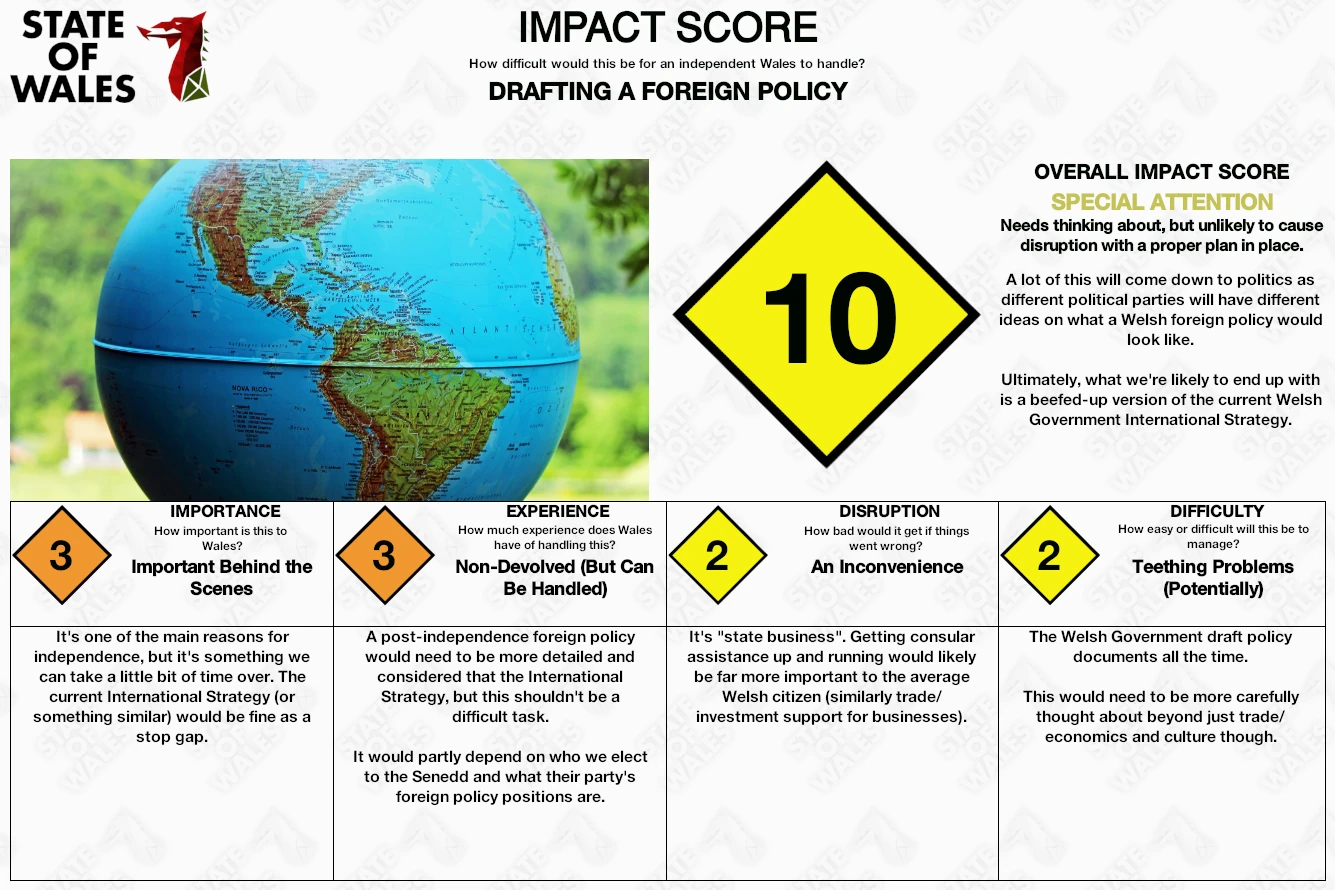
This is a bit of a boring/non-commital answer, but it would genuinely depend on who we elect to run Wales after independence.

It’s not as if you can set a foreign policy when different political parties have different ideas on what needs to be included.

The things that a Welsh Government would need to consider when drafting a foreign policy include:

  • The Welsh national interest: Which relationships with which countries and international organisations matter the most to us and what do we want or need from those relationships?
  • Our foreign policy philosophy: Do we see Wales as being part of a rules-based order which respects international law, or more realist/practical (or something else entirely)?
  • How do we want to be seen by the rest of the world and how does the rest of the world see us?
  • Where do we need embassies and consulates?
  • What is a Welsh position on major global issues? For example, does Wales support a two-state solution to the Israeli-Palestinian conflict (the UK doesn’t formally recognise Palestine)?
  • What foreign policy priorities are “fixed” (stay the same for multiple years or decades) or “reactive” (can change at short notice or only last for a year or two)?
  • How closely should foreign policy, defence policy and immigration policy be tied together?
  • Do we want an independent Wales to have closer ties to (or even join) the EU and/or NATO?
  • What can we promote to the rest of the world and what can we learn from them?

What's at Stake?

How Would This Be Run?

A Welsh equivalent of the Foreign Office (will be looked at separately). 

How Much Will This Cost?

Headline: Little direct cost but it would set out how much Wales would need to spend on foreign affairs (and defence).

Most of the costs here will be linked to running a diplomatic service, hosting events, foreign aid etc.

The cost of developing a foreign policy itself – as a policy statement – would be however much it costs civil servants and government ministers to draft it in terms of hours worked.

Would any new taxes need to be introduced? 

No, though whether Wales imposes tariffs (import taxes) would depend on what kind of trade deals we would have and whether, for example, we join the European Union.

Who will pay for this?

General taxation (all taxpayers).


How Long Would This Take?

We could start drafting a foreign policy straight away – and we technically already have one (of sorts) with the Welsh Government’s International Strategy.

It wouldn’t come into play properly until other countries open diplomatic relations with us after independence.

Based on the most recent European example – Montenegro8– most European countries and global/regional powers diplomatically recognised them within a month or two of declaring independence in June 2006. This figure reached around half of the world’s nation-states within a year.

In Wales’ case, you would expect the first countries to recognise us to be those in the English-speaking world, the Commonwealth and Western and Northern Europe.


People & Work

Who does this impact?

Everyone resident in Wales – both directly (international travellers and export/import businesses) and indirectly (foreign investment/job creation, friendly and unfriendly countries, our reputation abroad).

Would any jobs be created or lost?

None, other than the civil servants given the task of drafting a foreign policy.

You Might Also Like....
What would be an independent Wales’ national security policy?
Defence

What would be an independent Wales’ national security policy?

by Owen Donovan
January 19, 2026
0

...

Read moreDetails
What would Wales’ defence policy be?

What would Wales’ defence policy be?

September 30, 2025
Devolution & Overseas Aid

Devolution & Overseas Aid

September 1, 2025
Would an independent Wales join the Commonwealth?

Would an independent Wales join the Commonwealth?

July 29, 2025
Would Wales cope being outside of the G7 & G20?

Would Wales cope being outside of the G7 & G20?

July 29, 2025
Would an independent Wales have a seat on the UN Security Council?

Would an independent Wales have a seat on the UN Security Council?

July 29, 2025
Hard Power & Soft Power

Hard Power & Soft Power

June 29, 2025
What ideas shape a country’s foreign policy?

What ideas shape a country’s foreign policy?

June 29, 2025
The Welsh Government’s International Strategy

The Welsh Government’s International Strategy

June 29, 2025
What would happen if an independent Wales joins the EU, but England remained outside the EU?

What would happen if an independent Wales joins the EU, but England remained outside the EU?

May 20, 2025
How would Wales join the EU as an independent country?

How would Wales join the EU as an independent country?

May 20, 2025
Could an independent Wales join the Single Market but stay outside of the EU?

Could an independent Wales join the Single Market but stay outside of the EU?

May 20, 2025
Could an independent Wales stay outside of the EU and Single Market?

Could an independent Wales stay outside of the EU and Single Market?

May 20, 2025
How might the old UK countries work together after independence?

How might the old UK countries work together after independence?

May 19, 2025
Our Global Twins: Which independent countries are like Wales?

Our Global Twins: Which independent countries are like Wales?

May 17, 2025
Load More
  1. UK Government (March 2021). “Global Britain in a competitive age”.

  2. Irish Government, Department of Foreign Affairs & Trade. “Role and policies”.

  3. New Zealand Government, Department for Foreign Affairs & Trade. “Strategic intentions 2024-2028”.

  4. Ministry of Foreign Affairs of Denmark (2023). “Foreign & Security Policy Strategy”.

  5. Government of Iceland, Ministry for Foreign Affairs. “Topics of Foreign Affairs”.

  6. Government of Montenegro, Ministry of Foreign Affairs.

  7. United Nations Development Programme. “Montenegro, Official Development Assistance and Humanitarian Aid Sending”.

  8. Government of Montenegro (Archive, 2012). “Dates of Recognition and Establishment of Diplomatic Relations”.

Use of AI

No AI tools were used to draft this post.

Donations Welcome
Tags: Civil ServiceDenmarkDiplomacyEuropean UnionFP 301IcelandIrelandMontenegroNew ZealandPolitical TheorySeneddTradeWelsh Government
Previous Post

Hard Power & Soft Power

Next Post

What would a Welsh foreign office look like?

Owen Donovan

Owen Donovan

Archive

Categories

Copyright

Creative Commons Licence

State of Wales by Owen Donovan is licensed under a Creative Commons Attribution-NonCommercial-NoDerivatives 4.0 International License.

Subscribe by Email

Search

No Result
View All Result
No Result
View All Result
  • Go To Senedd Home
  • Go To Oggy Bloggy Ogwr
  • About & Contact
    • About State of Wales
    • Comments Policy
    • Complaints Policy
    • Contact & Subscribe by Email
    • Disclaimer
  • Features
    • After the UK
    • Chinny Reckon
    • Devil’s Advocate
    • How Wales Works
    • Road to Brexit
  • The Independence Index
    • The Independence Index (full)
    • Economics & Money
      • Business & Economy
      • Currency
      • Tax & Spending
      • Transport & Infrastructure
    • Society
      • Communities & Housing
      • Culture & Sport
      • Education
      • Health
      • Media & Communications
      • Science & Technology
    • The State
      • Environment & Natural Resources
      • Justice
      • Local Government
  • Elections Centre
  • Wales FAQ
    • How is Wales funded?
    • How are laws in Wales made?
  • Support & Donate