Senedd Home
Oggy Bloggy Ogwr
State of Wales
Sunday, August 16, 2026
  • About & Contact
    • About State of Wales
    • Comments Policy
    • Complaints Policy
    • Contact
    • Disclaimer
  • Elections Centre
  • The Independence Index
    • The Independence Index (Full)
    • Foreign Policy
      • Relations with the former UK & Ireland
      • Relations with Europe
      • Foreign Policy (General)
      • International Organisations & Law
      • Overseas Aid
    • Defence
      • Defence Policy
      • NATO
      • Armed Forces
      • National Security
      • Civil Defence
    • Rules & Regulations
      • Safety & Standards
      • Intellectual Property
    • Economics & Money
      • Business & Economy
      • Currency
      • Tax & Spending
      • Transport & Infrastructure
    • Society
      • Communities & Housing
      • Culture & Sport
      • Education
      • Health
      • Media & Communications
      • Science & Technology
    • The State
      • Environment & Natural Resources
      • Justice
      • Local Government
  • Support & Donate
No Result
View All Result
  • About & Contact
    • About State of Wales
    • Comments Policy
    • Complaints Policy
    • Contact
    • Disclaimer
  • Elections Centre
  • The Independence Index
    • The Independence Index (Full)
    • Foreign Policy
      • Relations with the former UK & Ireland
      • Relations with Europe
      • Foreign Policy (General)
      • International Organisations & Law
      • Overseas Aid
    • Defence
      • Defence Policy
      • NATO
      • Armed Forces
      • National Security
      • Civil Defence
    • Rules & Regulations
      • Safety & Standards
      • Intellectual Property
    • Economics & Money
      • Business & Economy
      • Currency
      • Tax & Spending
      • Transport & Infrastructure
    • Society
      • Communities & Housing
      • Culture & Sport
      • Education
      • Health
      • Media & Communications
      • Science & Technology
    • The State
      • Environment & Natural Resources
      • Justice
      • Local Government
  • Support & Donate
No Result
View All Result
State of Wales
No Result
View All Result
Home Defence

What would be an independent Wales’ national security policy?

Balancing the state keeping people safe, with keeping the people safe from the state.

Owen Donovan by Owen Donovan
January 19, 2026
in Defence, National Security
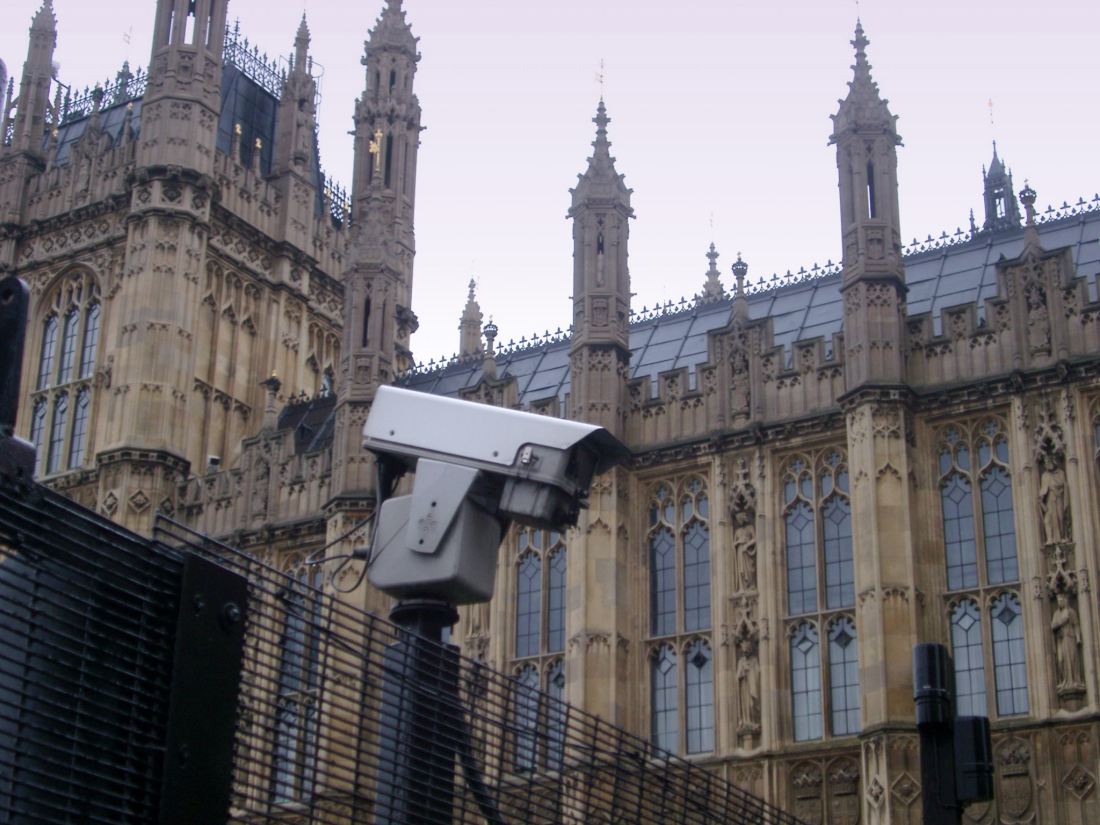
What would be an independent Wales’ national security policy?

photoeverywhere.co.uk under Creative Commons Licence BY-2.5

Share on FacebookShare on TwitterShare on RedditShare on BlueskyShare by email

Image Source: photoeverywhere.co.uk under Creative Commons Licence BY-2.5

This site is best viewed in landscape mode on smartphones.
Support IndyWales? Support State of Wales!

Donations keep this site going. If you like what I’m doing here and think this work is important to the independence movement, consider a donation. One-off or monthly; as little or as much as you want. Click the links below, or full details are available here.

What Happens Now?

National security isn’t devolved.

Political responsibility for national security – which includes things like intelligence gathering and counter-terrorism – is divided between a mix of the UK Ministry of Defence, the UK’s Foreign Office, the UK’s Home Office and a special UK Cabinet committee (National Security Council).

As foreign affairs and defence are closely tied together, there’s close working between the UK’s Foreign Office, Ministry of Defence and the UK’s intelligence services.

The UK’s National Security Strategy – updated in 20251 – is aligned to the UK’s defence policy in many respects. In terms of national security, priority areas include:

  • Investing more money in defence to deter Russian aggression, with a commitment to spend an equivalent of 5% of GDP on defence and national security in line with NATO agreements.
  • Improving border security, including the use of technology to protect undersea infrastructure and increase the number of detections at border points.
  • Make the UK a “harder target” by making it more difficult for foreign countries to influence the UK’s political system, alongside tightening digital security through laws such as the Online Safety Act.
  • Reduce reliance on imported fossil fuels and increase the amount of renewable energy generated locally to improve energy security.
  • Building up the UK’s defence industry and cybersecurity capabilities.

The specific/strategic priorities of the UK’s three main intelligence agencies (MI5, MI6, GCHQ) are not normally made public. Though all three play a key role in identifying and deterring national security threats domestically and internationally.

The Welsh Government has a role in responding to major incidents. However, it has no formal national security role, with even policing and criminal justice not being devolved.

Does This Work for Wales?

The only people who would know one way or another will have signed the Official Secrets Act. For the small number of plots that succeed, there’ll be a certain number that have been stopped or that are being closely monitored.

Recent examples of successes include the arrest and conviction of the former leader of Reform UK in Wales, Nathan Gill, for accepting Russian bribes. Within the last few weeks of 2025, a terror plot targeting Muslims and Jews was foiled in Cardiff.

At the same time, the Cardiff-born 2024 Southport terrorist slipped through the net despite being referred to the Prevent counter-extremism programme whilst at school.

So I’d lean more to “yes” over “no” – but it’s not perfect and probably never will be. You can only stay vigilant.

What Would Be the Pros & Cons of Independence?

Pros of Independence
Cons of Independence
Pros of Independence

The national security strategy would be tailored to our specific requirements. Some national security risks in Wales may be overlooked by UK authorities while having a disproportionate impact here (i.e. foreign influence in domestic policy, industrial security, foreign influence in the economy).

Wales would be able to decide which countries to share intelligence with and on what terms (and vice versa, which could be considered a disadvantage).

Wales would have a seat at the table at major international security conferences (possibly as a NATO or European Union member).

It should be relatively easy to develop a Welsh/national risk register out of existing community risk registers2.

You can argue that Wales is less of a target for foreign interference or terrorism than the major English cities, meaning that we may have to spend less on national security compared to similarly sized countries.

If we were ambitious, Wales could gradually build a “21st century military capability” from the ground up. This could include a heavy emphasis on cyberwarfare, automation and using “big data” to predict or identify major domestic security or defence vulnerabilities and deal with them.

Cons of Independence

The Welsh Government has just as little experience of handling national security as defence and foreign policy. This is doubly impacted by (unlike Scotland and Northern Ireland) having no devolved control over the criminal justice system.

Having an open border with England – through the Common Travel Area – would be strongly supported but also likely present the single biggest national security weakness.

Wales would lose access to/support from the UK’s intelligence community (other than through an intelligence sharing agreement).

Additionally, we would have no national security/intelligence capability from the start (other than the police); this would have to be built up from scratch.

Any failings would likely be amplified because even a single terror attack or breach of national security would have (proportionally) a far greater impact in Wales, as such an incident wouldn’t be expected here. There’s a risk of complacency if we believe Wales isn’t a target ourselves, or cannot be a source of national security risks to other countries.

You can “fight smart” using new and emerging technology all you want, but that presents as many risks as it does opportunities.

What Do Other Countries Do?

Ireland
Denmark
Finland
New Zealand
Ireland

  • Ireland’s key security interests include the protection of undersea infrastructure, cyber security and knowledge sharing3.
  • In practice, internal security and intelligence are led by the national police force (An Garda Síochána).
  • The Garda publishes an annual security plan. The priorities for 2025 include4 targeting organised crime and counter-terrorism, with a particular focus on “lone actors”.
  • There’s an acknowledgement that “hostile state actors” may target Ireland to gain political information and/or use digital threats.
Denmark

  • Updated their foreign policy and security strategy in 20235.
  • Russia is considered the most immediate threat from a foreign state, though the United States’ aggressive rhetoric around annexing Greenland (a constituent country of Denmark) is yet to feature formally.
  • Sees a need to “think across the board” when it comes to foreign policy and security, and promoting Danish economic strengths. This covers energy, technology, research, food and health.
  • Sees “irregular migration” as a particular security threat that undermines the internal market and free movement within Europe; supports a European asylum system.
Finland

  • The Finnish Government has a policy of “comprehensive security” (similar to its policy of “total defence”)6. At its most basic level, this means that individuals are as much responsible for maintaining national security as the society and public authorities.
  • There are several identified strategic tasks, with the strategy outlining which authority is responsible for which task. This covers leadership, foreign policy, defence and internal security.
  • In terms of internal security, priority areas include: maintaining the legal system, safeguarding democracy and trust in elections, crime prevention, border security, maintaining the security of supply chains, and emergency management.
New Zealand
  • New Zealand’s first national security strategy was published in 2023 in response to the Christchurch terrorist attack in 20197.

  • The focus is largely on prevention and promoting community cohesion.
  • Geographically, the Indo-Pacific region is described as being “at the centre of strategic competition” driven mainly by China.
  • Maritime security is a high priority due to New Zealand’s large territorial waters and maritime economic zone.
  • Climate change, social instability, biosecurity and inequality are considered cross-cutting threats that interconnect other national security threats.
What Options Does Wales Have?

Much like defence policy, the national security strategy of an independent Wales would be somewhat flexible, taking into account global politics and the national security priorities of whichever parties are in power in the Senedd.

Some of the things we would need to consider include:

  • How closely should foreign policy, defence/national security policy and immigration policy be tied together?
  • Threat and risk assessment – What immediate national security threats does Wales face, and which ones are longer-term or require specific responses?
  • Intelligence-sharing arrangements – Which countries would we share intelligence with and why?
  • Domestic and international law – This includes the regulation of investigatory powers, the future of the Online Safety Act, legacy laws such as the Official Secrets Act and how the courts deal with cases involving national security.
  • Level of capability – What format would a “Welsh intelligence service” take (if we decide to have a stand-alone agency), and what kind of resources and skilled personnel would existing agencies (such as the police and military) need for intelligence gathering and analysis?
  • Digital sovereignty – How would we keep our data safe from bad-faith foreign actors (including the increasing threat posed by US tech oligarchs)? Should we pursue open source solutions?

What's at Stake?

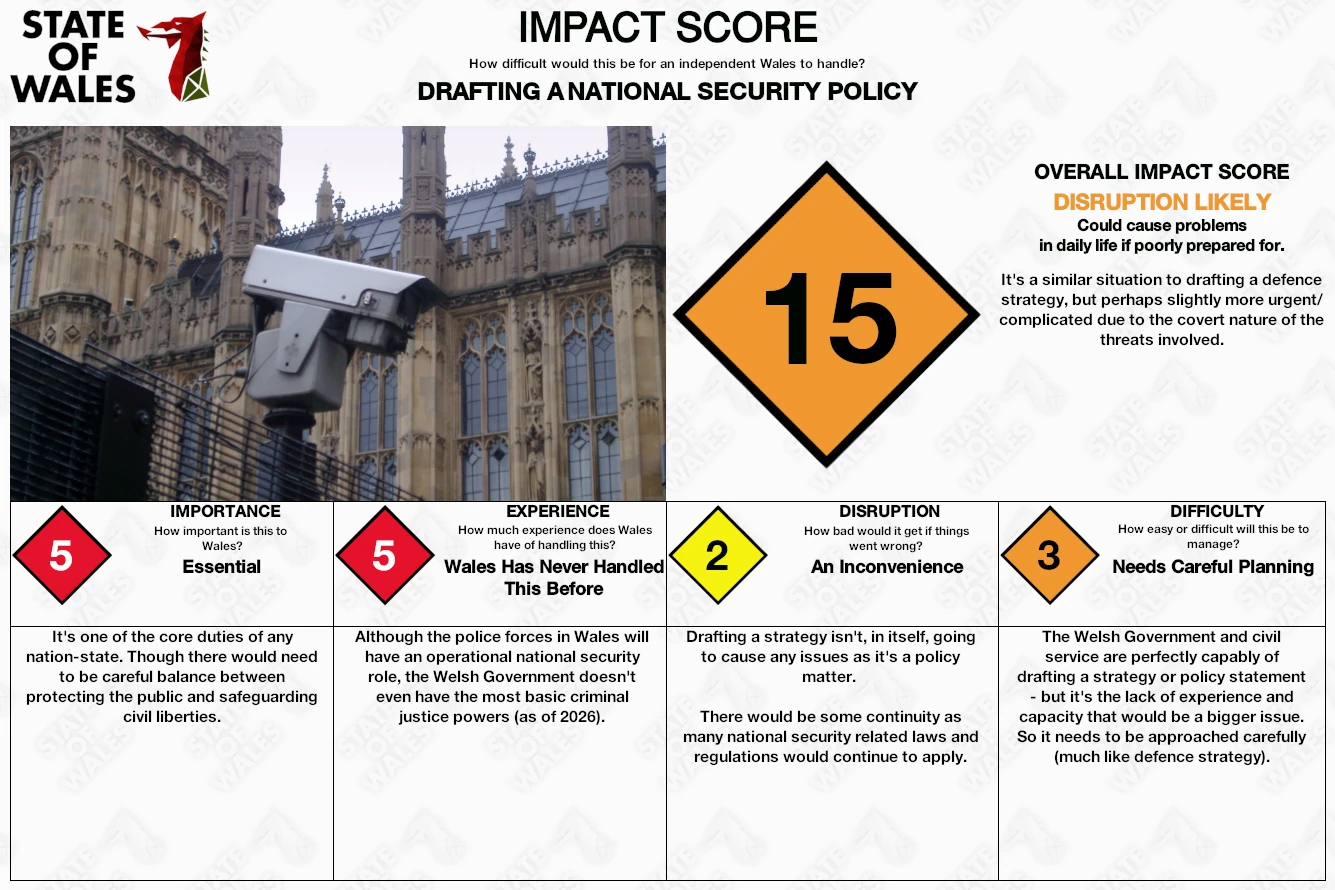
The overall score (out of 20) is the total of the scores for the four mini-categories (out of 5 each).

How Would This Be Run?

National security policy would likely be led jointly by our equivalent of the Home Office and the Ministry of Defence. This will be looked at in more detail separately. 

How Much Will This Cost?

Headline: A national security strategy itself would have few direct costs, but it would help give us an idea of how much Wales would need to spend on national security each year.

The cost of developing a defence policy would be the cost of civil servants and government ministers drafting it based on hours worked – likely in the low tens of thousands of pounds (or equivalent).

Would any new taxes need to be introduced?

No.

Who will pay for this?

General taxation (all taxpayers).

How Long Would This Take?

It would be safe to assume that a national security strategy would be developed alongside (or combined with) a defence strategy.

This would probably be done in separate phases. 

Pre-independence/transition period
Years 1 to 5
Years 5 to 10
Year 10 plus
Pre-independence/transition period

Interim/provisional defence and security policy to ensure Wales has a military capable of basic home defence duties and is secure from civil threats (i.e. terrorism, extremism, organised crime).

Years 1 to 5

A national security strategy identifying short-term, medium-term and long-term threats to Welsh national security (at home and abroad) and what practical steps can be taken to address them.

Years 5 to 10

 Any security/intelligence service (other than the police) should be up and running by this point.

Year 10 plus

Strategic Defence Review every 4-10 years. National Risk Register updated every 2-4 years.

People & Work

Who does this impact?

Technically, all of us. Those most likely to be on the wrong end of this would be political extremists living in Wales, with around 400 referred to the Prevent programme as of 2024-25.

Would any jobs be created or lost?

While a small number of civil service roles would be created to oversee national security policy, the majority of jobs would likely be created within the police and a Welsh intelligence/security service (or equivalent). This will be looked at separately.

You Might Also Like....

Would an independent Wales share security intelligence with other countries?
Defence

Would an independent Wales share security intelligence with other countries?

by Owen Donovan
January 19, 2026
0

...

Read moreDetails
What would be an independent Wales’ policy towards extremism?

What would be an independent Wales’ policy towards extremism?

January 19, 2026
Would an independent Wales have its own security service?

Would an independent Wales have its own security service?

January 19, 2026
Extremism in Wales

Extremism in Wales

January 19, 2026
The Security Services

The Security Services

January 19, 2026
What civil emergencies would an independent Wales need to prepare for?

What civil emergencies would an independent Wales need to prepare for?

January 19, 2026
What could the command structure of a Welsh military look like?

What could the command structure of a Welsh military look like?

November 26, 2025
What are the options for an independent Wales’ military?

What are the options for an independent Wales’ military?

November 26, 2025
What would Wales’ defence policy be?

What would Wales’ defence policy be?

September 30, 2025
What would Welsh independence mean for defence and national security in the rest of Britain?

What would Welsh independence mean for defence and national security in the rest of Britain?

September 29, 2025
Would people from Wales serving in the British military have to join a Welsh armed forces?

Would people from Wales serving in the British military have to join a Welsh armed forces?

September 29, 2025
What military threats does Wales need defending from?

What military threats does Wales need defending from?

September 29, 2025
What makes the military unique?

What makes the military unique?

September 29, 2025
Hard Power & Soft Power

Hard Power & Soft Power

June 29, 2025
Load More
    1. UK Government, Cabinet Office (24th June 2025). “National Security Strategy 2025: Security for the British people in a dangerous world“.

    2. Welsh Government, Local Resilience Forums, Community Risk Registers.

    3. Government of Ireland, Department of Defence & Defence Forces. “Strategy Statement 2025-2028“.

    4. An Garda Síochána. “Annual Security Services Plan 2025“.

    5. Ministry of Foreign Affairs of Denmark (2023). “Foreign & Security Policy Strategy“.

    6. Government of Finland, Security Committee (16th January 2025). “Security Strategy for Society“.

    7. Government of New Zealand (4th August 2023). “Aotearoa’s National Security Strategy: Secure Together Tō Tātou Korowai Manaaki“

Use of AI

No AI tools were used to draft this post.

Donations Welcome
Tags: CybersecurityDenmarkDF 401ExtremismFinlandGlobal SecurityIrelandNational SecurityNew ZealandOrganised CrimePolicing & Law EnforcementRussiaTerrorismUK GovernmentUSA
Previous Post

Extremism in Wales

Next Post

Would an independent Wales have its own security service?

Owen Donovan

Owen Donovan

Archive

Categories

Copyright

Creative Commons Licence

State of Wales by Owen Donovan is licensed under a Creative Commons Attribution-NonCommercial-NoDerivatives 4.0 International License.

Subscribe by Email

Search

No Result
View All Result
No Result
View All Result
  • Go To Senedd Home
  • Go To Oggy Bloggy Ogwr
  • About & Contact
    • About State of Wales
    • Comments Policy
    • Complaints Policy
    • Contact & Subscribe by Email
    • Disclaimer
  • Features
    • After the UK
    • Chinny Reckon
    • Devil’s Advocate
    • How Wales Works
    • Road to Brexit
  • The Independence Index
    • The Independence Index (full)
    • Economics & Money
      • Business & Economy
      • Currency
      • Tax & Spending
      • Transport & Infrastructure
    • Society
      • Communities & Housing
      • Culture & Sport
      • Education
      • Health
      • Media & Communications
      • Science & Technology
    • The State
      • Environment & Natural Resources
      • Justice
      • Local Government
  • Elections Centre
  • Wales FAQ
    • How is Wales funded?
    • How are laws in Wales made?
  • Support & Donate