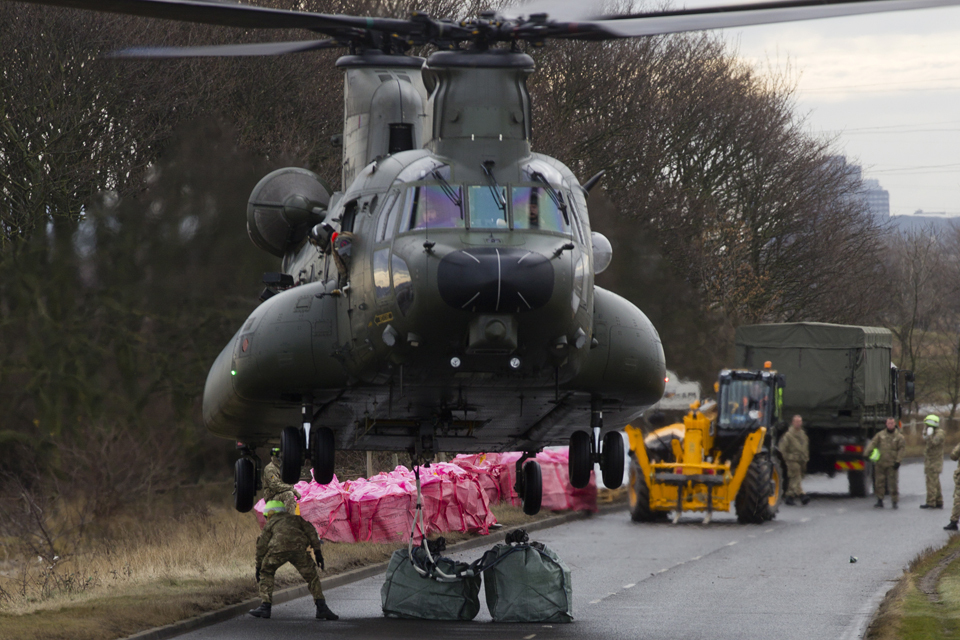
Image Source: Cpl. Jimmy Wise, RAF, Crown copyright
Donations keep this site going. If you like what I’m doing here and think this work is important to the independence movement, consider a donation. One-off or monthly; as little or as much as you want. Click the links below, or full details are available here.
What Happens Now?
Within the UK, the Welsh Government, local government and police can request military assistance if needed. That might be because the military has specialised equipment or training to deal with a situation or emergency that local councils or the emergency services don’t have.
This is called “Military Aid to the Civil Authorities” (MACA). One well-known example would be bomb disposal (undertaken by the Royal Logistics Corps), while military units were deployed as part of the COVID-19 vaccination programme.
While MACA is funded out of the UK’s defence budget, it isn’t provided for free, and the military can claim back costs. Drafting in the military is also considered a last resort in the UK1.
Civil defence doesn’t feature prominently, if at all, in the UK’s current defence strategy. The only reference is in relation to obligations under NATO to provide support to allies during wartime. There are also concerns about the UK’s ability to protect critical infrastructure at home, alongside calls for the creation of a “Home Guard”.
During the (First) Cold War, specialist institutions and policies were put in place to deal with a potential nuclear war. These include the Royal Observer Corps – a largely volunteer uniform service (largely aligned to the Royal Air Force) set up to report on nuclear explosions and fallout. They were stood down and disbanded in the early 1990s.
Does This Work for Wales?
No. Although that’s not only the case for Wales, as since the end of the (First) Cold War, civil defence has been a backseat concern when it comes to the UK’s defence strategy.
The focus has mainly been on power projection and operational support abroad alongside “big ticket hardware” (i.e. aircraft carriers). Although that’s starting to change, given the new threats posed by Russia and others.
The blue light emergency services take the lead in responding to civil emergencies and other major incidents. As things stand, if the UK were ever attacked militarily, as things stand it would likely be the fire service and ambulance service responding to incidents rather than the military or a dedicated civil defence force.
As noted, senior military officers and military academics have put forward the idea of an expanded military reserve, or civilian-led force/”Home Guard” focused on domestic defence and civil defence duties2.
Military Aid to Civil Authorities & Independence: Pros & Cons
The military has access to specialist training, equipment and resources that the blue light emergency services often don’t have.
Specialist quasi-military civil support units, such as the Wales Air Ambulance, can be integrated into the military. This means they would no longer rely on charitable donations or Welsh Government grant support.
The Welsh Government would ultimately decide where and when to deploy the military during a civil emergency. This would arguably be a far quicker process than it currently is in the UK (where there’s a quiet reluctance to use the military this way).
Wales would have the full resources of our own military at its disposal at any given time. UK resources may be spread out. For example, all bomb disposal units are based in England and Northern Ireland.
Civil defence could be fully integrated into military planning and command structures (i.e. a dedicated senior commander responsible for civil defence), when it’s something of an afterthought within the UK.
Wales would have control over immovable military assets in Wales, including training grounds, training operations and military bases.
The current setup – whereby the military only gets involved on request (i.e. search and rescue helicopters) – largely works and probably makes the best use of resources overall.
While the Welsh Government does have a role – and some experience – in civil emergency planning and civil defence, they have very limited experience in defence.
It could be considered hypocritical to (potentially) deploy Welsh military personnel on humanitarian aid/disaster relief missions overseas, but not do the same thing closer to home.
It’s likely that the development of a full Welsh military – capable of deployment overseas, if necessary – may take the best part of a decade. There would need to be an “interim/bare bones” Welsh military to cover the gap. That includes covering MACA duties.
Relying too heavily on the military to step in to civil emergencies may end up turning the military into a glorified emergency service, diverting focus and budgets away from defence duties and training.
There would be a risk of/temptation to use the military as an extra police force (i.e. deploying the military during civil disorder). This has a disastrous history in the UK, particularly in Northern Ireland.
What Do Other Countries Do?
![]()
Providing aid to the civil power and civil authorities (such as the police) is considered one of the core roles of the Irish Defence Forces.
Ireland also has a separate, volunteer-based uniform civil defence force (Civil Defence Ireland), which is considered part of Ireland’s wider defence forces. Units are largely organised at the local authority level.
Their role is to support emergency services and local authorities during civil emergencies, with assistance provided by the military if needed. In 2024, Civil Defence Ireland responded to over 3,000 separate incidents, supported by 2,300 registered volunteers3.
![]()
Supporting public authorities is considered part of the “national/domestic tasks” of the Danish military4.
The specific civil and home defence tasks include bomb disposal, pollution control, extreme weather support, search & rescue, air ambulance services and police support.
The Danish Defence Forces publishes regular bulletins listing civil and home defence incidents.
![]()
Providing support to national authorities is considered a core role of the Finnish Defence Forces.
In practice, civil defence is mainly left to individuals and other public authorities, overseen by Finland’s Interior Ministry. There’s a heavy emphasis on preparedness – to a far greater extent than the majority of countries in Europe – as part of the country’s concept of “Total Defence”.
![]()
The New Zealand defence forces undertake specialised home and civil defence tasks, such as search & rescue, emergency engineering projects and humanitarian assistance.
More generally, civil defence is the responsibility of public authorities. There’s a dedicated National Emergency Management Agency run by New Zealand’s equivalent of the Home Office.
What Options Does Wales Have?
This would be similar to what we have now in the UK. The military would only activate and get involved if the situation is deemed serious enough for a public authority to actively request aid.
Under this option, you would assume that the military would be able to claim back the costs of deployment.
There would be an expectation that the military provides aid during civil emergencies, and military personnel would be trained to provide this and put on active stand-by in the lead-in to a possible major incident (i.e. an Amber or Red weather warning).
Under this option, the military probably would not be able to claim back costs from public authorities for assisting (unlike what happens in the UK).
This is similar to the previous option, except responding to civil emergencies would be led mainly by reservists.
The regular/full-time military could still get involved (i.e. to provide specialist equipment or air support) on request. Under this option, local authorities would have greater control over locally-based reservists. So, for example, a local council could call upon local reservists to support local authority workers during a flood.
This would be similar to Ireland. There would be a separate uniform agency focused entirely on civil defence duties, likely working very closely with the fire service and local authorities.
Units would likely be organised and run based on existing local authority boundaries. Different units may train or specialise in specific tasks based on the expected civil defence requirements in their given area (i.e. mountain rescue for mountainous areas).
A slight twist on the previous option, whereby instead of having a standalone agency with dedicated civil defence volunteers (and some full-time staff), a “Civil Defence Wales” (or alike) would act as an umbrella/coordinating agency for existing voluntary organisations providing civil defence services. For example, the RNLI, Red Cross, and Mountain Rescue.
They would all remain distinct organisations and largely run themselves, but “Civil Defence Wales” could provide centralised backroom services such as training, logistics, procurement, legal services and switchboards and also be the main point of contact for any public bodies seeking assistance.
What's at Stake?
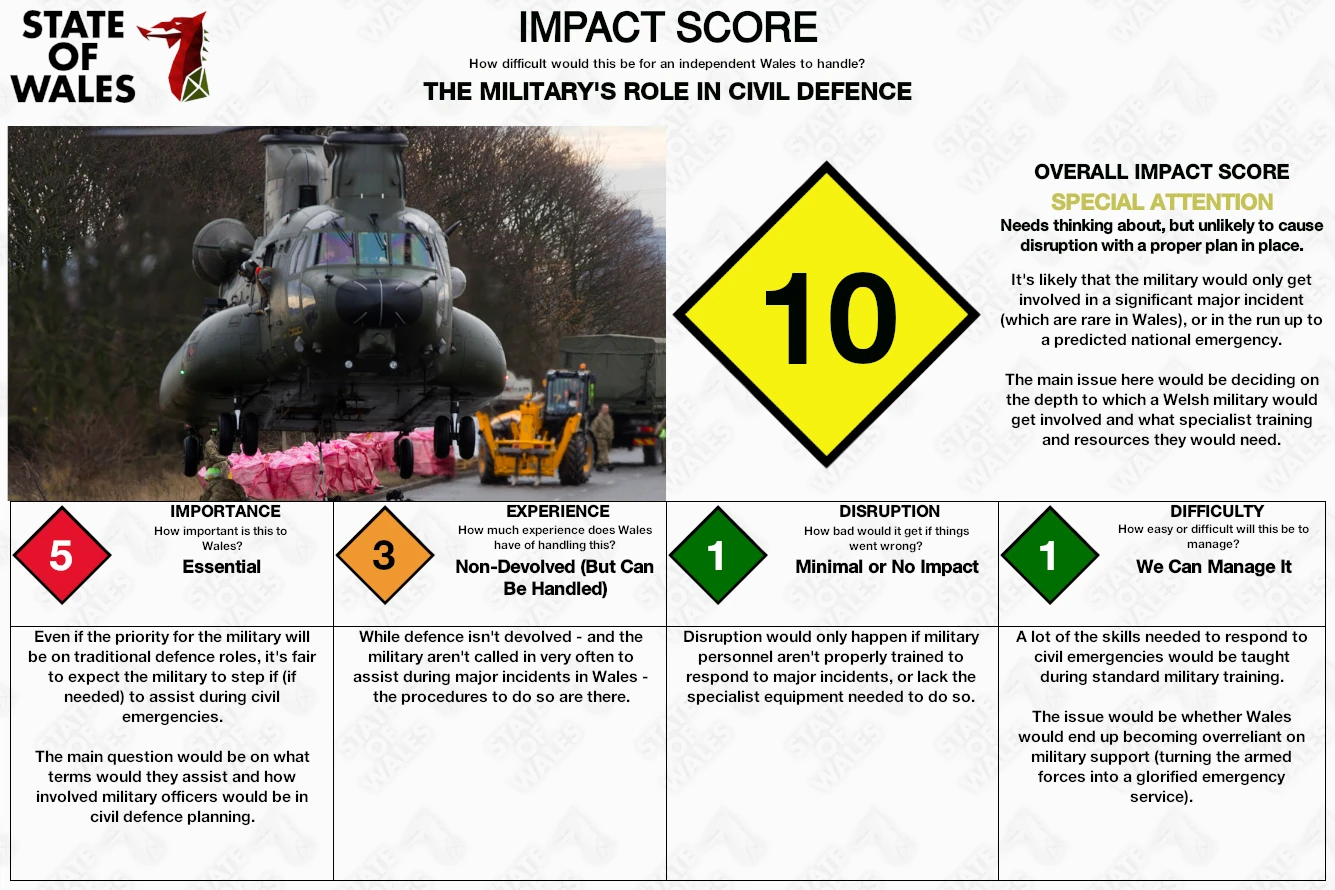
The overall score (out of 20) is the total of the scores for the four mini-categories (out of 5 each).
How Would This Be Run?
Military command structures were looked at separately. The civil/government command structure will also be looked at separately.Â
How Much Will This Cost?
Headline: No direct cost implications. Indirectly, it would vary from incident to incident. Setting up a stand-alone volunteer-led civil defence agency could cost up to £7 million per year based on international examples.
Civil aid to public authorities would likely be a core duty of the Welsh armed forces, so the cost of providing services would come out of the military budget more generally.
The funding for a stand-alone civil defence agency or equivalent would likely be top-sliced from the defence budget. There’s no current breakdown of how much Ireland spends on its Civil Defence agency, but a report from 20195 suggested annual spending of around €7 million, which would be closer to €8 million (£7 million) at 2026 prices.
NATO has set a target for member states to spend at least 1.5% of GDP on national security, including civil defence.
As of 2023 prices, 1.5% of Welsh GDP works out at just under £1.4 billion6. That would include spending on things like policing, the fire service and areas of local government dedicated to emergency planning – so a large chunk of it is already being spent.
Would any new taxes need to be introduced?
No.
Who will pay for this?
General taxation (all taxpayers), though the military could be allowed to recoup costs from public authorities (as is currently the case in the UK).
How Long Would This Take?
The civil defence role for the military would likely be written into a defence and/or national security strategy. So it would be developed alongside the military itself; this was looked at separately.
Setting up a standalone civil defence agency or uniform service would take longer. For want of an example, setting up an agency of the size of Natural Resources Wales (formed by the merger of three separate Welsh Government agencies) took around 18 months7.Â
People & Work
Technically, everyone. Though it would have a particular impact on people living in/businesses operating in areas that face specific risks that would need a civil defence response (i.e. living or working next to a river).
It is unlikely there would be any major job impacts one way or another.
Any civil defence role the military plays would be covered by standard recruitment.
Setting up a stand-alone civil defence agency (similar to Ireland’s) may create a small number of full-time administration, training and operational command positions (maybe no more than 30-40). There may be more posts available for volunteers.
You Might Also Like....
UK House of Commons Library (28th July 2022). “Deploying the armed forces in the UK“.
Royal United Services Institute (12th September 2025). “Lessons for the UK Strategic Defence Review ‘Home Guard‘”
Government of Ireland, Department of Defence (10th December 2025). “Department of Defence and Defence Forces Annual Report 2024” (p52-56).
Danish Defence Forces (Forsvaret). “National tasks of the Defence (translated from Danish)”
Government of Ireland (October 2019). “Spending Review: Civil Defence Expenditure“.
Welsh Government (23rd April 2025). “Regional gross domestic product and gross value added: 1998 to 2023“. 1.5% of £92.8 billion.
BBC News (29th November 2011). “One environment body will save £158m – Welsh government“
No AI tools were used to draft this post.