Senedd Home
Oggy Bloggy Ogwr
State of Wales
Sunday, August 16, 2026
  • About & Contact
    • About State of Wales
    • Comments Policy
    • Complaints Policy
    • Contact
    • Disclaimer
  • Elections Centre
  • The Independence Index
    • The Independence Index (Full)
    • Foreign Policy
      • Relations with the former UK & Ireland
      • Relations with Europe
      • Foreign Policy (General)
      • International Organisations & Law
      • Overseas Aid
    • Defence
      • Defence Policy
      • NATO
      • Armed Forces
      • National Security
      • Civil Defence
    • Rules & Regulations
      • Safety & Standards
      • Intellectual Property
    • Economics & Money
      • Business & Economy
      • Currency
      • Tax & Spending
      • Transport & Infrastructure
    • Society
      • Communities & Housing
      • Culture & Sport
      • Education
      • Health
      • Media & Communications
      • Science & Technology
    • The State
      • Environment & Natural Resources
      • Justice
      • Local Government
  • Support & Donate
No Result
View All Result
  • About & Contact
    • About State of Wales
    • Comments Policy
    • Complaints Policy
    • Contact
    • Disclaimer
  • Elections Centre
  • The Independence Index
    • The Independence Index (Full)
    • Foreign Policy
      • Relations with the former UK & Ireland
      • Relations with Europe
      • Foreign Policy (General)
      • International Organisations & Law
      • Overseas Aid
    • Defence
      • Defence Policy
      • NATO
      • Armed Forces
      • National Security
      • Civil Defence
    • Rules & Regulations
      • Safety & Standards
      • Intellectual Property
    • Economics & Money
      • Business & Economy
      • Currency
      • Tax & Spending
      • Transport & Infrastructure
    • Society
      • Communities & Housing
      • Culture & Sport
      • Education
      • Health
      • Media & Communications
      • Science & Technology
    • The State
      • Environment & Natural Resources
      • Justice
      • Local Government
  • Support & Donate
No Result
View All Result
State of Wales
No Result
View All Result
Home Defence Armed Forces

How would an independent Wales buy new military equipment?

Owen Donovan by Owen Donovan
November 26, 2025
in Armed Forces, Defence
How would an independent Wales buy new military equipment?

Robert Sullivan via Flickr, Public Domain

Share on FacebookShare on TwitterShare on RedditShare on BlueskyShare by email

Image Source: Robert Sullivan via Flickr, Public Domain

This site is best viewed in landscape mode on smartphones.
Support IndyWales? Support State of Wales!

Donations keep this site going. If you like what I’m doing here and think this work is important to the independence movement, consider a donation. One-off or monthly; as little or as much as you want. Click the links below, or full details are available here.

What Happens Now?

Defence is non-devolved and is the responsibility of the UK Government.

The main agency responsible for defence procurement is Defence Equipment & Support (DE&S), headquartered in Bristol. They are an arms-length body of the UK Ministry of Defence.

Separate agencies focus on digital infrastructure, estate management and international logistics (as well as others).

The total value of new contracts placed by the MoD during 2023-24 was £16.2 billion. UK suppliers also exported £14.5 billion worth of equipment and services over the same period1.

Military procurement is subject to special exemptions and clauses in the Procurement Act 2023. This means, in certain circumstances, that the military can purchase services and equipment directly from a single source (without putting a contract out to tender).

NATO sets a target for member states to spend at least 20% of their defence budgets on new equipment. According to NATO figures, the UK spent just under 36% of its defence budget on equipment in 20252, though it’s unclear how much of this spending meets the NATO definition.

Does This Work for Wales?

The defence industry was said to be worth £500 million to the Welsh economy in 2024. However, the Welsh proportion of the defence industry’s contribution to the UK economy as a whole (3.3%) is lower than our population share (around 4.5%)3.

In 2021-22, defence procurement spending in Wales was worth £744 million, supporting up to 5,400 jobs in the wider supply chain. Even then, the amount spent per head in Wales (£240) was lower than the UK average (£310) at the time4.

Looking at Wales alone, you can make an argument that we’re not getting value for money from the proportional £2.84 billion Welsh share of UK defence spending as of 2023-24.

A report published by the Labour party (when in opposition at the UK level) suggested that poor procurement practices by the MoD had led to wasteful spending totalling £13.3 billion across an 11-year period5. Most of this was blamed on overspending (usually due to delays) or contract cancellations.

The Ajax armoured vehicle – manufactured in Wales by US company, General Dynamics – has been held up as one example of a delayed defence procurement project.

A proportional “Welsh share” of this wasteful spending works out at around £600 million (just under £55 million per year).

What Would Independence Mean?

Pros of Independence
Cons of Independence
Pros of Independence

Military procurement is often complicated and spread out across several years. Building up our civil service capacity and experience of handling that level of procurement could improve how we buy new equipment and services elsewhere in the public sector. This could save money in the long run.

We have opportunities to learn lessons from the catalogue of mistakes made by the UK Government/MoD over the last 10-15 years.

Wales’ defence industry is already highly globalised, and we continue to have a fairly strong manufacturing base and track record. 

The Procurement Act 2023 would remain part of Welsh law after independence due to the common law system, so the regulatory/red tape framework would already be in place and largely aligned with England (until we decide to change it, or join the EU).

Even if Wales ends up spending most of its military capital budget with foreign suppliers, we could include contract clauses so that equipment is (at least partially) manufactured locally. This would be similar to the CAF plant at Newport for new trains.

There are emerging types of military equipment – likely to be in high demand – that ought to be straightforward to produce locally, such as smaller drones/UAVs and electronic warfare equipment.

There’s an opportunity to source more services and supplies (i.e. food, accommodation services) locally, leading to greater investment in the Welsh economy.

If Wales joins the EU after independence, we would become a party to the EU’s free trade deals and defence funds. This may make it a bit easier to buy defence equipment from major EU suppliers in Germany, France, Austria and Sweden.

Cons of Independence

There’s a moral argument that Wales should concentrate on spending money on people and services rather than defence. This would be tied to an idea (likely popular among those from the pacifist tradition) of Wales either having no military at all, or some kind of non-militarised “civil force”.

The Welsh Government are very unlikely to have any senior civil servants with experience of buying military equipment and services. This means that early procurement deals after independence are at risk of being handled poorly if we don’t have a clear process in place.

A lot of our defence equipment spending is likely to be outside Wales, as we can’t build everything ourselves (i.e. lack of shipbuilding capability). The irony is that this could boost Scottish and English manufacturing.

Defence procurement is often difficult based on the UK’s troubled track record. We complain about even small amounts of money being “wasted” in Wales, so if we wasted the kind of money the MoD has over the last few decades, it would cause serious political problems. We would need to get procurement right from the very start.

“Big ticket” military equipment is very expensive (i.e. fighter jets). Capital spending is usually spread across several years (i.e. as part of a 5 to 10-year investment programme). Despite this, if we want Wales to have top-tier equipment, it may divert funding from more routine purchases that are more urgently needed on the ground.

Welsh military suppliers may (but not necessarily would) face additional red tape when selling to the English military; this was looked at in more detail separately. Though this is likely to only be the case for security-sensitive services and equipment.

A bigger defence and security industry would likely make Wales more of a target for spying and sabotage, meaning we would need to redirect more resources towards national security.

What Do Other Countries Do?

Ireland
Denmark
Finland
New Zealand
Ireland

Defence procurement is undertaken directly by the Irish Department of Defence’s Procurement & Acquisitions Branch. As an EU member state, Ireland has to comply with EU procurement rules. Ireland’s defence capital budget for 2026 is expected to be €300 million (£265 million), which is around 20% of the total defence budget6.

Denmark

Military procurement is a responsibility of the Danish Defence Acquisition & Logistics Agency (DALO), which is an agency of the Danish Ministry of Defence7. The agency employs up to 2,500 people (the majority of whom are civilian staff) and handles all military-related spending, both big and small. This includes maintenance, infrastructure and estates.

The agency handles DKK 20 billion (£2.36 billion) of Denmark’s annual defence budget, which is said to be the equivalent of two-thirds of defence spending. As an EU member state, Denmark has to comply with EU procurement rules.

Finland

Procurement is managed directly by the military via the Finnish Defence Forces’ Logistics Command8. Their remint includes purchases and maintenance of equipment and supplies for all branches of the Finnish armed forces. As an EU member state, Finland has to comply with EU procurement rules.

€2.9 billion (£2.55 billion) has been allocated towards equipment procurement in 20269. This is around 46% of Finland’s defence budget in 2026.

New Zealand

Procurement is managed directly by New Zealand’s Ministry of Defence, subject to New Zealand’s procurement and value-for-money rules (the equivalent of the UK Treasury’s “Green Book”)10.

The New Zealand Government will spend NZ$12 billion (£5.16 billion) across a 4-year period until 2029 on defence procurement11.

What Options Does Wales Have?

Regardless of what size or kind of armed forces we decide Wales needs, it’ll have an annual capital budget, of which a sizable chunk would go on equipment.

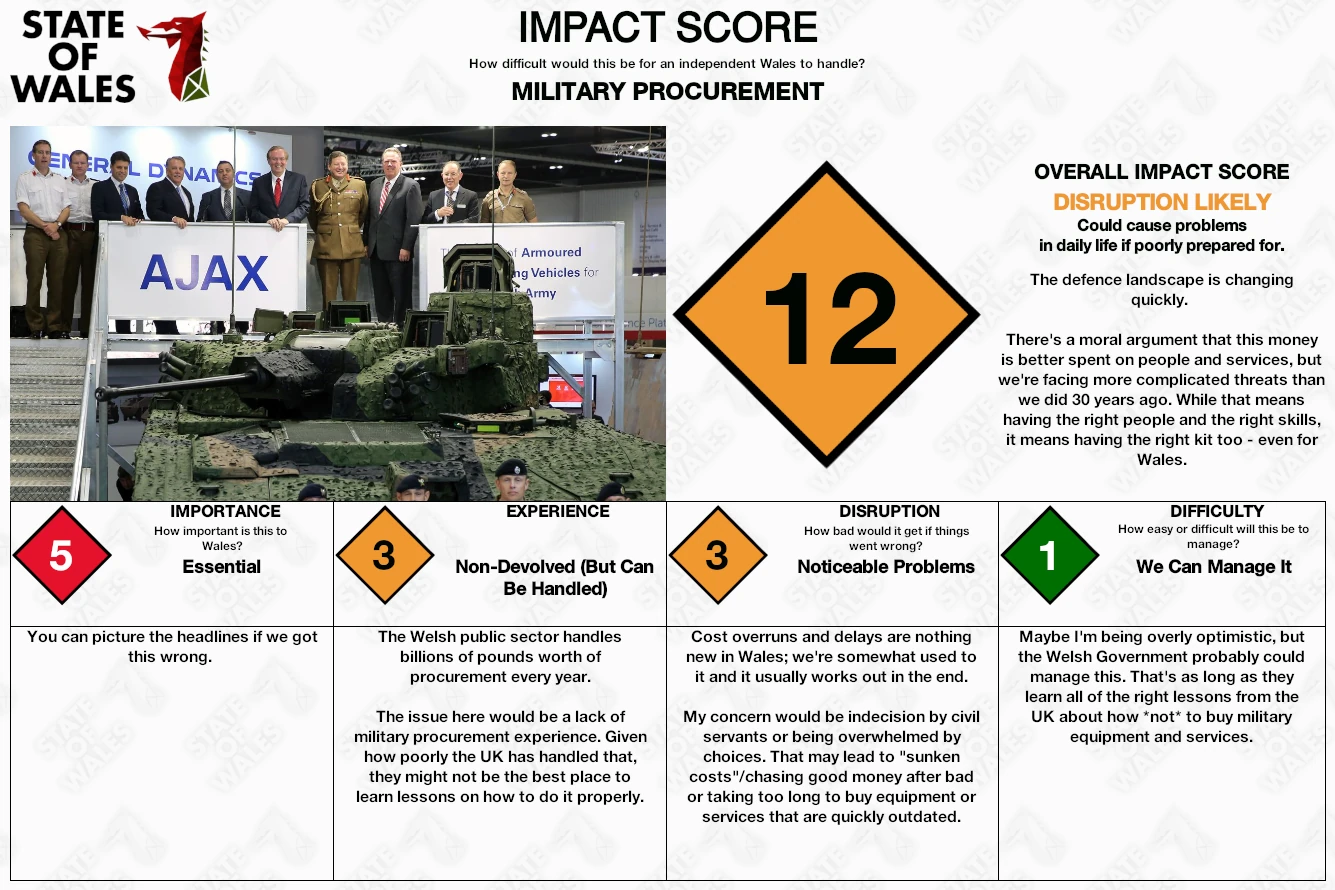
What's at Stake?

The overall score (out of 20) is the total of the scores for the four mini-categories (out of 5 each).

How Would This Be Run?

Direct procurement by the military
Direct procurement by the Welsh Government
Procurement through an arms-length agency
Direct procurement by the military

Under this model, a senior military commander (an equivalent of the Quartermaster General or a “Head of Military Logistics & Supplies”) would be in charge of procurement and handle the military’s capital spending. The military would decide what equipment or services they need and would lead the process of buying that equipment themselves.

The pros of this approach are that the military are probably best placed to know what they need in terms of equipment, services and training. The cons are that it may be a bit more difficult for the Senedd, auditors and the Welsh Government to keep track of what’s being done.

Direct procurement by the Welsh Government

A procurement unit (or equivalent) within the Welsh Ministry of Defence (or equivalent) would handle the buying and selling of military equipment and services.

The pros are that the minister responsible for defence would be directly accountable for military procurement, allowing senior military officers to focus on day-to-day operations.

The cons are that the civil service may not have the necessary experience to handle this kind of spending, it would take time to train civil servants to handle it, or consultants would need to be brought in.

Procurement through an arms-length agency

 This is similar to the UK’s approach.

If we decided to have a dedicated military procurement agency, one close equivalent we can think of that already operates in Wales is NHS Wales’ Shared Services Partnership. It handled around £860 million of the NHS’s budget during 2023-2412 and provides a lot of the NHS’s backroom, estates and purchasing services.

The pros are that we could directly hire procurement experts (including from the private sector) to oversee military capital spending. In principle, this should mean that the best decisions are made at the right time.

The cons are that the UK’s DE&S is proof that outsourcing procurement in this way doesn’t always lead to cost or time savings. It may also make it harder for the Welsh Government to keep military capital spending under control if ministers and senior civil servants are more “hands off”.

How Much Will This Cost?

Headline: A likely scenario would put annual capital spending on the military (equipment, infrastructure, R&D, services) at around £800 million.

The exact amount spent would depend on the level of capability we want the Welsh armed forces to have. This was looked at separately.

The “low” estimate (a military focused on home defence) would be in the region of £400 million. A high estimate (a military capable of taking full part in NATO) would be closer to £1.2 billion (at current prices).

Also, if Wales joins NATO, we would need to consider the alliance’s target for each member state to spend at least 20% of its annual defence budget on equipment, research and development.

Would any new taxes need to be introduced? 

No, though there may be different VAT rules if Wales joined the EU after independence.

Who will pay for this?

General taxation (all taxpayers) via the defence budget. Though if Wales joins NATO, we may be able to purchase equipment jointly with other member states.

How Long Would This Take?

Procurement rules (Procurement Act 2023 and its associated regulations) would remain in place. The exact wording may need to be changed to account for independence, but these are minor amendments in the grand scheme of things.

This would only change if the Senedd decided to create new rules/laws for public procurement, or if procurement rules changed through EU membership (or single market access).

A decision would need to be made during an independence transition period as to whether the Welsh military will procure equipment directly ( by themselves or via the Welsh Government), or whether procurement would be undertaken by an arms-length agency.

If we decide on direct procurement, nothing changes.

If we decide on an agency, it would need to be set up either immediately before independence or within 1-2 years of independence day (before the point Wales starts to “spend big” on equipment). 

People & Work

Who does this impact?

The quality of equipment and services ultimately affects those who use them (military personnel) and, in some cases, could make the difference between life and death.

Would any jobs be created or lost?

The defence industry was said to support around 6,500 jobs in the Welsh economy (2.2% of the UK’s total) – though many Welsh residents will work cross-border and only 60% of these jobs (3,900) were directly tied to Ministry of Defence spending13. For most other nations and regions, MoD spending supports between 70%-90% of defence jobs.

So Wales is one of the UK’s nations and regions that is proportionally less reliant on MoD spending to support our defence sector.

In the most likely scenario, Wales would probably be spending a similar amount (if not slightly more) on defence procurement than the UK currently does in Wales. This wouldn’t necessarily be with the same companies or for the same equipment and services.

Some of this spend may end up being outside Wales if we can’t source the services or equipment here.

That could mean a net loss of jobs in the defence supply sector (manufacturers and contractors), but a net gain in defence jobs overall (because of the establishment of a Welsh military).

There may be more contracts tendered at a level suitable for Wales-based companies to supply (particularly services), which may create more jobs if companies need to take on more staff to meet new contracts.

You Might Also Like....

What would independence mean for war memorials and Remembrance events?
Armed Forces

What would independence mean for war memorials and Remembrance events?

by Owen Donovan
November 26, 2025
0

...

Read moreDetails
How could an independent Wales support veterans and service-leavers?

How could an independent Wales support veterans and service-leavers?

November 26, 2025
How would a Welsh military recruit & train new personnel?

How would a Welsh military recruit & train new personnel?

November 26, 2025
What could the command structure of a Welsh military look like?

What could the command structure of a Welsh military look like?

November 26, 2025
What are the options for an independent Wales’ military?

What are the options for an independent Wales’ military?

November 26, 2025
Veterans in Wales

Veterans in Wales

November 26, 2025
What would independence mean for existing MoD contracts with Welsh suppliers?

What would independence mean for existing MoD contracts with Welsh suppliers?

November 26, 2025
What defence assets might an independent Wales “inherit” from the UK?

What defence assets might an independent Wales “inherit” from the UK?

November 26, 2025
Military Law & Independence

Military Law & Independence

November 26, 2025
How would an independent Wales join NATO (if we wanted to)?

How would an independent Wales join NATO (if we wanted to)?

October 27, 2025
If an independent Wales joined the EU, what would that mean for Welsh defence policy?

If an independent Wales joined the EU, what would that mean for Welsh defence policy?

September 30, 2025
If an independent Wales joined the EU, what would that mean for Welsh defence policy?

What would an independent Wales’ defence budget and equivalent of the MoD be?

September 30, 2025
What would a Welsh military be expected to do?

What would a Welsh military be expected to do?

September 30, 2025
What would Wales’ defence policy be?

What would Wales’ defence policy be?

September 30, 2025
How and when would a Welsh armed forces be deployed?

How and when would a Welsh armed forces be deployed?

September 29, 2025
Would people from Wales serving in the British military have to join a Welsh armed forces?

Would people from Wales serving in the British military have to join a Welsh armed forces?

September 29, 2025
What military threats does Wales need defending from?

What military threats does Wales need defending from?

September 29, 2025
What makes the military unique?

What makes the military unique?

September 29, 2025
Hard Power & Soft Power

Hard Power & Soft Power

June 29, 2025
Load More
    1. UK Government, Ministry of Defence (6th March 2025). “MOD trade, industry and contracts: 2024”

    2. NATO. “Defence expenditure of NATO countries 2014-2025” (p14, Table 8a).

    3. UK Parliament, House of Commons Library (12th September 2025). “The contribution of the defence industry to UK regions”

    4. UK Ministry of Defence (2023-24), “Written Evidence submitted to (unspecified) Committee“.

    5. John Healy MP, Labour Party (January 2022). “Dossier of waste in the Ministry of Defence 2010-2021“

    6. Government of Ireland, Department of Defence (7th October 2025). “Budget 2026: Record €1.5 billion for Defence“

    7. Government of Denmark, Ministry of Defence. “Defence Acquisition & Logistics Agency: Organisation (translated from Danish).

    8. Finnish Defence Forces, Logistics Command

    9. Government of Finland, Ministry of Defence (25th September 2025). “Finnish Defence Forces to launch army materiel procurement projects for 2030s“

    10. Government of New Zealand, Ministry of Defence. “How Defence works with business“.

    11. Government of New Zealand, Ministry of Defence (7th April 2025). “Overview 2025 Defence Capability Plan“

    12. NHS Wales, Shared Service Partnership. “Annual Review 2023-24“

    13. UK Parliament, House of Commons Library (12th September 2025). “The contribution of the defence industry to UK regions“

Use of AI

No AI tools were used to draft this post.

Donations Welcome
Tags: BusinessDenmarkDF 304European Single MarketFinlandGovernment SpendingIrelandMilitaryNATONew ZealandPublic ProcurementSeneddTradeUK GovernmentWelsh Government
Previous Post

How would a Welsh military recruit & train new personnel?

Next Post

How could an independent Wales support veterans and service-leavers?

Owen Donovan

Owen Donovan

Archive

Categories

Copyright

Creative Commons Licence

State of Wales by Owen Donovan is licensed under a Creative Commons Attribution-NonCommercial-NoDerivatives 4.0 International License.

Subscribe by Email

Search

No Result
View All Result
No Result
View All Result
  • Go To Senedd Home
  • Go To Oggy Bloggy Ogwr
  • About & Contact
    • About State of Wales
    • Comments Policy
    • Complaints Policy
    • Contact & Subscribe by Email
    • Disclaimer
  • Features
    • After the UK
    • Chinny Reckon
    • Devil’s Advocate
    • How Wales Works
    • Road to Brexit
  • The Independence Index
    • The Independence Index (full)
    • Economics & Money
      • Business & Economy
      • Currency
      • Tax & Spending
      • Transport & Infrastructure
    • Society
      • Communities & Housing
      • Culture & Sport
      • Education
      • Health
      • Media & Communications
      • Science & Technology
    • The State
      • Environment & Natural Resources
      • Justice
      • Local Government
  • Elections Centre
  • Wales FAQ
    • How is Wales funded?
    • How are laws in Wales made?
  • Support & Donate